
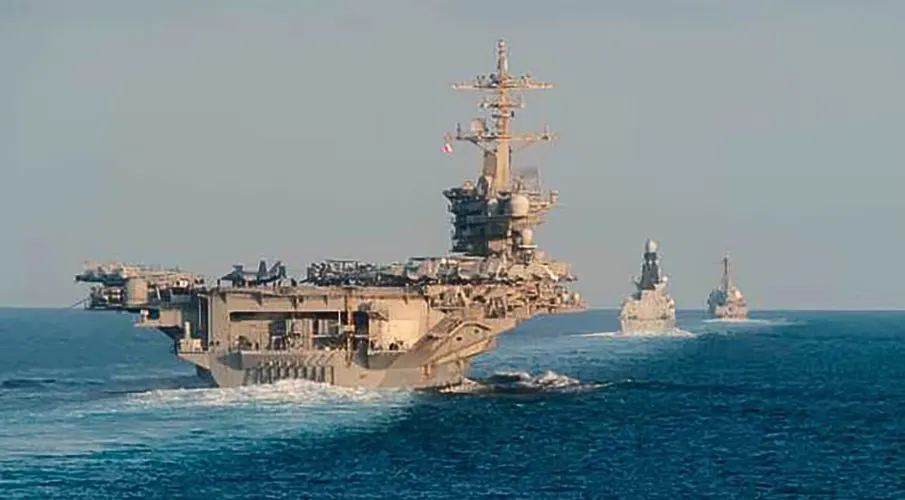
On August 3, a man went overboard from the USS Abraham Lincoln. The sea was rough, he was wearing a life jacket, and a helicopter from the carrier’s air wing pulled him from the water within an hour, uninjured. The Navy calls it a mental health crisis. It is the clearest case, but not the only one. According to multiple consistent reports, at least 2 other sailors have tried to throw themselves over the rail, while shipmates grabbed a third at the last second and pulled him back. The man rescued on August 3 was treated aboard the ship and later transferred off the Lincoln for further care. A rescue helicopter deployed against a crewman’s own despair, that is the state of this deployment. The ship is in its 9th month at sea, 250 days without solid ground, a record in recent times. Aboard are 5,000 sailors and Marines, tied to the war against Iran, now entering its 6th month. The deployment was supposed to last 7 months.
On August 7, around 200 family members sat across from Acting Secretary of the Navy Hung Cao in San Diego. One woman accused the leadership of destroying their trust. Another said her husband had texted her that day saying he hoped he would not wake up in the morning. Annabelle Loma said her husband had tried to jump after his time at sea kept being extended again and again; now he is being held under medical supervision and fears that 13 years of service could end in a dishonorable discharge simply because he is burned out. Maria Rodriguez said her husband and several shipmates had pulled another sailor back from the edge before he went over.
Reporter: "Family members of service members are concerned about conditions on the LIncoln."
Trump: "No they’re not."
Reporter: "Has the deployment gone on too long?"
Trump: "No. Not nearly long enough."
These are not the words of weak men. Someone who has served for 13 years and now finds himself standing at the rail has not become weak, he has been used up, and that difference is where the entire scandal lies. What is wearing people down is not just the length of the deployment. California Congressman Mike Levin cites moldy showers and broken toilets, often no hot water, too little food and shortages of basic hygiene supplies; about a dozen families have now described the same conditions, and he is demanding a full investigation. Senator Richard Blumenthal wrote to Defense Secretary Pete Hegseth that the Lincoln has spent longer at sea without a port call than any carrier before it, and he is demanding that a bipartisan congressional delegation be allowed aboard. Back in April, when photos of rationed food and reports of water shortages were already circulating, Hegseth dismissed it all as misinformation.
And the Navy itself? In response to questions, a spokesman thanked the crew for its resilience. Yet while family members are describing attempted jumps and a man had to be pulled from the water on August 3, the command says it has seen no increase in suicidal thoughts or suicide attempts. Clean water and healthy meals are supposedly assured, and the air-conditioning systems are working. A network of chaplains and counselors is also said to be available. Anyone who has ever seen an agency take shelter behind an official statement knows the comfort such words provide. Between that piece of paper and the man in the water on August 3 lies an entire ocean.
The road to this point was predictable. On November 21, the Lincoln left San Diego bound for the Pacific before being redirected to the Middle East. Since then, the crew has set foot on land on only two days, in December on Guam and in July in Oman. Relief is on the way, with the USS George Washington carrier strike group, fresh from a visit to Vietnam, now heading toward the region. Until it arrives, every day aboard counts twice. For those on the ship, every extension has felt like another piece of eternity.
Resilience: it is the word leadership uses to shift the burden onto the people it is failing. Anyone who uses people for 250 days as tools of his war and denies them the most basic necessities is not treating them as an end, but as a means, and then christens the result bravery. Gratitude from the mouths of leadership is cheap as long as it costs them nothing, because it does not begin with a speech in a hall, it begins with the hot water nobody is providing. An investigation last year found that nearly half of deployed sailors were not receiving adequate help dealing with the pressure aboard ship, and urgently called for better support in light of the military’s high suicide rates. They knew all of this long ago. Anyone who knows it and extends the deployment anyway is choosing against his own people. In the end, what remains is a ship fighting the enemy while losing its own crew, and the question of who the world’s largest fleet is actually protecting here.
Updates – Kaizen News Brief
All current curated daily updates can be found in the Kaizen News Brief.
To the Kaizen News Brief


Die Raubtiere die in den Regierungen sitzen werden immer mehr und brutaler. Einfache Soldaten, Menschen interessieren soweit sie verbraucht und verheitzt werden können, dann nicht mehr.
…da kann ich nur beipflichten, schlimm ist es
Wann gibt es endlich einen Aufstand beim Militär?