
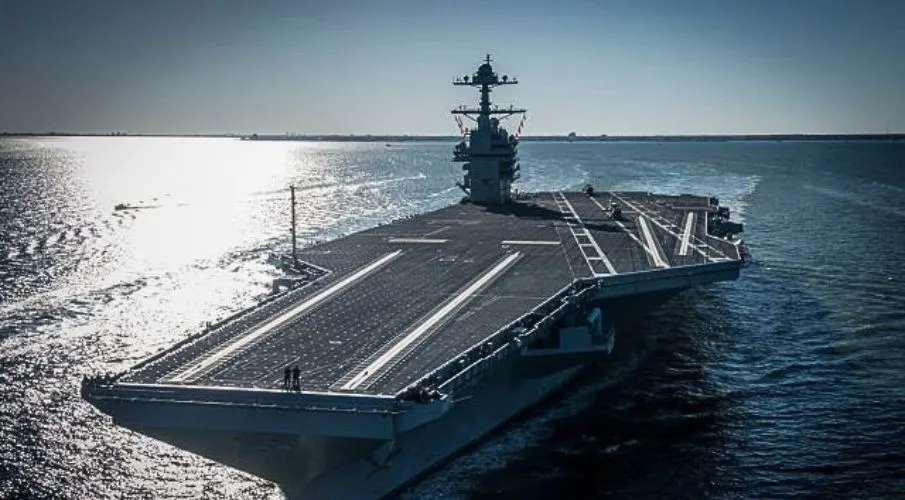
A catapult no one wants back except one man is now returning because that one man sits in the White House. On Thursday, Donald Trump signed a national security memorandum, and the most modern navy in the world learned from it that it is supposed to rip out its electromagnetic catapults and replace them with steam. Its admirals have had good reasons for years to oppose that. Good reasons on the deck of this president are what the wind does to loose paper.
It hits the Doris Miller, the fourth ship in the Gerald R. Ford class, and every carrier after that. The first 3, the Gerald R. Ford, the John F. Kennedy and the Enterprise, get to keep their new technology, the rest will be rebuilt. A sailor once praised steam at the rail, the president heard it, and now it is turning into a multibillion-dollar redesign. That is how weapons decisions get made in this administration, as the delayed echo of a conversation between two men and a railing. Back in 2017, Trump demanded in an interview that the Navy return to “goddamn steam”; the experts pushed back because ripping out a system built this deeply into the ship costs a fortune. About the new technology, all he had to say at a conference in Pennsylvania recently was that it was far too complex and nowhere near as good. A judgment he neither explains nor has to explain, because here power replaces the argument.

The bitter part is the timing. Just in February, that same Navy was praising its electromagnetic catapults and new arresting systems, which get aircraft into the air and back aboard faster than the old Nimitz class. By March, almost 37,000 launches had gone through the Ford’s 4 catapults. Operating this ship costs, according to initial figures, around $100 million less per year than operating a Nimitz carrier, partly because around 500 fewer sailors are needed and hardly anyone has to keep temperamental steam technology running anymore. The Ford has just returned from 11 months at sea, with operations against Venezuela and in the Iran war. They are ordering the rollback of something that has only just proved itself. It is like tearing down the sails because the wind feels too new.
Bryan Clark of the Hudson Institute in Washington puts it plainly: electric is simply more reliable, and if you can do without steam, you get rid of all the mechanical parts you would otherwise have to drag around with you. Inside, the Ford has long since stopped being a Nimitz. Where steam lines once ran, there is now a wall or something else entirely. On the old carriers, steam powered not only the catapults but half the ship’s household, from heating to the galley, through pipes that could leak all over the place. Bringing that lost world back, Clark estimates, means endless problems and billions in costs. If you want steam back, you do not just want a catapult, you want an entire nervous system of pipes that was only just deliberately removed.
The Ford, nuclear-powered and the first ship in the class, swallowed more than $13 billion and stumbled during construction over its own innovations, especially the catapults and ammunition elevators. General Atomics, which builds these catapults, has held the contract for the Doris Miller since 2023 and is almost 50 percent finished; changing course now, the company warns with all due caution, would bring cost and schedule risks and hand ground to adversaries. The shipbuilder HII says it will work closely with the Navy to modify what is already under construction. The Doris Miller is not expected to enter service until 2034 anyway, and its keel is to be laid this year.

EMALS replaces the classic steam catapult with an electromagnetic launch system. Electrical energy is stored, electronically controlled and converted along the catapult track into linear acceleration that brings the aircraft up to takeoff speed. The system works more precisely, requires less mechanical steam equipment and is a central part of the Ford class. This is exactly the technology that, under Trump’s order, is now supposed to be replaced on the future USS Doris Miller by traditional steam and hydraulic systems.
The last carrier with steam, the George H.W. Bush, entered service in 2009, and the Nimitz class was the last of its kind. But the jump backward goes further than it sounds. In 1954, the first workable steam-catapult trials took place aboard the USS Hancock, and that same year the USS Intrepid became the first ship to launch aircraft using American-built steam catapults. The system was refined over decades, and no one is literally asking for the exact system from back then, it would be dishonest to claim that. But its basic idea, high-pressure steam and a piston in a cylinder, is a good 70 years old. The electromagnetic catapult was conceived as its successor, bringing aircraft up to speed with a traveling magnetic field and, according to NAVAIR, intended for the Ford and everything that followed. The president is ripping out the successor and bringing back the grandfather. Progress is hard, regression is easy, and here that ease bears the features of a whim.

Left image: Grumman S2F-1 Tracker during the first operational launch with the C-11 steam catapult from the USS Hancock on June 1, 1954. Hancock am 1. Juni 1954. Right image: The USS Hancock in March 1954 after its modernization.
While Washington thinks about spending billions on reverse gear, the other side is pulling ahead. China is already running its newest carriers with electromagnetic catapults, and France plans to use them on its next one. The largest defense budget in the world is paying for a trip in the wrong direction that no one asked for except one man. A company that behaved this way, scrapped its best product to relaunch the outdated predecessor model and expected applause for it, would never survive a balance sheet. Only a state can afford what no board of directors would survive, because the bill will not come due until the grandchildren have to pay it.
The rollback does not stand alone. Trump has already interfered with Air Force One, and with the F-35 fighter program as well. He ordered changes to the Constellation-class frigates, and there are supposed to be battleships bearing his name. On a ship worth anything, the one who holds the rudder is the one who knows how to read the stars, not the one who owns the ship. Here it belongs to the loudest man, and the stars bore him. The expert doubts because he sees the limits of his knowledge; the amateur gives orders because he does not know those limits exist. Mark Kelly, senator from Arizona, test pilot and aeronautical engineer, who has launched from the bow hundreds of times, says not even he would tell the Navy how to design its ships. Humility is a question of knowledge, and anyone who knows nothing does not know it.
The memorandum does more. It wants to speed up submarine maintenance and draw foreign money into American shipyards; a foreign shipbuilder could in the future build up to 2 ships overseas as long as it trains American workers and invests locally. The Coast Guard already does something similar with its new icebreakers, partly through the Finnish company Rauma Marine Constructions and partly through Bollinger Shipyards in Louisiana, where 3 ships are being built and more than $1 billion is involved. On top of that, a new public shipyard, the first in 83 years, and a warehouse that can quickly replace damaged submarine parts. The Navy wants to expand its fleet anyway, with 2 Virginia-class boats and one Columbia-class boat every year; most recently, $76.6 billion went to General Dynamics Electric Boat and HII Newport News for 9 Virginia-class and 5 Columbia-class submarines through 2038.

Above all of it stands a single will. One man moves shipyards and billions because something occurred to him years ago at a railing. At some point, the excuse stops working that every such decision is merely eccentric or badly advised on its own. When an 80-year-old whose alertness is publicly being questioned and who carries a long record of documented false statements personally decides technical questions worth billions against the experts, then people are entitled to question his judgment. Not out of mockery, but because aircraft carriers and human lives depend on that judgment. This is not a remote diagnosis. It is a question of law and the Constitution.

The concern has a name behind it. Cardiologist Jonathan Reiner, professor at George Washington University and former physician to Dick Cheney, is publicly demanding clarity about the president’s condition. He points to bruising on both hands and severely swollen legs. Add to that appearances where Trump seems to doze off, and extensive imaging whose reason no one has explained. He explicitly does not make a diagnosis from afar, but says what is visible demands answers the public deserves. Instead of answering, the White House lashes out; its spokespeople insult doctors and reporters, as has now been documented. The same White House has meanwhile confirmed chronic venous insufficiency, so the swollen legs are not something invented by opponents. An office that answers medical questions with insults gives its answer in another way.
In the end, what remains is a steam catapult nobody wanted except one man, and a modern ship being rebuilt into the past, against its engineers and against its own Navy. Whoever steers without knowing the sea is not putting himself at risk, but everyone on board. The question is no longer whether this decision is smart. The question is when he will finally be removed from the bridge.
Updates – Kaizen News Brief
All current curated daily updates can be found in the Kaizen News Brief.
To the Kaizen News Brief


So langsam habe ich die Phantasie, daß alles, was diese Administration anstellt, einem Plan folgt, der andernorts geschriben wird. In Moskau.
… es ist auf jeden fall alles grotesk und ergibt wenig sinn, ausser, dass trump mehr und mehr abdriftet in sämtlichen belangen
So kann man seine Verteidigungsfähigkeit auch gen 0 fahren.
Dampfkatapulte.
Als ob Trump überhaupt was über die Funktionsweise von den Flugzeugkatapulten weiß.
Ich kenne da so einen alten Spruch: das ist ähn Dampfmaschin
Dat gab es früher
Dreifach Rolle Zurück in die 50iger