
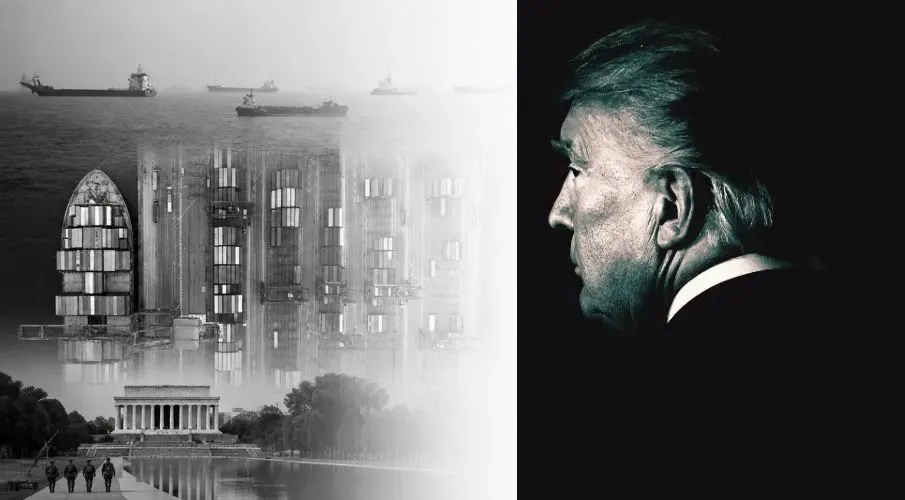
Anyone who wants to know how far a government is willing to go has to watch what it does on a single day when no one forces it to do anything. August 11 provides plenty of evidence, at a reflecting pool and on the open sea, as well as in a courtroom dealing with trade law. Taken individually, each incident might seem like a curiosity. Taken together, on one and the same Tuesday, they paint the picture of a government that no longer recognizes any boundary it did not draw itself.
Act 1
The first act takes place at the Reflecting Pool in front of the Lincoln Memorial. That's where former Olympic canoeist David Hearn allegedly damaged the pool's coating during a bike ride in June. The federal prosecutor in charge, Jeanine Pirro, dropped the charges and told the court with unusual candor that the felony allegation had been poorly founded and that a botched renovation, not vandalism, was responsible for the damage. That should have been the end of it, in a country governed by the rule of law and one that actually cares about evidence. But Trump flew into a rage over Pirro's decision. On social media, he demanded that she reconsider her hasty decision. He posted a photo online, labeled it "Vandalism," and cited a highly credible witness who had supposedly seen Hearn pulling at the coating. Hearn himself says he merely touched a piece in the water that had already come loose. Prosecutors had at one point turned a misdemeanor into a felony. The Reflecting Pool is just one of many construction projects Trump is using to polish up the image of the capital, projects that regularly land him in court.

At the White House's request, the Justice Department is now looking into whether a new charge can be constructed, probably as a misdemeanor. The discussions are taking place informally within the Criminal Division and have not yet reached the department's top leadership. The timing is delicate because next month the court will decide whether the dismissal becomes final, meaning Hearn could never again be prosecuted over the same incident. His attorney, Norm Eisen, calls the effort exactly what it is: an attempt to bring a case back from the grave after the department itself admitted it had lost it for lack of evidence, just so it can keep harassing an innocent man. The department says it is following the evidence, which, in light of the request from the White House, almost sounds like mockery.

Above all of this stands a new attorney general. Todd Blanche, formerly Trump's defense attorney, was confirmed over the weekend by a 50-49 vote and sworn in Monday after serving as acting attorney general since Pam Bondi was fired in April. For weeks, he had tried to reassure the Senate that he would not bend the department to the president's will. At the same time, he maintains that it is the president's right and duty to interfere in criminal investigations, a break with every predecessor who avoided even the appearance of such interference. Put those two statements side by side, and you understand the second one and can forget the first.
A French thinker on the separation of powers understood that freedom dies where the executive power also takes the judicial power for itself. That is exactly what happens when a president decides who gets prosecuted and a federal prosecutor is punished for following the evidence instead of the president's rage. A pool with peeling coating is about the smallest conceivable reason for any of this, and maybe that's exactly the lesson of the first act: If even a reflecting pool can set the justice system in motion, then there is no longer any case too small.
Act 2
The second act takes place farther out, in the Gulf of Oman. Early Tuesday, an American helicopter fired at the rudder of the Panama-flagged freighter Vela Nova, which was attempting to break the blockade of Iranian ports and had ignored warnings. According to the security firm Vanguard, a missile struck the ship about 71 nautical miles off the coast of Pakistan. A fire was extinguished, and all 17 crew members escaped unharmed. Afterward, the crew apparently tried to transfer to another civilian vessel. It could have ended differently. In June, 3 Indian sailors were already killed during an operation like this, the first deaths in this campaign through which Washington is trying to cut Iran off from its oil and therefore its revenue. The attack comes during a period of relative calm while simultaneously increasing the pressure on a regime whose currency has long been collapsing.

That same day, the freighter Tihamah burned off the coast of Yemen. Vanguard counted 2 dead, while the Yemeni government reported 4 and said the Houthis had fired 3 ballistic missiles. The Iran-backed militia had previously announced a blockade of Saudi ships in the Red Sea, threatening the very route the kingdom had been using to bypass the closure of Hormuz. Roughly 20 percent of global oil trade passes through this strait, and it is the central point of contention in all negotiations. Trump imposed the blockade in April and lifted it in June as part of an agreement. In July, he reinstated it after Iran began attacking ships again.
By Monday, the U.S. Central Command, Centcom, had diverted 55 merchant ships. Another 2 had been disabled and 2 boarded. During the first round through mid-June, 194 had been diverted and 9 disabled. Both sides are now using the same weapon, economic pressure. In Iran, it drives up prices and costs jobs. In the United States, gas prices are rising, and with them inflation around the world. The fact that Tehran's regime crushed its own protests last winter, leaving thousands dead, does not change the fact that civilian crews are being fired upon here.
Act 3
The third act returns to a courtroom, this time in trade law. A judge on the Court of International Trade, Richard Eaton, had ordered Customs and Border Protection, CBP, to refund the tariffs declared unlawful in February to all companies, including those that had never sued. The government is fighting that order before the federal appeals court. Of all things, it is relying on that June 2025 ruling on birthright citizenship that restricted nationwide injunctions, arguing that Eaton does not have the authority to rule for everyone. $100 billion has already been refunded. The dispute concerns companies whose customs proceedings have already been closed. A rule passed by Congress prohibits the agency from reopening such cases. They can always sue, the government says, and there is still time to do so.

Attorney Barry Appleton even considers that the stronger legal argument, yet he hits the sore spot. The government took the money under a law that, according to the Supreme Court, never gave it the authority to do so, and returning that money should not be a reward for going to court. Demanding that a small business sue for an amount it does not even know about, and do so within a deadline it has never heard of, is the quiet cruelty of this act. It is no coincidence that 25 states are already suing over Trump's new tariffs.
3 acts, one director. At the Reflecting Pool, the justice system bends to one man's rage. At sea, missiles decide trade routes. In tariff law, the government keeps money it was never entitled to. Each incident has its own logic, but they all come down to the same sentence: A boundary only holds as long as someone defends it. Courts and federal prosecutors, along with Congress, are the institutions standing in the way this week. Last week, an appeals court stopped the $400 million ballroom Trump is building onto the White House without congressional approval, and he announced that he would take the case to the Supreme Court. It is the next act, and it has already begun.
These Are the Moments We Fight For, Investigate, Support - Standing Up Against the Trump Regime
We will continue to stand up to this regime, and we will stand against ICE. Some victories were fleeting, others have lasted, but there is one thing a person must never lose in life: the ability to look themselves in the mirror. Human rights and a free society are worth fighting for, and they are what we investigate and expose for, even as the voices have grown fewer and a weary silence has settled over this time. That silence will never apply to us.
Updates – Kaizen News Brief
All current curated daily updates can be found in the Kaizen News Brief.
To the Kaizen News Brief


Ihr seid nicht still und dafür danke ich euch. Es braucht Menschen die hin sehen und reagieren.
❤
Es gibt Momente wie heute beim Lesen dieses Artikels.
Der letzte Absatz ist es, der mich immer wieder daran erinnert, warum ich den Kaizen-Blog unterstütze! Eine Stimme für die Schwächsten, gegen Ungerechtigkeit und vor allem eine Stimme für die Menschen, denen sonst keiner hilft und die keiner hört.
🙏🏼 🙏🏼 🙏🏼 🙏🏼
Ganz, ganz lieben Dank
Trump muss gewinnen.
Das ist bei ihm krankhaft.
Er verbeißt sich in Dinge nur um es irgendwie zu konstruieren, dass er Recht hat.
Todd Blanche macht da gerne mit.
Für ihn ist der Präsident allmächtig und steht über allen Gestzen und Urteilen.
Die 50, die ihn bestätigt haben, sind alle mitschuldig an dem, was noch über das Justizministerium kommt.
Die neue Anklage wird erfolgen, bevor das Gericht das Verfahren für abgeschlossen erklärt.
Seine „Vandalen Theorie“ muss doch weiter in aller Munde sein.
Ein weiteres Puzzlestück um von den Epstein Files abzulenken.
Mit Todd Blanche als Justizminister erwarte ich da leider ohnehin nichts.
Er wird Trump noch vehemently schützen, als Bondi.
Vielleicht, weil er selber drin steht.
Auf zivile Besatzungen zu feuern, ist unmenschlich.
Warum reagieren die entsprechenden Länder nicht, deren Schiffe es waren.
Im Gegensatz zu den Danktionen gegen Putins Schattenflotte, ist die Blockade der iranischen Häfen eine rein von den USA ausgerufene Blockade.
Die USA schreibt anderen Ländern vor, wie sie mit dem Welthandel und dem Iran umzugehen gaben.
Das muss man sich auf der Zunge zergehen lassen.
Das das Mullah Regime ein Terrorregime ist, ändert an dem Sachverhalt nichts.
In den USA sind Sammelklagen möglich?
Wenn sich eine Kanzlei findet, die die Mittelständler pro Bono vertritt, käme auf die Regierung eine Klagewelle von mehreren Milliarden zu.
Es muss doch mutige Anwälte geben.