
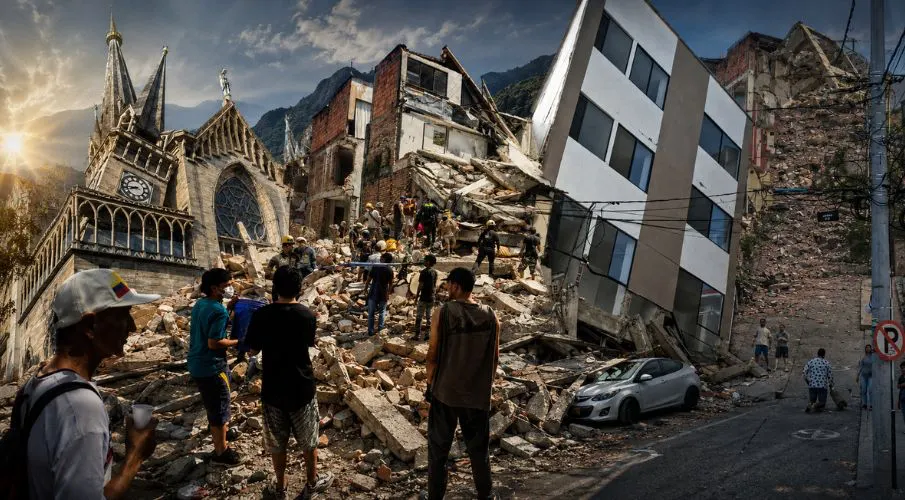
At 7:34 a.m. local time Monday morning, a magnitude 7.4 earthquake tore through western Colombia. Its focus was 103 kilometers deep near San José del Palmar in the department of Chocó, and the jolt was so powerful that people felt it as far away as Venezuela, Ecuador and Panama. It was also felt in Bogotá, Medellín, Popayán and many other cities across central and western Colombia. The Colombian Geological Service called it the strongest earthquake recorded in the country this century, and also the strongest in the past 10 years. By Tuesday, August 11, at 1 p.m. Central European Time, more than 160 people had been confirmed dead, and rescue crews in dozens of cities and towns were still digging for people trapped beneath the rubble.
The death toll climbed throughout Monday in grim waves. The first 18 deaths were reported in Pereira, then the number rose to 71, shortly afterward to 111, and by evening to 132, before climbing past 160 on Tuesday. By Monday morning, Risaralda had borne much of the toll with around 40 deaths, while Valle del Cauca reported 27 and Chocó initially reported 4, many of them in the departmental capitals. On citizen-run websites, relatives compiled the names of their missing family members; by Monday evening, more than 2,700 people were considered missing, including about 188 in Cali alone, according to President Abelardo de la Espriella. The initial number of injured stood at 87, but individual cities were already adding dozens more, including 64 in Armenia, while several hospitals in Risaralda reported serious damage, among them San Jorge University Hospital and Santa Mónica, which was left without power. Around 1,600 buildings were considered damaged or collapsed, including 37 destroyed homes and 61 buildings that had completely come down. In many places, soldiers and families lifted chunks of concrete with their bare hands and passed them back through human chains of volunteers.

But the place hit hardest was the one the country heard the least about. Chocó, the region surrounding the epicenter, is one of Colombia's poorest and most neglected areas, repeatedly battered by fighting between armed groups. Large parts of it can only be reached by water or air, some only along trails through the jungle, and so the true extent of the destruction there initially remained unknown; the governor said authorities were only just beginning to assess it. In El Cairo, a town of about 7,000 people near the earthquake's focus, authorities said 80 percent of the homes had been damaged. But the shaking reached far to the east. In Armenia, around 40 buildings suffered structural damage, including schools and universities, as well as the airport, and even in communities around Bogotá, town halls and schools cracked.

Behind the numbers are faces. Dana Carolina Zamora posted a picture online of her missing uncle, Miguel Ángel Zamora, a 60-year-old farmer holding his dog in his arms. He lived near the epicenter in a house made of wooden poles and mud, hardly built to withstand a jolt like this, and there had been no sign of him since the earthquake. In Bahía Solano, Mateo Valencia, the mayor's son, died beneath collapsing masonry. In Támesis, a falling rock killed a 73-year-old man, while in Valle del Cauca, 3 children were killed in Calima El Darién and another in Yumbo. Mónica Sánchez, who runs a small workwear shop in Pereira, managed to get out of the building with her 12 employees just before a wall collapsed. Around her, she said, the city was falling apart.

These pictures of the missing are more than missing-person notices. A French philosopher described the face of the Other as the origin of all ethics; it looks at us before we can categorize it and places a responsibility on us that we cannot escape. A land of the forgotten is one where people have learned to look past those faces. Now the earthquake is forcing the entire country to look at them, at the old man with his dog and the seamstress who lost her workshop. The question is whether that gaze will last longer than the rubble.

For President de la Espriella, the disaster is his first major test. He had been sworn in only on Friday and is controversial because of his promise to come down with full force on criminal groups. That same morning, he convened a central emergency command and announced that he would personally direct the government's response from Bogotá; later, his government declared a national state of disaster when the death toll passed 71. He said he had mobilized the entire military and police apparatus, sent engineers and rescue crews into the region, along with search dogs, and announced rent subsidies for those whose homes need repairs before they can live in them again. That evening, he traveled to Quibdó, the capital of Chocó, and promised that Chocó would never again be the land of the forgotten. To Colombians in their darkest hours, he said they were not alone.

Night fell over the country under a state of emergency. Curfews were in effect in Cali, Manizales, Pereira and other badly hit cities as the search continued. Operations were suspended at six airports, while 18 roads were cut off, many by landslides. Power flowing through the grid dropped by 18 percent, and phone service temporarily went down in several departments. In Manizales, the earthquake damaged one of the cathedral's towers. Schools and universities suspended classes, and an emergency shelter was set up at the Coliseo Mayor. Medellín, which was largely spared, sent engineers to inspect buildings and rescue crews to the affected areas, while Bogotá sent another 100. Collection points for water and mattresses, helmets and protective goggles were set up in Cali and the capital, Bogotá's food bank called for donations, and Avianca allowed those affected to change their flights at no extra charge. Cali postponed the 30th Petronio Álvarez Music Festival, which had been scheduled to take place there from August 12 through 17, and soccer games in Pereira were also suspended. By evening, the Geological Service had recorded 47 aftershocks, the strongest reaching magnitude 4.8, and late that night the ground shook again in Chocó.

At the same time, authorities worked to contain rumors. There was no tsunami threat, they said, and the earthquake had nothing to do with the unrest at the Puracé volcano, which has been under an Orange Alert for weeks. Its cause lies deeper, in the slow subduction of the Nazca Plate beneath the South American Plate, a process that has shaken western Colombia for as long as anyone can remember. The last earthquake of comparable force to strike the region was a magnitude 7.2 quake on November 23, 1979.

Help came quickly and from far away. The U.S. State Department pledged $15.5 million for emergency shelter and food, along with additional assistance, and Secretary of State Marco Rubio offered Washington's support to the country, while U.S. citizens in Colombia were urged to register; governments across Latin America offered help of their own. The timing hits an Andean region already shaken to its core, after two consecutive earthquakes devastated neighboring Venezuela in late June and killed more than 6,300 people there.

Amid all of this, another Colombia emerged. In Medellín, where no deaths were reported, hundreds of calls poured into the emergency hotline. Volunteers lined up at collection points, and neighbors dug alongside soldiers. Where the state had long left the poorest to fend for themselves, strangers now carried slabs of concrete away together. It is a bitter comfort that a society so often rediscovers its sense of solidarity only in disaster, and an open question whether it will hold on to it beyond the days of rubble.

The sun rose over Chocó on Tuesday, and rescue crews are still working among the ruins, many of them exhausted after a night spent searching through the wreckage. Many Colombians are only beginning to understand what this disaster will take from them in the long run. A promise is easily made that this will never again be the land of the forgotten; whether that promise holds will be decided in the weeks when the cameras are long gone. But the faces on the missing-person pages remain, and with them the responsibility they place upon us.
Updates – Kaizen News Brief
All current curated daily updates can be found in the Kaizen News Brief.
To the Kaizen News Brief


Bei solch furchtbsren Unglücken fehlen einem die Worte, weil der Kloß im Hals steckt.
Erdbeben sind etwas,wogegen man sich nicht wirklich schützen oder wappnen kann.
sie kommen quasi ohne Vorwarnung und reißen Mensch und Tier in den Tod.
Zu sehen, dass Menschen in solch schwerer Stunde zusammenhalten, gibt Hoffnung für die Menschheit.
Hoffentlich können die Vermissten sicher geborgen werden und Familien wieder zusammen finden.
Der neue Ministerpräsident wird sich an sejnen Taten, nicht an seinen Versprechungen, messen lassen.
Seine Chance zu zeigen, dass er für das Volk da ist.