
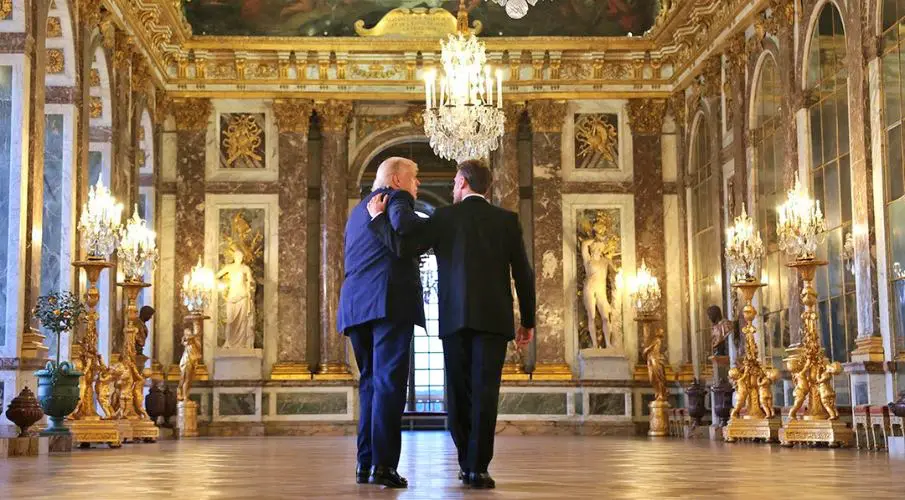
Trump signed the agreement with Iran in Versailles, in the palace of historic treaties, during a dinner beneath golden doors marking America’s two hundred and fiftieth birthday. Who signed what and when remained unclear, the agreement can be abandoned at any time, and its only guarantee is the threat of the next bomb.
“It is signed,” Trump said as he left Versailles, saying he had just signed it there. In the palace of the French kings, the president put his name on the declaration of intent with Iran on Wednesday, without cameras, as the White House acknowledged. Yet the document had already been digitally signed on Sunday, and while Pakistani Prime Minister Shehbaz Sharif announced that the agreement would take effect immediately and that both sides had signed it, Iran’s Foreign Ministry stated that the ceremony planned for Friday in Switzerland would no longer take place.
Trump signed the declaration of intent with Iran for a sixty day ceasefire and the reopening of the Strait of Hormuz. Iran also signed the declaration of intent. Auch der Iran hat die Absichtserklärung unterzeichnet.
Who signed and when remained uncertain throughout the day. Earlier in the week it had been said that Trump and Vice President JD Vance, along with Iran’s chief negotiator Mohammad Bagher Ghalibaf, had signed the document on Sunday. On Wednesday, an American official said it was now Trump and Iranian President Masoud Pezeshkian, while Tehran initially remained silent. No one explained whether Trump’s signature in Versailles differed from the digital one on Sunday, nor whether it triggered the start of the sixty days meant to lead to a final agreement. Pakistan and Qatar had brokered the talks, and their planned ceremony now remained suspended in uncertainty.
The location was not incidental. Over the centuries, many treaties ending wars and border disputes were signed in Versailles, the most infamous in 1919, which concluded the First World War and whose harsh conditions are considered by many historians to have contributed to the origins of the Second. That a new peace agreement was signed here, in the hall where another peace had once been written in a way that carried the next war within it, remained only symbolic on the surface, but anyone who knows history could hear the echo.

The occasion celebrated America’s two hundred and fiftieth birthday. Macron presented Trump before the famous golden doors for photographers and hosted a dinner prepared by Alain Ducasse, white asparagus with lobster and caviar, chicken with truffles, and chocolate cake with vanilla ice cream. The palace, Macron said, was an instrument of diplomacy and a tool of influence, perhaps more honestly than he intended.
What was signed there was described by one official as an agreement among gentlemen. Either side could walk away at any time until a final treaty existed, and if negotiations failed to move forward, pressure would once again be applied very aggressively. Asked how the agreement would be enforced, Trump answered by asking what else he should do, drag them into court, saying they would bomb Iran again if it broke the deal. He said he did not believe it would come to that and did not want to resume attacks, but terrible things happen in war.
After days of silence, American officials dictated the wording to reporters while Iran continued to withhold it. The document consists of fourteen paragraphs. It establishes a minimum standard for reducing highly enriched Iranian uranium and guarantees the territorial integrity of Lebanon after recent Israeli strikes. Washington suspends sanctions without formally lifting them. Passage through the Strait of Hormuz remains free of fees for sixty days, although the draft does not exclude future charges, and Iran will not return the strait to its prewar status, Ghalibaf said, because payment for passage is now fixed in the agreement.

Trump calls his agreement a wall against the bomb and Obama’s a road toward it. The two can hardly be compared. The 2015 agreement was detailed, eighteen pages and more, concluded between Iran, the United States, five additional powers, and the European Union. Today’s document is vague and provisional, an outline of a path meant to end in a full agreement. The proposed reconstruction fund of three hundred billion dollars would exceed the 1.7 billion Obama once returned to Iran many times over. Obama himself sounded doubtful, saying it was questionable whether Trump’s outcome would prove substantially better, and reminding people that problems are rarely bombed away where diplomacy resolves eighty or ninety percent and avoids war.
One question, however, remained unanswered that day, and it weighed more heavily than all the signatures. Trump was asked whether anyone in his administration would be held accountable for the missile strike on an elementary school in Iran that killed more than one hundred sixty five people, and he suggested that he would not do so. He called the question strange and said the attack had happened long ago, in the first days of the war, that mistakes may have been made, but that nobody had acted intentionally. The Department of Defense was still reviewing the case. Children died in that school, and the president who celebrated peace beneath golden doors found no words for them beyond saying that terrible things happen in war.
Read also our article: Minab, 175 Dead and a Tomahawk - One Video and 116 Meters
Even within his own ranks, opposition emerged. Senator Bill Cassidy of Louisiana called the agreement the most serious foreign policy mistake in decades and said Reagan must be turning in his grave. Before the war, the strait had been open, Iran had been crushed under sanctions, and thirteen American soldiers were alive. Now, thirteen Americans were dead, families had paid billions at the gas pump, sanctions were being lifted, and the bombing had stopped. Cassidy had lost his primary after Trump supported his opponent. Senator Ted Cruz of Texas spoke of bad advice being given to the president, saying that giving billions to theocratic fanatics who wanted to kill you was not a good idea and that not one cent should reach the Ayatollah through free passage.
Trump opened the press conference with a forty minute monologue that ranged from Iran and Ukraine to drugs hidden in hubcaps. He praised the secured border and said Mexico had lost control of its own country and that President Claudia Sheinbaum was frightened. The frozen Iranian assets, he said, did not belong to America but to Iran and would probably have to be returned because if they were kept, nobody would trust the dollar anymore. If the agreement failed, he joked, he would blame Vance. If it succeeded, he would take the credit himself. And every time peace had been discussed, the stock market had risen like a rocket, while the one president he never wanted to become was the unfortunate Herbert Hoover.
Trump: “If the Iran agreement works, I’ll take credit for the success. If it doesn’t work, I’ll blame JD.” A statement Trump has made in similar form before.
Trump spoke with unusual sharpness about Israel. He said he felt sympathy for Lebanon and advised Israeli Prime Minister Benjamin Netanyahu to act more gently, saying there was no need to tear down a building every time someone from Hezbollah entered it. Lebanon had once been one of the great cultures of the Middle East and had been ruined over recent decades, and a visit from there to Washington was expected in the coming weeks.
“Buildings are being brought down on people or destroyed right next to them. How would you want to live there? It is so unfair, especially in Beirut. You know, you drive through Beirut - I looked at the pictures, I looked at the footage two days ago, yesterday, where they struck. That was a major attack. In my view, it was unnecessary.”
Macron defended the accusation that he had rolled out the red carpet for Trump. Using a soccer metaphor, he said that whether at home or away, he wanted to score goals and offer a guest a warm welcome. He said he had always trusted Trump, even during disputes over tariffs after Trump threatened a one hundred percent surcharge on French wine unless a European digital tax was dropped. Macron called an American directive preventing foreigners from accessing the newest models from Anthropic and forcing the company to take them offline strictly nationalist. Giorgia Meloni praised Western unity and pressure on Moscow, saying the goal was direct talks between Zelenskyy and Putin, from whom no serious signal had yet emerged. The summit, attended by Zelenskyy, had convinced Trump that Russia was currently not negotiating seriously, Macron said, calling it the moment of Évian.
Oxfam called the summit one of omissions, saying climate and equality, along with human rights, had been pushed aside to secure Trump’s participation and that silence had become the strategy, although leaders at least called for a joint response to the Ebola outbreak in Congo. What Oxfam calls omission is something we witness day and night. What is happening in America we see around the clock. The violations of human rights are severe, thousands of innocent people are being held in detention, and we are trying to return every single one of them to freedom, subjected to an ICE that resembles a militia and driven by an extreme right wing populism from which Europe, including Germany, is not protected. We also experienced Iran directly on the ground for weeks and saw bombs fall without reason or restraint on targets that did not follow even the most basic military logic. That the regime in Tehran is barbaric remains undisputed, but an entire population was punished. If this is meant to be the standard for human rights in 2026, then much has gone wrong in recent years.
Human rights need support more urgently than ever, and stopping right wing populism requires even more than support, it requires resilience and determination. One could handle all this in the style of a wire service, but that is not our way. That future generations are being left standing in the rain, as is happening right now, must be said clearly, and that politicians like Trump cannot continue down this path is more a duty than diplomacy. Diplomacy is a fine and important thing, but it depends on reliability, and with Trump one is simply left behind.
If both presidents ultimately signed, it would be a major step for two countries whose relations collapsed in 1980 over the hostage crisis at the American embassy in Tehran. Pezeshkian entered office promising better relations with the West, but since Iran killed thousands of protesting citizens in January and hardliners consolidated control over the religious state, he has been standing at the edge.

Only fifteen weeks ago Trump declared that there would be no agreement except unconditional surrender, and when the text was now read paragraph by paragraph, it sounded like many things, but not surrender. Iran emerged from confrontation with the strongest military in the world not only intact but with proof that economic chaos remains its sharpest weapon, the strait closed, facilities and Gulf bases set on fire, and according to Trump’s own words, it worked. Antony Blinken, one of the architects of the 2015 agreement, mocked that the only achievement was reopening a waterway that had already been open before the war and that Iran was now being rewarded with oil concessions. But the broader lesson is the bitter one. For two decades Iran stood at the threshold of the bomb without crossing it and was bombed twice for it, while North Korea, which once completed the path to the bomb and today possesses more than sixty warheads, no longer hears threats from Trump. Anyone drawing the wrong conclusion from that may already have drawn it.
That was how the day ended in Versailles, where a peace was signed that either side may abandon at any time and that is held together only by the threat of the next bomb. The man who admired the gold of the doors placed his name in the place where Europe once wrote conditions from which the next war emerged, and for the children who died in an Iranian school he found only the words that terrible things happen in war. A peace whose first guarantee is the threat of bombing already carries the next war inside it. Versailles knows how that ends.
Updates – Kaizen News Brief
All current curated daily updates can be found in the Kaizen News Brief.
To the Kaizen News Brief In English


Es ist alles so mühsam 😢
Versailles…. die Geschichte brüllt, aber keiner hört hin.
Trump wird hofiert, mit rotem Teppich und Luxusmenue.
In seiner Fantasie sah er sich wohl als Ludwig den XI.
Aber, da Trump keine Bildung hat, weiß er nicht, wie Ludwig XI. endete.
Die iranischen Mullah sind die wahren Gewinner.
Das Volk im Iran der größte Verlierer.
Trump interessiert nur ein Abkommen, was er als Sieg verkaufen wird.
Die vielen gestorbenen Kinder interessieren ihn nicht.
Das Trump nun „Mitleid“ mit dem Libanon hat, liegt wohl auch an Infantino, der vor einiger Zeit die libanesische Staatsbürgerschaft angenommen hat.
Und das Trump Diktatoren verehrt, ist nichts Neues.
Daher keine negative Worte gegen Nordkorea und Russland.
Europa sieht in der Unterschrift und dem Gespräch mit Selensky ein positives Zeichen.
Das soch Trumps Einstellung zu Russland geändert hat.
Oh Ihr naiven Reguerungschefs 😞
Auch die Absichtserklärung ist erstmal nur eine Absichtserklärung.
Bis Trump es sich anders überlegt oder die Hardliner im Iran quer schießen.