
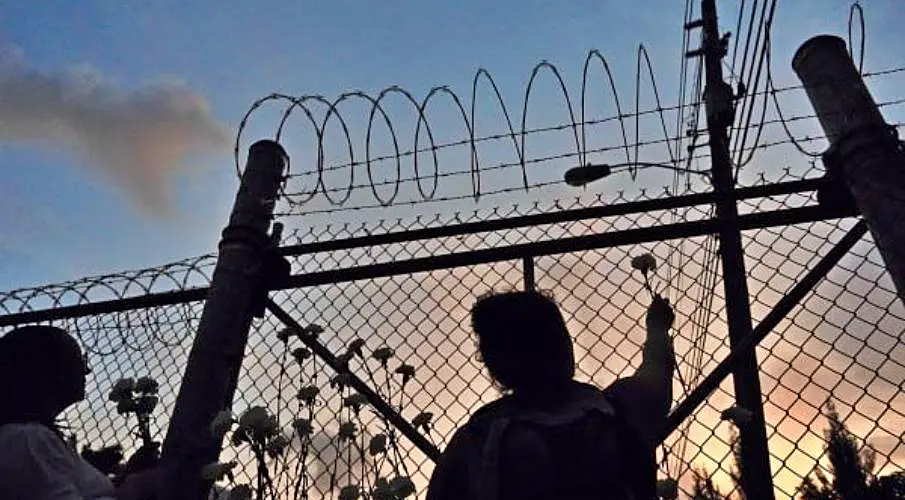
El Paso - Camp East Montana: From a tent in the desert of West Texas, where one must remind oneself to remain human, that is one possible beginning. But one could also begin with another message: It is not a camp. Certain critics place great importance on that distinction, and placing importance on proper terminology is, as everyone knows, the first step toward civilization. The dictionary, however, that incorruptible pedant, considers the term “concentration camp” entirely applicable to the facility in question - but the dictionary has never had a press office to explain which words are permitted in the present and which are supposed to belong to the past.

What this is about: A coalition of legal advocacy organizations - the American Civil Liberties Union, its Texas affiliate, the Texas Civil Rights Project, Human Rights Watch, journalists, NGOs, and the law firm Farella Braun + Martel LLP - has now filed suit in federal district court for the Western District of Texas in El Paso. Named as defendants are Immigration and Customs Enforcement, the Department of Homeland Security, the Department of Defense, and the responsible officials. The complaint concerns conditions at the largest facility operated as part of the Trump administration’s mass deportation program for detained migrants. The lawsuit contains the word “inhuman,” which is remarkable insofar as the word presupposes an opposite term that apparently not everyone still believes in here.

The case is being brought on behalf of four individuals who seek class action status for all detainees. The setting is Camp East Montana, a twenty four hectare - pardon, sixty acre - facility in the Chihuahuan Desert, constructed on the grounds of Fort Bliss military base. The name of that base means “bliss,” and it belongs to the finer ironies of American history that during the Second World War there already stood a camp there for Japanese Americans and Japanese citizens. The ground, as people say, has experience. Around 2,500 people are currently being held here. The complaint now gathers what the ACLU describes with the inelegant but precise expression “horrific legal violations.” There is severe medical neglect together with outbreaks of disease, including a measles epidemic that spread for months and infected at least fourteen people - a medical feat of a particular kind, reviving under open desert skies a disease that in the twenty first century might almost be called museum worthy. There are violent assaults by staff and coercive deportation threats. There is extensive and arbitrary solitary confinement used to punish people for asking for such extravagant things as medical care or the opportunity for personal hygiene. There is inadequate and rancid food from which detainees lose weight to a degree considered worth documenting. There is desert storm dust blowing through openings in the tent walls and doing what desert dust does to human lungs. And there are, for the sake of completeness, the dangerous and unsanitary living conditions of the tent camp in general.

You can read the full complaint here
The defendants, the filing states, continued doing nothing despite known risks; their conduct demonstrates “deliberate indifference - not mere negligence” toward the constitutional rights of detainees. Pause for a moment on that legal distinction, because it is the most philosophically interesting part of the entire matter. Negligence would mean one did not see the disaster coming. Deliberate indifference means one saw it coming and decided it was none of one’s concern. It is the difference between the sleeper and the person who is awake and closes his eyes - and if one believes Hannah Arendt, it is the place where evil truly resides: not in the monster, but at the desk that ends its responsibility punctually at five o’clock.

At least three people have already died in Camp East Montana. One of them was Geraldo Lunas Campos, fifty five years old, from Cuba. He died, according to witness testimony, after guards restrained him and placed him in a chokehold. The medical examiner’s office of El Paso County ruled his death a homicide caused by asphyxiation. This is where irony ends, because it must end here; a chokehold that kills a restrained man allows for no punchline, and anyone who tried to extract one would already have changed sides. Detainees also report beatings and sexual abuse, denial of medical care, hunger, and the deprivation of access to lawyers.
One of the plaintiffs, Cameroonian national Gerald Akari Angye, said it in his own words. The conditions in this desert tent camp were inhuman and cruel; no person should have to endure something like this. He had already experienced torture in his home country of Cameroon and never imagined he would suffer such severe violence in the United States of America of all places. He said he had been beaten; even that day he was still wearing a brace on his hand and wrist, he was in pain and afraid. No one deserved such treatment, he added, because all of them were human beings and deserved to be treated as such. It is a peculiar measure of the condition of a republic when a man who escaped a dictatorship must remind people within it that he is human - and when that reminder appears new.

Kyle Virgien, senior attorney at the ACLU National Prison Project, called Camp East Montana nothing less than a “civil rights catastrophe.” Since the day it opened, the facility has made headlines through horrific legal violations and now three deaths, and yet ICE has escaped accountability. The lawsuit exists so that no further person will have to endure what the government subjected the plaintiffs to.
Another plaintiff, referred to in the complaint as Navdeep, spoke the sentence that captures the entire matter in a single idea: one feels like a political pawn, torn from work and family and placed into a tent not meant for human life. One could die here, and it seemed as though nobody cared. Behind closed doors, Navdeep feared, the operators could conceal the truth about a death or about the other abuses; that is why it mattered that people outside learn what was happening here. Many were vulnerable or becoming weak under these conditions; however different their origins might be, all of them were human beings, and he wanted to be a voice for everyone here. This too is, viewed soberly, a philosophical act: whoever, in a tent he believes may become the place of his death, still insists on speaking for others performs an act of solidarity that the apparatus surrounding him is attempting to abolish.

Read also our article: Suffocated in Isolation – The Death of Geraldo Lunas Campos and the Silence of the System
Politics has heard its share. Thirty five Democratic members of the Texas legislature called earlier this year for an investigation following “numerous credible reports of torture, killing, and inhuman treatment.” Democratic members of the U.S. Congress also raised alarms; Representative Veronica Escobar further condemned the fact that private operators were profiting from all of this. Which brings us to the actual poetry of the matter, the poetry of company names. Operations have been run this year by Amentum Services Inc., which took over from Acquisition Logistics LLC - “Acquisition Logistics,” a phrase one might previously have associated more with pallets than with people. The predecessor had never been registered to conduct business in Texas; according to the consumer advocacy organization Public Citizen, the successor company has a history of health, safety, and other violations of federal law. Human responsibility, in short, has been outsourced to a service provider already familiar with the law in all the wrong ways.

Read also our article: Research Shows: Tents of Despair - 911 Transcripts and the Ramsingh Case
And the apparatus continues to grow. The Trump administration is advancing a plan to convert industrial warehouse buildings into additional ICE detention facilities; at least eleven such warehouses in eight states have already been purchased or contracted as part of a thirty eight billion dollar project. The warehouse, that place where a market society stores what it has not yet sold or no longer needs, thus becomes the place where people are held. Rarely has architecture expressed its worldview so openly. Which brings us back to the question of definition with which we began. Some people, as mentioned, object to the term. The sober answer is that these facilities fit the dictionary definition of the term and that the United States has a long history of operating such camps: for Indigenous tribes during the Trail of Tears and the Long Walk, for escaped and liberated enslaved people officially classified during the Civil War as “contraband,” for Filipinos, Okinawans, and Vietnamese in three different wars of the twentieth century, and indeed for Japanese Americans and Japanese citizens during the Second World War. It is a tradition whose mention is often considered impolite.
Germany’s camps also did not begin immediately as instruments of mass murder, but very early became instruments of persecution, disenfranchisement, coercion, and political repression. The American facilities are not doing that either; both began as institutions for people whom the respective leader had declared to be a problem. That is exactly the development ICE is now driving forward. History does not whisper its warning, it screams it. One must add that the advantage of history’s scream is that it can still be ignored, provided the windows remain shut. In the Chihuahuan Desert there are no windows, only openings in the tent walls through which the dust enters. As it turns out, those are the same openings through which the truth is trying to get out.
But we will not rest until not only this camp, but every camp of its kind, closes its gates forever - and with them the language that knows how to soften and normalize such gates. Germany, too, should understand this as a warning. That the AfD could one day become capable of governing can no longer simply be dismissed - and it never begins with the camp, but with the sentence that determines who belongs and who does not. And anyone who has not understood our work up to this day may perhaps understand it a little better now: it is nothing more than the attempt to keep one of those openings alive through which truth finds its way out - and to provide help where otherwise only very few are willing to provide it.
To be continued ...
Updates – Kaizen News Brief
All current curated daily updates can be found in the Kaizen News Brief.
To the Kaizen News Brief In English


Es erschüttert mich wirklich. Vor allem das soviel mitmachen. Die Wächter, der Verwaltungsapparat. Eine brutale Diktatur. Ja es ist notwendig, darauf hinzuweisen, dass uns in Deutschland mit der Afd sehr ähnliches bevorsteht. Eigentlich überall dort wo Faschisten in Regierungen kommen.
Genau das ist es, was wir eigentlich in D als Lehre aus der NS Zeit ziehen sollten. Leider haben wohl viele in der Schule geschlafen, oder es interessiert sie nicht.
In der ehemaligen DDR gab es null Aufarbeitung der Nazizeit.
Das sieht man jetzt besonders an den vielen Stimmen für die AfD
Camp East Montana.
Eines von vielen Detention Centern 😞
Was unterscheidet sie noch von den Konzentrationslagern der Nazis?
NICHTS.
Menschen werden entwürdigt, misshandelt und nicht mit dem Notwendigsten versorgt.
Die Wärter, all die die mut machen, sind genau wie die Nazis.
Und zu behaupten, es ist nur ein Job, zeigt wie moralisch verkommen ALLE sind, due das in irgendeiner Form unterstützen.
Wann erfolgen die Morde, wenn der Platz zu eng wird?😞
Die Wüste ist weit und schweigt 😞