
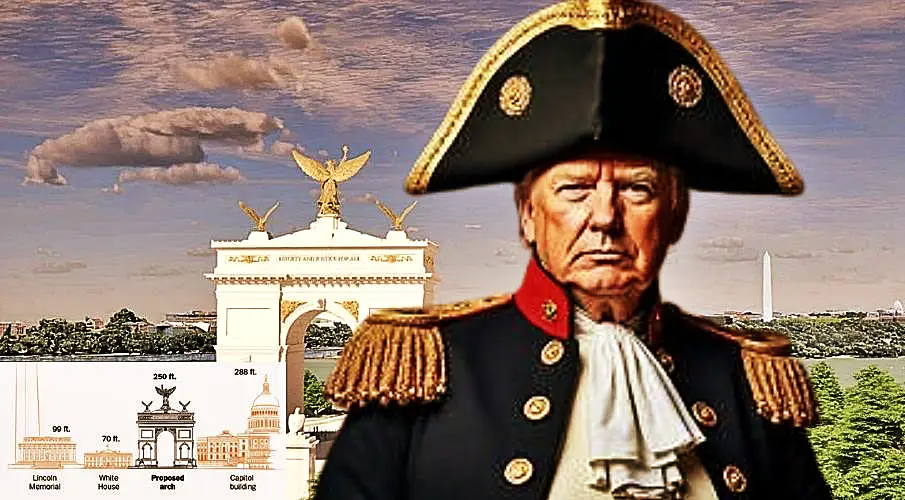
Washington is currently experiencing two conflicts that at first glance appear to have nothing to do with one another. One involves presidential records, text messages, and emails. The other concerns a massive triumphal arch of stone and steel near Arlington National Cemetery. In reality, both cases touch on the same question. How far does a president's power extend, and who draws the line when that power continues to expand? Federal Judge John D. Bates of the United States District Court for the District of Columbia in Washington has now pushed back against parts of the Trump administration and ordered several areas of the White House to fully comply with the Presidential Records Act. Those affected include the White House itself, the National Security Council, the United States DOGE Service, and presidential advisers.
The ruling strikes at a particularly sensitive point. The law was created after the Watergate scandal and Richard Nixon's resignation. At the time, its purpose was to prevent presidents from treating government records as personal property. A president's documents were no longer supposed to belong to the president himself, but to the American public.
But that is exactly where a new dispute began this year. The Justice Department's Office of Legal Counsel argued that parts of the law interfere with presidential independence and are unconstitutional. Shortly afterward, new internal White House guidelines followed. Experts warned that the changes could weaken existing safeguards. Among other things, staff members would reportedly only have to summarize important text messages later through emails or written memoranda.
Judge John Bates has now temporarily stopped that course of action. Under his order, records must be preserved and official business content must be secured through official communication channels. The new rules are to be implemented no later than the end of May. The administration has already signaled resistance. A White House spokesperson stated that Donald Trump is committed to preserving his historical presidency and that the ruling is based on a fundamental misunderstanding.
At nearly the same time, a second dispute is unfolding elsewhere
The administration is working on plans for a monumental triumphal arch with a projected height of approximately 250 feet near Arlington National Cemetery. Memorial Circle is expected to be used for the project. Survey crews are already conducting measurements while the administration simultaneously argues that it does not require new congressional approval.
The reasoning has begun to raise eyebrows.
Trump officials are relying on a decision dating back to 1924 and 1925. At the time, Congress approved plans for the Arlington Memorial Bridge and two monumental columns that were ultimately never built. The administration now argues that the new triumphal arch is essentially the realization of that old concept.

Interior Secretary Doug Burgum stated that Donald Trump sees the 250th anniversary of American independence as the perfect opportunity to finally bring a vision more than a century old to life. Lawyers, historians, and Democratic lawmakers describe the argument as a construction that is difficult to justify. Wendy Liu of the Public Citizen Litigation Group openly called the reasoning absurd. Jared Huffman drew comparisons to other administration actions, including changes at the White House and work at the Lincoln Memorial without prior congressional approval.

Several Democrats are now even referring to so called vanity projects and are demanding hearings.
Ultimately, this is not only about records or a triumphal arch. Behind both conflicts lies the same larger question. What happens when existing rules are increasingly treated as obstacles that can be bypassed rather than as limits meant to apply to everyone? Because every political system ultimately depends on something very simple. Not on how much power someone has, but on how much power someone does not have.
Updates – Kaizen News Brief
All current curated daily updates can be found in the Kaizen News Brief.
To the Kaizen News Brief In English


Zitat: „…Eine Sprecherin des Weißen Hauses erklärte, Donald Trump sei dem Erhalt seiner historischen Präsidentschaft verpflichtet …“
Hören die noch, was sie sagen?
Historical Präsidentschaft….wenn man damit Persönliche Racheaktion, Illegale Zölle, beschimpfen von Verbündeten, die Weltwirtschaft in eine Krise stürzen und den Abbau der Demokratie meint, dann ist das in der Tat eine historical Präsidentschaft.
So viel Schaden hat in 250 Jahren kein Präsident der USA angerichtet.
Gut, das Gerichte endlich aufwachen und gegen ihn entscheiden.
Obwohl das in 2026 nicht ungefährlich ist.
Leider wird Trump, wie ein schreiendes Kleinkind zu seiner Mutter rennt, seinen Marionetten Supreme Court bemühen.
Und der Kongress Knicks doch eh ein.
Die hängen alle sehr an ihrer Macht und wollen es sich mit Trump nicht verderben.
…warten wir ab, es kommt mehr und mehr gegenwehr bei den Reps auf, heute sind viele vor einer Abstimmung abgereist …
Langes Memorial Day Wochenende 🙈