
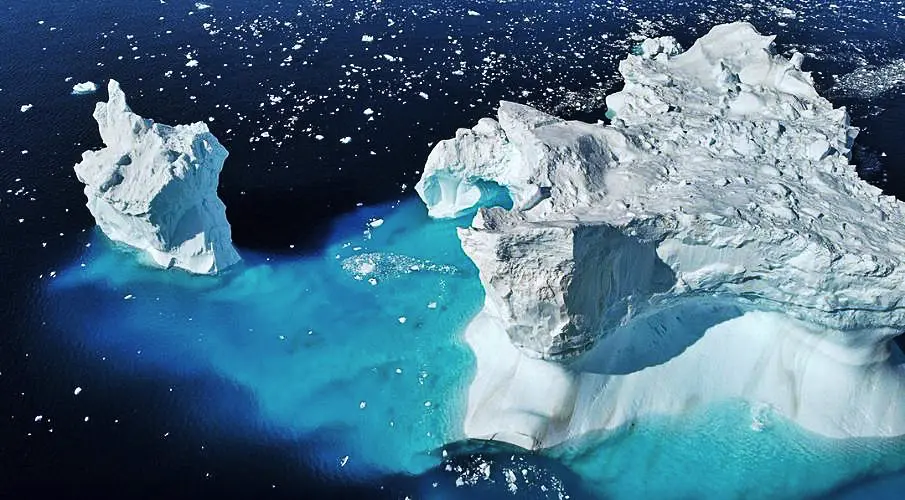
Antarctica is one of those places on Earth that is both visible and hidden at the same time. Everyone knows the images of ice, snow, and endless white landscapes. At the same time, much beneath that surface remains inaccessible. That is exactly where climate researchers have faced a problem for years. Humans have only been observing Antarctica with modern methods for a few decades. Satellites, monitoring stations, and detailed data provide valuable information, but measured against the history of Earth's climate, this is only a brief moment. Anyone wanting to understand how massive ice sheets behave under much warmer temperatures has to go much further back.

A large scale study by scientists from Durham University and the University of Cambridge therefore focuses on a period when Earth had already once been significantly warmer than it is today. The work, published in the scientific journal Quaternary Science Reviews, examines the last interglacial period approximately 129,000 to 116,000 years ago. This era is particularly interesting to researchers. At that time, global sea levels were several meters higher than they are today. For years, the question has been how large Antarctica's contribution to that rise may have been.
The difficulty begins with the evidence. The available data remains incomplete even today. There is no single document and no single measurement that provides a definitive answer. Instead, researchers assembled many individual pieces. They analyzed marine sediments, ice cores, and even genetic traces found in Antarctic octopuses. Only the combination of all these sources creates a picture that is now becoming considerably clearer.

The graphic reveals what is changing beneath the surface of the Southern Ocean. It displays different representations of the distribution of warm water masses around Antarctica. The colors illustrate differences in the strength and expansion of these water layers. Blue areas represent lower values, while green, yellow, orange, and red indicate progressively stronger concentrations.
Several of the visualizations show larger warm regions moving closer to the Antarctic continent and spreading along coastal zones. This is precisely the development described by studies conducted by Dr. Ali Mashayek and his colleagues at the Scripps Institution of Oceanography and UC San Diego. Their analyses suggest that warm water layers within the upper 2,000 meters of the ocean have moved closer to ice shelves during recent decades.
According to their calculations, the upper Circumpolar Deep Water zone is shifting toward Antarctica at an average rate of approximately 1.26 kilometers per year. What matters is that this heat does not reach the ice from above. It moves beneath floating ice shelves and attacks them from below. As a result, large areas of ice can lose stability and over longer periods contribute to rising global sea levels.
The findings suggest that during this warmer period, large portions of the West Antarctic Ice Sheet may have disappeared, particularly in the Amundsen sector. Especially revealing was an ice core taken from Skytrain Ice Rise at the edge of the Ronne Ice Shelf. Samples dating from approximately 126,000 years ago contained lower concentrations of sea salt than modern samples. For researchers, that carries important meaning. It suggests that the Ronne Ice Shelf had not collapsed at the time and may have retained at least its current size.
This significantly narrows the possible areas of ice loss. If Ronne remained intact, then large portions of the missing ice must likely have been concentrated in the Amundsen sector and potentially parts of the Ross Sea region. Another finding also stands out because at first glance it appears to have little to do with ice sheets. Researchers examined populations of Turquet's octopuses, animals living on the ocean floor in regions including the Weddell Sea, Ross Sea, and Amundsen Sea. Today a massive ice sheet separates these areas. Yet genetic data revealed surprisingly close relationships among certain populations.

Researchers see a possible explanation. In more recent geological history, underwater pathways may have existed that allowed these animals to spread between regions. Such connections would only have been possible if massive amounts of ice had temporarily disappeared. After comparing all available evidence, scientists developed two realistic scenarios for earlier ice loss.
In the first scenario, Antarctica would have contributed approximately four meters to global sea level rise. In the second scenario, the contribution would have reached around six meters. At first these numbers sound like distant figures from Earth's ancient past. Yet that is exactly where the connection to the present begins.
Current models suggest that Antarctica could likely contribute an additional 0.3 to 0.4 meters to global sea levels by the year 2100 if similar developments continue. Some projections under specific conditions even consider around 0.6 meters possible. Half a meter initially sounds manageable. For coastal regions, port cities, and low lying areas, however, the perspective changes significantly. Sea level rise does not occur evenly and its effects often become visible long before water permanently covers land. Storm surges reach farther inland, coastlines shift, and pressure on infrastructure increases.

Researchers therefore emphasize that many questions remain unanswered. They call for additional ice drilling projects, larger genetic databases of marine organisms, and more detailed models for processes beneath ice shelf surfaces. Antarctica often feels distant. Yet the data hidden there beneath miles of ice does not tell a story about another world. It describes a world that has already existed.
And possibly one that is changing again.
It is worth pausing for a moment and stating plainly what is actually happening here. A statement, an image, a movement like Trump's dominates headlines within minutes, gets shared, commented on, and passed around. And while everyone is occupied with it, another story continues unfolding quietly in the background, more subtle, without outrage or spectacle. Climate and the environment are that kind of story. They do not generate quick clicks or heated debates because people find it harder to become angry about a melting glacier than about a man once again posting another image of absurdity somewhere. Outrage needs a face, and the planet does not have one.

But that is exactly where the question should be asked. What carries farther into the future, a healthy planet or the next scandal that will already be forgotten tomorrow? One hundred years from now, Trump will simply be a name in a history book, nothing more. The air, the water, and the soil will still have to exist one hundred years from now, otherwise there will be nobody left to open that history book. Perhaps in the end it would serve us better to fight for the right to a healthy environment, to take to the streets, and even accept limitations that may be uncomfortable. Not because it feels good, but because someone a hundred years from now should still be able to breathe.That is not the more exciting cause. It is simply the more important one.
Updates – Kaizen News Brief
All current curated daily updates can be found in the Kaizen News Brief.
To the Kaizen News Brief In English


Die Erdgeschichte ist ein spannendes Thema, dass mich schon in der Schule sehr interessiert hat.
Hitze, Vulkane, Eiszeiten, Erderwärmung.
All diese Wechsel endeten mit einem Massenaussterben von Spezies.
Species die erdgeschichtlich gesehen die Erde viel länger bevölkerten, als der Mensch.
Keine der Spezies hatte aktiv Anteil am Aussterben.
Nur der Mensch hat einen Turbo eingelegt um eine Erderwärmung/Klimawandel herein zu führen.
Und das, obwohl er erdgeschichtlich betrachtet noch nicht einmal einen Wimpernschlag lang existiert.
Die Frage ist wahrscheinlich nicht einmal ob die Menschheit bestehen bleibt, sondern wie lange 😞