
Islamabad - The United States is increasing pressure on Iraq, and this time it is not about details, but about the fundamental question of which side the country is on. As Washington and Tehran face each other in open conflict, the US government is demanding that Baghdad clearly distance itself from Iran and dismantle the militias linked to Tehran within its own borders. At the same time, it has halted cooperation with Iraqi security forces and frozen funding. Two Iraqi government officials confirmed the move.
The demand is clearly stated. The State Department says the United States will not tolerate attacks on American targets and expects the Iraqi government to take immediate action to dismantle pro Iran militias in the country. These are groups that have repeatedly attacked US facilities in recent weeks. In March, the American embassy in Baghdad was shelled, as was a US base and an airport with American air defense systems in the north of the country. Several of these attacks were claimed by militias aligned with Iran. They followed an airstrike on the headquarters of one of these groups that killed three people. The militia blamed the United States and Israel.
With the suspension of cooperation, Washington is hitting Iraq at a sensitive point. Joint counterterrorism operations against the so called Islamic State are being halted, training programs for Iraqi soldiers suspended, logistical support reduced. An official from the Iraqi Defense Ministry said this particularly affects the air force and ongoing training programs. Hussein Allawi, security adviser to Prime Minister Mohammed Shia al Sudani, said the cooperation should continue. But the decision from Washington stands.
See also our documentation: Iraq fights on both sides - and no one knows how this will end
On April 9, Deputy Secretary of State Christopher Landau summoned Iraqi ambassador Nazar Al Khirullah and sharply condemned the recent attacks. This also involved a drone strike that landed near US diplomats in Baghdad. According to the State Department, multiple drones were used.
At the same time, the political situation inside the country is tightening. The formation of a new government is dragging on, while both the United States and Iran are trying to exert influence. Donald Trump had already threatened in January to cut support for Iraq if Nuri al Maliki were to become prime minister again. Al Maliki responded publicly, calling it open interference. At the same time, Shiite parties with close ties to Iran are the strongest forces in the country’s political system.

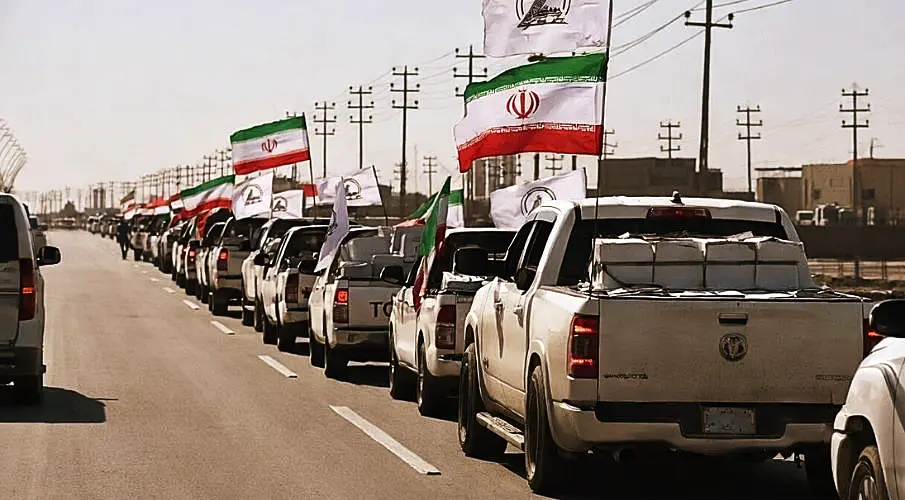
Footage from the south of Iraq. Shiite militias, armed, organized, their flags and religious symbols openly carried like an answer to a question no one asked. The weaponry is heavy, the presence is not hidden, they are there and they want it to be known.
The militias now at the center of the issue are not a new phenomenon. Many of them emerged after the US invasion in 2003 to fight American troops. Iran provided training and weapons. Later, these groups joined the fight against the so called Islamic State and were partially integrated into state security structures. But some of the more radical factions remained outside direct control and maintained their ties to Tehran.
That is precisely where the problem lies. The line between state and armed groups in Iraq is not clearly drawn. Some militias are politically integrated, others operate independently, many are intertwined in military and economic structures. Ramzy Mardini, director of Geopol Labs, puts it bluntly. Iraq could fracture if the government now tries to remove these groups by force. The assumption that Baghdad can act as a unified and independent actor is wrong.

Fighters of Hashd al-Shaabi - Iraqi Shiite militias - have arrived in large numbers in Iran to support the regime. The white flag shows the official emblem of Hashd al-Shaabi, the umbrella organization of Shiite militias in Iraq. The scope and the exact role are disputed. Research on site showed that the numbers are significantly lower than reported. The figures of nearly 5,000 fighters mentioned by intelligence services and media are far from reality. They primarily serve political amplification. According to our research, the actual number is significantly lower, we currently assume at most around 1,500. The often mentioned "60 buses" have also not been confirmed so far - a movement of this magnitude would hardly go unnoticed.

See also our article: Baghdad, broad daylight abduction - armed men drag U.S. journalist from the street into a vehicle
The situation on the ground continues to escalate. The US embassy warned on Monday that pro Iran militias could be planning new attacks on American citizens and facilities. Travel warnings were renewed, consular services suspended. Earlier this month, American journalist Shelly Kittleson was abducted in Baghdad by the militia Kataib Hezbollah and released a week later. The group said this was done out of respect for the position of the Iraqi prime minister, who was involved in securing her release. During the handover, a drone strike occurred near the convoy accompanying the journalist. American officials described it as an ambush, Iraqi security sources disputed that account.

Added to this is the influence from Tehran. Shortly before the suspension of US support, Esmail Ghaani, commander of the Quds Force of the Iranian Revolutionary Guard, traveled to Iraq. His message was clear. The decision about the government lies with Iraq alone, external forces should not interfere. A direct jab at the United States.
Iraq now stands between two powers that both make demands while simultaneously limiting the country’s room to maneuver. The United States relies on pressure and sanctions, Iran on established structures and direct connections inside the country. What looks from the outside like a political decision is internally a question of stability. Anyone who goes too far here risks not only conflict with one side, but the balance of a state that has never fully recovered since 2003.
Updates – Kaizen News Brief
All current curated daily updates can be found in the Kaizen News Brief.
To the Kaizen News Brief In English


