
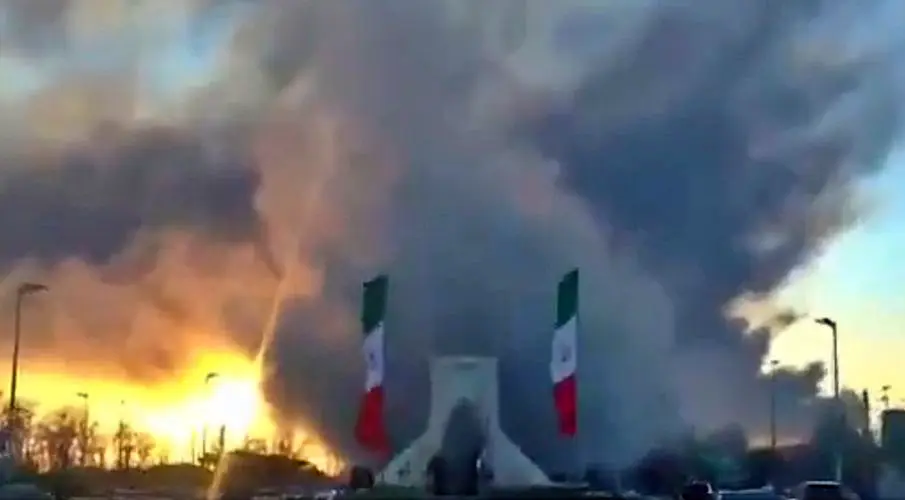
The war against Iran has entered a new phase. While American and Israeli forces continue to strike targets inside the country, the conflict is now spreading across multiple states. Missiles are striking, drones are being intercepted, diplomats and civilians are leaving the region. The military operation is expanding - and with it the danger that the entire Middle East will be drawn in. On Wednesday, the United States authorized the departure of nonessential government personnel and family members from Saudi Arabia. American government employees and their families are also permitted to leave Oman if they wish. The step follows several Iranian attacks in the region. The American Embassy in Saudi Arabia had already been targeted in an attack. Washington is attempting to reduce personnel as the conflict expands.
Massive attacks against Tehran
At the same time, new information shows how vulnerable American facilities have become. Six US soldiers were killed in an Iranian drone strike on an operations center at the port of Shuaiba in Kuwait. The site was located more than 16 kilometers from the main US Army base. Satellite images show a destroyed building with black smoke rising from it. The center consisted of a container building with no significant defenses. Joey Amor, the husband of the killed Sergeant First Class Nicole M. Amor, said the soldiers had been moved there because smaller groups were considered safer than large bases. Two hours before her death, he had still been exchanging messages with his wife. The Pentagon has since confirmed four of the six casualties. Killed were Captain Cody A. Khork of Florida, Sergeant First Class Noah L. Tietjens of Nebraska, Sergeant First Class Nicole M. Amor of Minnesota and Sergeant Declan J. Coady of Iowa. All belonged to the 103rd Sustainment Command of the Army Reserve. The attack occurred one day after the beginning of the American-Israeli military campaign against Iran.
The military scale of the operation is now enormous. Admiral Brad Cooper, commander of US Central Command, said American forces have struck nearly 2000 targets in Iran since the start of the operation. The attacks have severely damaged Iran’s air defenses and destroyed hundreds of missiles, launchers and drones. More than 50,000 troops are involved, supported by around 200 combat aircraft, two aircraft carriers and strategic bombers. Cooper said in a video message: We have only just begun. Iran is responding with massive counterattacks. According to the US military, more than 500 ballistic missiles and over 2000 drones have been launched. Israel reported several missile attacks on the north of the country, most of which were intercepted. Qatar was also targeted by an Iranian attack. Two ballistic missiles were fired, one struck the Al Udeid base but caused no casualties.
The consequences are now affecting civilians in several countries. In Kuwait City, an eleven year old girl died after debris from an interception fell onto a residential house. Her mother and three other family members were injured. Saudi Arabia reported that its air defense shot down nine drones. The United Arab Emirates said that since the start of the war it has intercepted more than a thousand Iranian drones and missiles. According to the Ministry of Defense, 57 drones actually struck Emirati territory, while of 186 ballistic missiles only one reached its target.
Sea routes are also coming under increasing pressure. A commercial ship in the Gulf of Oman near the coast of the Emirates was struck by a projectile. The attack damaged the steel hull of the vessel but caused no casualties. The British maritime security center confirmed the incident. At the same time the war is reaching new locations. In Tehran, state television reported heavy explosions at dawn. Israel said its air defenses had been activated because of Iranian missiles. In the Lebanese city of Baalbek, at least four people were killed and six others injured in an Israeli strike on a residential complex.
Israeli forces are also continuing strikes inside Iran. Military spokesman Effie Defrin said a building in the city of Qom had been hit where clerics were supposed to gather to discuss the selection of a new Supreme Leader. As the military escalation continues, political uncertainty in Washington is growing. The Republican Speaker of the House, Mike Johnson, said after a classified congressional briefing that no one can currently predict how the conflict will end. The United States does not have the task of building a new political order in Iran. It is up to the Iranians themselves to determine their future.
There is also criticism in the Senate. Democratic Senator Tim Kaine sees a troubling pattern. The administration begins military operations without involving Congress. Kaine said the government has repeatedly launched attacks without first seeking authorization and afterwards has held only classified briefings that lawmakers can barely discuss publicly. Secretary of State Marco Rubio defended the decision to strike. President Trump acted because a unique opportunity had presented itself. The United States did not want to risk being attacked first. Rubio also said the government will do everything possible to evacuate American citizens from the region. According to estimates, around 1500 Americans are in particularly dangerous areas.
The consequences extend far beyond the immediate war zones. In Gaza, Palestinians are watching the conflict with growing concern. Many fear that border crossings could be closed again and that the supply situation could deteriorate further. Residents of a tent camp in Khan Younis said they have had enough of wars and fear that food and water will soon become even harder to obtain. The international community is also warning of the consequences. UN emergency relief coordinator Tom Fletcher said the conflict is affecting civilians in nearly a dozen countries in the region. Attacks have already struck residential houses, hospitals and schools. Affected are Iran, Lebanon, Syria, the Palestinian territories, Israel, the Emirates, Bahrain, Qatar, Kuwait and Saudi Arabia.
The military operations continue. Diplomats are being evacuated, ships are being hit, missiles are being intercepted. The conflict has long surpassed the boundaries of a single war. What began as an attack on Iran is developing into a regional confrontation whose end no one can predict.
Updates – Kaizen News Brief
All current curated daily updates can be found in the Kaizen News Brief.
To the Kaizen News Brief In English


Ein Angriff ohne Mandat der UN.
Ein Angriff ohne Genehmigung des Kongress.
Und Johnson stellt sich hin und erzählt „..Die Vereinigten Staaten hätten nicht die Aufgabe, im Iran eine neue Staatsordnung aufzubauen. Es liege an den Iranern selbst, ihre Zukunft zu bestimmen…“
Während Bomben Zivilisten töten, nicht nur im Iran.
Das ist die typische Psychologie von Narzissten.
„Ich gebe Dir die Chance… wenn Du es dann selber nicht hinbekommst, bist Du selber Schuld“.
In klaren Worten „wir zerbomben den Iran, damit der Iran sich neu aufbaut. Wenn es nicht gelungt, sind die Iraner selber Schuld“
Ein Volk, was seit über 40 Jahren brutal unterdrückt wird.
Die US Amerikaner scheinen sich aber nicht groß an dem Krieg zu stören.
Die Kritik fällt verhalten aus.
Genau wie die Kritik aus der restlichen Welt sehr verhalten geäußert wird.
In den Nachrichten wird fast nur von den wirtschaftlichen Folgen gesprochen. Von Schäden für den Tourismus. Von Schäden an der Infrastruktur.
Die vielen Toten sind eine Randnotiz 😞
Außer man kann sie politisch gut inszenieren… 😞
…da fehlen sogar uns manchmal die worte