
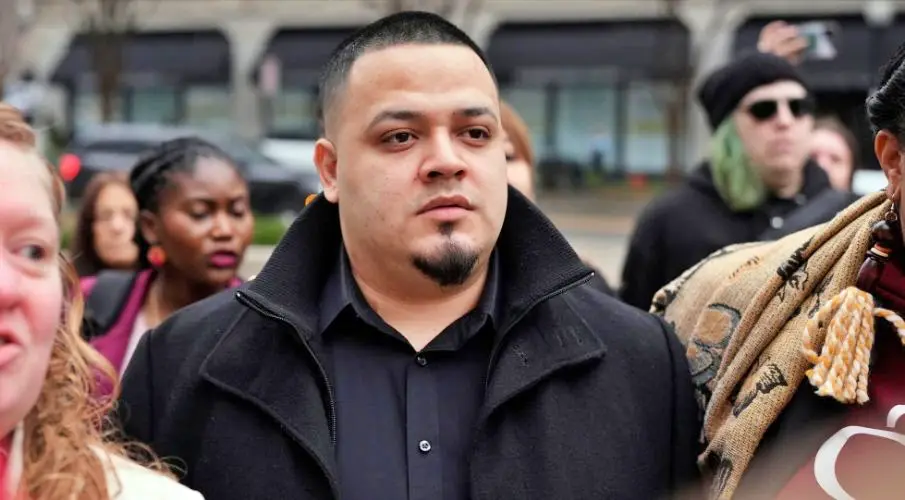
Kilmar Abrego Garcia sits in a courtroom in Nashville, headphones on to follow every word in Spanish. Cameras wait outside, inside the seats fill quickly. A man who, more than a year ago, prevailed before the Supreme Court of the United States and had to be brought back from a prison in El Salvador now stands again at the center of proceedings that are still not clearly explained. We have been involved in this case since March 2025 and have seen everything this administration is capable of. What Kilmar had to endure is, in parts, beyond words.
The federal government is pursuing two paths at once. On the one hand, it seeks to deport Abrego, most recently with Liberia mentioned. On the other, the Department of Justice is pushing forward a criminal case for human smuggling. Judge Paula Xinis of Maryland puts the problem plainly. You cannot have both at the same time. He must be in the country if you want to prosecute him. The origin of the charges lies in a traffic stop in Tennessee in 2022. Prosecutors view it as evidence that Abrego was part of a smuggling network. But the case stalls. Judge Waverly Crenshaw pauses the proceedings to address a central question. Is this a targeted and possibly retaliatory prosecution.
The defense, attorney David Patton, states it clearly. This case is the result of a deliberate attempt to punish him for fighting back instead of accepting a brutal injustice. Crenshaw himself sees indications of that. As early as last year, he spoke of a realistic possibility of retaliation.
In the courtroom, it becomes clear how difficult this question is to resolve. The government refuses insight into internal decisions. The trail leads back to Baltimore, where an investigation into that same traffic stop ran for more than two and a half years and was then closed when Abrego was taken to El Salvador. After his success before the Supreme Court, that same investigation is suddenly reopened. The Department of Homeland Security speaks of significant findings and publicly labels Abrego a human smuggler and a member of MS 13. Shortly afterward, prosecutors in Tennessee file charges.
Judge Crenshaw orders an evidentiary hearing. The Department of Justice is to explain why it is pursuing this case. The response is extensive. In 24 pages, the government repeatedly emphasizes that everything is based on clear evidence and not on personal motives. It states that any claim of hostility is contradicted by the available evidence.
In the courtroom, the statements appear less clear. Rana Saoud, a former Homeland Security investigator in Nashville, says she first learned of the case through an article by the conservative Tennessee Star. She cannot recall who sent her the article. She no longer has her phone. She then calls Robert McGuire, the lead prosecutor in Tennessee. He also had not been aware of the traffic stop at that time. Both decide to take a closer look at the case.
Saoud states under oath that political attention played no role for her. They do not let themselves be guided by it. She says she even stopped following the news because other priorities were more important. At the same time, she acknowledges that she does not know the internal decisions within the Department of Justice.
Then Robert McGuire himself takes the stand. On the central question, he answers clearly. Who made the decision to bring charges. He did. Neither Todd Blanche nor anyone from Washington or the White House instructed him to do so. He says he saw indications of human smuggling in the video of the traffic stop and pursued the case.
But that account is not the full picture. Emails show that Aakash Singh from the office of the deputy attorney general was involved early. On the same Sunday that McGuire first learned of the case, Singh wrote to him and requested a meeting. In further messages, he calls the case a high priority. All of these messages were secured through targeted reporting and are part of the record. When asked who “we” refers to in those messages, McGuire says he assumes it meant the leadership of the Department of Justice. Additional emails from reporting show Singh asking about the status of the charges and applying pressure. The defense reads each of these messages aloud in court. In one internal email, McGuire writes to his team that he had heard Todd Blanche and Emil Bove wanted the charges to be pushed forward more quickly. At the same time, he asks his staff not to put their assessments in writing. He prefers face to face conversations.
A senior staff member still contradicts him in writing. Ben Schrader, head of the criminal division, clearly opposes the charges and asks that his assessment be forwarded to Washington. On the day the charges are filed, he resigns.
The defense also points to a phone call between Blanche and McGuire on June 6, the day Abrego was returned to the United States. McGuire describes it as brief. Blanche merely informed him. He says he cannot recall the details precisely. In the background is a document that plays a central role in court. A memorandum from Pam Bondi dated February 2025. It instructs Department of Justice attorneys to consistently represent the government’s position. Those who refuse risk disciplinary action or even dismissal. When asked whether that message was clear, McGuire answers briefly. He understood the directive.
The Abrego case is no longer just about a single prosecution. It stands for the question of how independent law enforcement still is when political interests visibly enter the process. Judge Crenshaw must decide whether the government has convincingly shown that only evidence is at work here. Or whether the indications of pressure and influence from Washington carry more weight.
The decision will determine whether this case proceeds at all. And it will show how much weight a single sentence in a courtroom can ultimately carry. You cannot have both at the same time, and Kilmar’s chances of leaving that courtroom as a legal victor, finally a free man, are more than good.
To be continued ...
Updates – Kaizen News Brief
All current curated daily updates can be found in the Kaizen News Brief.
To the Kaizen News Brief In English


Verwundert es mich, dass Personen auf Trumps Linie, unter Eid Lügen?
Leider nein.
Der Fall Garcia hat von Anfang an „gestunken“.
Je mehr Aufmerksamkeit er bekam, desto mehr wurde Garcia zu einem roten Tuch der Trump Regierung.
Das Sandkorn in der „perfekten“ Abschiebemaschinerie.
Zugeben, dass man Fehler gemacht hat?
Niemals.
Hier wird ein einzelner Nann gedemütigt, nur weil er sich gewehrt hat und seine Fall zuviel Aufmerksamkeit bekam.
Danke, dass Ihr dran bleibt.
…ja sicher, seit anfang an, wo noch niemand wusste arbeiten wir an diesem fall, bis zum ende
Wenn angeblich Verbrechen begangen werden, um einen unbescholdenen Menschen abschieben zu können. Die Lüge regiert in Trumps USA, die armen Menschen.
…ein unfassbarer fall, doch leider gab es viele davon, teils noch schlimmere, über die wir auch berichtet haben bzw involviert waren
Wie wünsche ich ihm die Freiheit. Und Euch wünsche ich auch dass Albrego frei gesprochen wird, denn ihr habt viel Arbeit, Geld und Mut in diesen Fall investiert.
…das ding wird gewonnen, da sind wir uns alle einig, und das hat er absolut verdient