
Provo, Utah (KB) - There are courtrooms where far more unfolds than a legal proceeding, where two families sit whose lives were shattered forever by the same act, and the courtroom inside the Fourth District Courthouse in Provo, Utah, was one of those places on Monday. At the front sat Tyler Robinson, twenty three years old, charged with the aggravated murder of conservative activist Charlie Kirk. Seated behind him were the parents and widow of the victim, and only a few rows away sat the parents of the accused. For the first time, Kirk's family found themselves in the same room as the man accused of killing him. It is an image that cannot easily be forgotten because it captures the entire pain of two families pushed into the same abyss by the same day.
Charlie Kirk's widow, Erika Kirk, and Donald Trump Jr. were present in the courtroom as prosecutors sought to move the case toward trial and pursue the death penalty.

Tyler Robinson left the Fourth District Courthouse in Provo following the first of what is expected to be a five day preliminary hearing in the murder case involving Turning Point USA founder Charlie Kirk. Robinson was transported under extraordinary security measures, including a Lenco BearCat armored vehicle and a SWAT tactical escort. Earlier that morning, he had been brought to court under the same heightened level of security.
The five day preliminary hearing that began on Monday serves a clearly defined purpose. Prosecutors must convince Judge Tony Graf that sufficient evidence exists to move Robinson's case to trial. This is not yet a trial. It is simply the determination of whether one should take place. The legal threshold is low, extraordinarily low in fact. Mark Kouris, a former prosecutor and judge in Salt Lake City, reduced it to a simple formula. The standard is essentially fifty one percent, the probability that the defendant committed the crime. That threshold, he explained, is exceptionally low, making the likelihood that prosecutors fail to meet it virtually nonexistent. Another legal scholar, former federal judge Paul Cassell, described the evidence as a proverbial grand slam, saying the only remaining question is whether there is a sufficient legal basis to proceed to trial.

What makes the prosecution's case so substantial is what has already become public. According to investigators, DNA matching Robinson's was found on the trigger of the rifle used to kill Kirk, as well as on the spent shell casing, two unfired rounds, and a towel in which the rifle had been wrapped. Prosecutors also described a message Robinson allegedly left for his roommate, who was also his romantic partner. "I had the opportunity to take Charlie Kirk out, and I'm going to do it," the message reportedly said. In another message to the same partner, Robinson allegedly wrote that he had grown tired of Kirk's hatred and that some hatred simply could not be negotiated away. They are words that leave you breathless because they reflect the cold determination of an act that was not committed in sudden passion but was instead carefully planned.
Read also our investigations: The boy who had everything and still lost his future - An investigative reconstruction
The Distorted Truths About Tyler Robinson and Messages From Hell
The path that led to Robinson's arrest carries something profoundly tragic, touching on the philosophical question that hangs over the entire case. After authorities released surveillance images of the suspect and details about the rifle, Robinson's own parents confronted him. They persuaded him to meet with a family friend, a retired deputy sheriff, who apparently helped arrange Robinson's surrender. Pause for a moment and consider that detail. It was his own parents who convinced their son to surrender himself to the justice system. There are few decisions more painful for a mother or father than delivering their own child into the hands of the law, yet there is also a measure of dignity in that decision that should not be overlooked amid this entire tragedy. Robinson's parents sat in the courtroom gallery on Monday only a few rows behind the parents of the man their son is accused of killing.
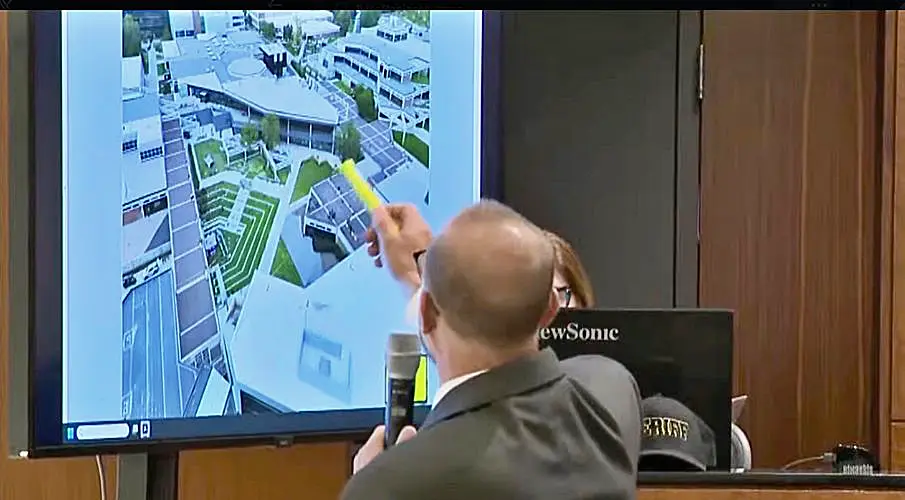
The prosecution's first witness was Chris Bagley, then a police officer at Utah Valley University, where Kirk was shot before thousands of spectators on September 10 of last year. Bagley described the beginning of his workday, securing an area near a building known as the Hall of Flags, and explained that he had a clear view of Kirk's right side while Kirk was speaking. Kirk had just begun answering a question when Bagley heard a gunshot and chaos erupted. People jumped to their feet and began running. Moments later, Bagley heard over the radio that someone had been taken into custody and began searching the crowd for anyone who might have been injured. He discovered a pistol holster lying on the ground, but he knew the shot he had heard came from a rifle, not a handgun. It is a detail that illustrates both the precision of the investigation and the confusion of that moment.
Bagley ran up a public staircase to the roof of the Losee Building, knowing it offered an unobstructed line of sight to the location where Kirk had been seated. On the roof he noticed something that seemed out of place, a red and black screwdriver, along with a disturbance in the gravel that resembled what he described as a sniper's nest. The impressions suggested the positions of two elbows, two knees, and a place where someone may have rested a firearm. Bagley secured the area with crime scene tape. Later, while reviewing surveillance footage, he saw a person running to the edge of the roof and jumping down. He also discovered a shoe print in the grass on the building's northeast side. Piece by piece, the picture of a carefully planned assassination began to emerge.

Officer Chris Bagley stated that the impression he observed in the gravel on the rooftop cannot be seen in any of the photographs taken of the area. Nevertheless, he testified under oath that the impression was in fact there.
Yet the hearing also revealed the other side of the case, the defense, and it did so with the persistence that belongs to the rule of law, however uncomfortable that may seem in individual instances. Defense attorney Kathryn Nester asked Bagley whether he had ever participated in a planning meeting about how officers intended to protect people that day. Bagley answered that he had not. Six officers had been on duty that day while thousands attended the event. There had been no metal detectors, no security drones, and no officers stationed on the roof, the staircase, or the pathway when he arrived for work. Utah is also a state where open carry is legal. Adults are generally permitted to carry firearms openly or concealed, often without a permit. It forms a bitter backdrop for a crime like this, a place where firearms are part of everyday life while protection from them remains the exception.
Equally revealing was the issue of the body camera. After the shooting, Bagley searched the roof but did not find any shell casings at that time. His body camera stopped recording while he was on the roof. "I think my battery died. I don't know," he testified. He never returned to the roof once the camera had been recharged because, as he explained, the scene had become too chaotic. He said he had approximately twenty seven minutes of footage from that day. There was also the pistol holster that he never took into evidence and about which he did not know whether it had ever been examined for fingerprints. These are the small gaps every defense attorney looks for, and identifying them is not cynicism. It is the very role the rule of law assigns to the defense.

A significant portion of the day was consumed by the painstaking dispute over which evidence would actually be admitted and which could be shown in court. Judge Graf initially rejected one video exhibit because it had been altered with markings, blurring, and a highlighted circle, and because no witness was present who could fully explain what had been changed. Prosecutors announced they would present an unedited version on Tuesday, a recording that, according to a state investigator, shows Robinson on campus both before and after the shooting. It is a revealing process. Even where the evidence appears overwhelming, the court insists that only unaltered material may be admitted. That insistence on authenticity is what distinguishes the rule of law from a show trial.
Particularly illuminating was the dispute over whether David Hull, a former investigator with the State Bureau of Investigation, should be permitted to identify the defendant in open court. When the deputy prosecutor asked Hull to look around the courtroom and identify the suspect, the defense immediately objected. Nester argued that it constituted an impermissibly suggestive in court identification that violated Robinson's constitutional rights. She cited numerous precedents holding that asking a witness to identify a defendant sitting alone at the defense table is inherently suggestive and effectively taints the identification itself. It is a subtle point, almost philosophical in nature. Whoever sits at the defense table has already been singled out by that very placement, and recognizing him there proves nothing beyond the arrangement of the chairs. The judge called the attorneys to the bench and subsequently ruled that Robinson had been identified.
Agent David Hull testified that Tyler Robinson was on the Utah Valley University campus approximately four times on September 10, including twice before the shooting and again afterward.
Amid all of these legal arguments, however, sat people whose suffering cannot be measured in statutes. About one minute after Bagley began describing Kirk's arrival on campus, Kirk's parents and his widow quietly left the courtroom before the testimony reached the shooting itself. Kirk's mother, Kathryn, clutched a packet of tissues while listening with her head lowered and her eyes closed. Widow Erika Kirk rested her head on the shoulder of the woman seated beside her. Robinson himself sat quietly between his attorneys, studying the evidence displayed on a courtroom monitor and occasionally taking notes. He wore a gray suit, a pale pink dress shirt, and a tie, while his wrists were secured by restraints attached to a chain around his waist. It is a contrast that is difficult to bear, the quiet concentration of the accused and the silent grief of those whom he is alleged to have left mourning.
Erika Kirk has done something in the months since her husband's death that falls outside what most people would have expected. At her husband's memorial service in September, she declared that she forgave the man accused of killing him. She said her husband Charlie had always wanted to save young men, even young men like the one accused of taking his life. "I forgive him because that is what Christ did," she said through tears. "It is what Charlie would do." That act of forgiveness stood apart from nearly every other prominent conservative response. President Donald Trump said on television in September that he hoped Robinson would receive the death penalty. Prosecutors are indeed seeking capital punishment, which under Utah law is available only when aggravating circumstances exist, and they argue that Kirk's shooting endangered numerous other people present at the event. The defendant's own life may therefore ultimately hang in the balance, in a country that remains deeply divided over whether the state should have the power to take a life.
Following her husband's death, Erika Kirk assumed leadership of Turning Point USA, the conservative youth movement her husband helped build. Speaking on behalf of the family, she said every court hearing is a painful reminder of his death and of the loss that permanently changed her life and the lives of their children. She added that the public support they had received carried them through the darkest days of their lives. Out of respect for the judicial process, the family would not comment further for the time being. It is a position that deserves respect despite any criticism, particularly in a case that has become such a powerful political symbol.
Because that is exactly what it has become, a symbol, and therein lies the danger. Television crews camped outside the courthouse, armed officers stood on nearby rooftops scanning the area through binoculars, and a drone circled overhead. Donald Trump Jr. attended the hearing, as did far right influencer Jack Posobiec. The case has long since moved beyond the question of guilt or innocence and become the stage for a broader political confrontation in which some demand vengeance while others preach forgiveness. Judge Graf reminded everyone in the courtroom to conduct themselves with dignity. No buttons, no political clothing, no visible displays of support for anyone would be permitted. It is an attempt to keep the courtroom free from the noise raging outside its walls, and that effort itself reflects how close politics has come to overwhelming the law.
At the end of this first day, there were no major revelations, as one reporter observed with measured restraint. The prosecution presented testimony from a former officer about the apparent sniper's nest on the rooftop and introduced several videos of the shooting that were not shown publicly because of their disturbing nature. It was a day devoted to fundamentals, legal groundwork, and painstaking arguments over admissibility. Yet one question lingered above everything else, one that no piece of evidence can answer. How does a twenty three year old come to kill another human being in cold blood because he believed that person's views were worthy of hatred? "Some hatred simply cannot be negotiated away," Robinson allegedly wrote. It is the sentence that hangs over this entire proceeding because it describes not only the alleged crime but also the climate from which it emerged. A country in which political opponents become enemies and enemies become targets has crossed a line that no court hearing can move back.
Robinson has not entered a plea of guilty. His attorneys have made no public statement regarding either his guilt or his innocence. The hearing will resume Tuesday at 9:00 a.m., when prosecutors will again attempt to introduce the surveillance video in its unedited form. What remains is the image of a courtroom where two families sit only a few rows apart, separated by little distance yet united by the same loss, because on that day the parents of the accused lost a son just as surely as the parents of the victim lost theirs. Above them all sits a judge insisting upon unaltered evidence, and in that insistence lies perhaps the only comfort such a proceeding can offer. That in the end, it is not the loud demand for revenge and not the political spectacle that will decide the outcome, but the quiet, patient weight of what can actually be proven.
Updates – Kaizen News Brief
All current curated daily updates can be found in the Kaizen News Brief.
To the Kaizen News Brief In English


An einen wirklich fairen Prozess glaube ich in Anbetracht der Vorverurteilung nicht.
Nicht, dass ich nicht glaube, dass es Robinson nicht wahr.
Aber das Verfahren ist extrem politisch.
Das zeigt sich daran, dass Donald Trump Jr anwesend war. Der mit dem Fall per se nichts zu tun hat.
Aber es ist (Wahlkampf) Taktik hier das Gewicht der Präsidentenfamilie einzubringen.
Von dem Prozess des Attentäters auf die demokratische Abgeordnete, ihren Mann und dem Hund hört man gar nichts mehr.
Aber das waren ja „nur Demokraten“ 😞