
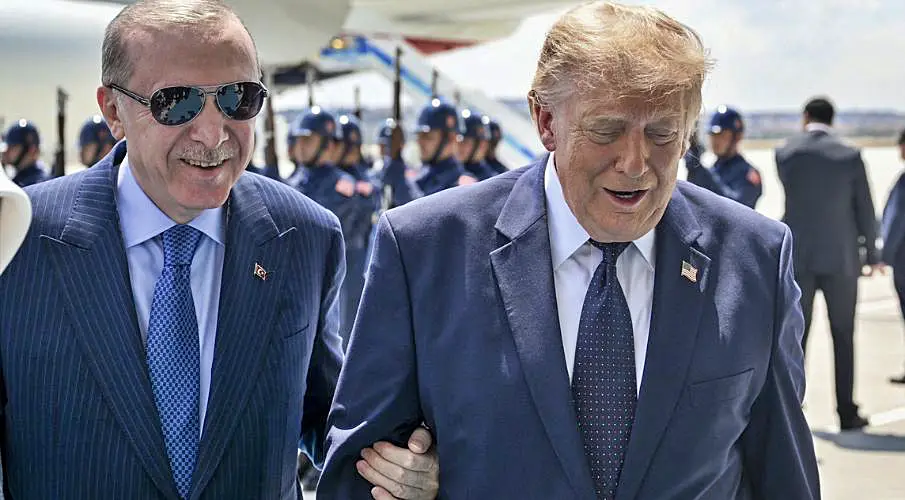
There are gatherings whose real substance lies not in the decisions that are made, but in the sentences casually spoken along the way, and the NATO summit in Ankara is one of those gatherings. Thirty two states have assembled in the Turkish capital to invoke the unity of an alliance that has been suffering for a year and a half under the weight of its most powerful member. And in the middle of this setting stands Donald Trump, repeating what he has been repeating for months, that the United States should control Greenland, that semi-autonomous island that belongs to NATO member Denmark. Let that contradiction settle for a moment. An alliance that rests on a single promise, namely that its members will defend one another's territory and never threaten it, is being confronted by its strongest partner with precisely the kind of threat it was once founded to resist.
Trump on Greenland: "That is what hurt my relationship with NATO. Because Greenland does not help Denmark. Denmark does not really spend money to help Greenland, but it is an important part for the United States. And it is surrounded by Chinese ships and Russian ships. Greenland should be controlled by the United States, not by Denmark. We could pull all our soldiers out of Europe. They had better be careful."
Greenland is an important part for the United States, Trump said during his meeting with Turkish President Erdogan, and he would not allow the island to be threatened by China and Russia. In doing so, he repeated the false claim that Greenland is surrounded by Chinese and Russian ships. It should be controlled by the United States, he said, not by Denmark. It is a remarkable logic. You protect an ally from an invented threat by denying that ally its own territory. Of all the threats Trump has made against NATO and its members, his persistent demand for Greenland is the most dangerous, because it does not target some side issue. It targets the foundation itself.
But the threat from within is only one side of this summit. The other side was already visible before it began, in the city hosting it. Security forces in Ankara carried out extensive raids the day before the meeting and arrested more than two hundred people accused of links to extremist groups, including the so-called Islamic State. Prosecutors had issued arrest warrants for two hundred forty one suspects, and two hundred nine of them were taken into custody in police and gendarmerie operations around the capital. Among those arrested, authorities said, were fifty six alleged supporters of the Islamic State and thirty five members of a far-left group known for armed attacks and assassinations in Turkey.

That is the official version. But several media outlets reported something else, and it is that something else that should make people listen. The independent left-leaning newspaper Birgün and other reporters said those arrested also included a politician, an LGBTQ activist, and at least three lawyers said to be close to left-wing groups. That raises the suspicion that the government may be using security as a pretext to silence critics and prevent possible protests against NATO during the summit. The pro-Kurdish DEM Party spoke of an arbitrary wave of arrests targeting leftist and socialist organizations and once again revealing the state the country is in. Turning Ankara into a giant prison, with bans imposed for the NATO summit, was unacceptable, the party said.
Turkey is planning strict security measures for the summit, including a ban on demonstrations, the closure of access roads to the airports, and the sealing off of areas around the venue and the hotels used by delegations. Erdogan's government has always placed security first and regularly carries out such raids. Last month, three hundred twenty four people accused of links to the Islamic State were arrested in a nationwide operation. One can consider such severity necessary, because the Islamic State has carried out numerous deadly attacks in Turkey, including the attack on an Istanbul nightclub on New Year's Eve 2017, in which thirty nine people were killed. But the line between legitimate counterterrorism and the misuse of security as a weapon against political opponents is thin, and in a country like Erdogan's Turkey it is often no longer visible. It is precisely in this place, in this atmosphere, that an alliance has gathered which claims to defend freedom.

And Trump? For the host, he found only warm words. They had a very special relationship, he said as the two men came together for their bilateral meeting, a relationship that benefited both countries. Asked what made that relationship so strong, Trump replied that it was chemistry, that it worked between them. Sometimes you get along well with the toughest people, he said, gesturing toward Erdogan, and sometimes you cannot get along with the weakest, most pathetic people. Note the choice of words. The leader of a country that is arresting lawyers and activists is elevated to a tough man with whom one gets along well, while those who do not submit to Trump are dismissed as weak and pathetic. It is an ordering of the world in which strength is measured by ruthlessness and weakness by the refusal to bend.
This sympathy for the strong has its counterpart in open contempt for European allies. Trump used the meeting with Erdogan to revive his old complaints. He had tested the European partners, he said, when he asked them for help in the Iran war. Italy refused, Germany refused, France refused. That was fine, he added, but why were the United States spending hundreds of billions of dollars if the others were not there for them? It is a complaint that reaches the heart of the conflict between Trump and NATO, that alliance he has called a paper tiger. One must look closely at the construction of this accusation to see how crooked it is. Trump starts a war alongside Israel without asking the allies, and then accuses them of not supporting him in that war. It is as if someone invites himself into a fight and then feels insulted because no one holds his fists for him.

While Trump insults the Europeans, NATO's own experts paint a different picture of the situation, a more sober one. A senior alliance official said on the sidelines of the summit that despite several reckless Russian actions, including airspace violations over Poland, Romania, and Estonia, the alliance had successfully deterred Russia from a possible attack on a member state. He said he saw absolutely no indication that Russia was interested in any kind of conflict with NATO. Moscow was overstretched by its war in Ukraine and knew that NATO would respond to any attack on a member. Russia is deterred, he said, but it is deterred because of the measures being taken. It is a sentence of quiet importance, because it explains what Europe's security actually rests on. Not on the mood of a single president, but on the cohesion of an alliance that is being undermined by the very man visiting it that day.
On the war in Ukraine, Trump sounded confident, as he so often does. Asked about his planned meeting with Ukrainian President Zelenskyy on Wednesday on the sidelines of the summit, he said he had recently had great phone calls with both Zelenskyy and Russian President Putin. Both wanted to settle the matter now, he said, and Erdogan was helping them. It is the familiar melody of the quick peace Trump has long promised and that never arrives. One wishes it were as simple as he presents it. But the reality over the weekend spoke a different language. A Russian strike last week killed thirty one people, and another on Monday morning killed at least twelve. Between the great phone calls and the dead in Ukraine lies an abyss no press conference can bridge.
This is where the deeper tragedy of the summit becomes visible. European governments depend on Trump, however much they fear his politics. Ukraine needs American Patriot air defense systems in the fight against Russian attacks, and only one country can provide them. So the Europeans smile while they are insulted and remain silent while their territory is being denied. They have come to show how much more they are now spending on defense, in the hope of keeping the powerful partner engaged. It is the diplomacy of powerlessness, the courtship of a man who understands favor only as an instrument of control.
Even within Turkey, Trump's appearance did not go unanswered. Ozgur Ozel, widely regarded as the de facto opposition leader, accused the American president of being the only state guest of his kind to stay away from the mausoleum of Turkish Republic founder Mustafa Kemal Atatürk. Since Eisenhower in 1959, every American president visiting Turkey had gone to the tomb to honor the man who remains revered in Turkey as the father of the nation. Even Trump's predecessor Joe Biden, who never visited Turkey as president, laid a wreath at Atatürk's tomb in 2011 as vice president. Trump did not. And in that small gesture lies a larger meaning. Those who do not honor the dead of history often reveal how little history itself means to them.
Ozel, who was removed from the leadership of the Republican People's Party last May by court order, a ruling many consider politically motivated and that nonetheless made him, in the eyes of his supporters, the real opposition leader, found even sharper words. Trump, he said, should have been greeted by children holding pictures of the one hundred sixty five girls killed in Iran. He was referring to an airstrike on a school at the beginning of the Iran war. It is a sentence meant to hurt, and it should hurt. Because beside all the diplomatic courtesies, it places the one question that appears in none of the summit photographs. What remains of the grand words about security and peace when children die in a school at the beginning of a war, and when the man who led it moves through the capital of an ally as though nothing had happened?
To understand why this dispute over Greenland and the loyalty of the allies carries such weight, one must look at the sentence that holds the entire alliance together at its core. It is Article 5 of the North Atlantic Treaty, the mutual defense pledge under which an attack on one member is treated as an attack on all. It states that an armed attack against one or more allies shall be considered an attack against them all, and that each member will take whatever action it deems necessary, including the use of armed force, to restore and maintain the security of the North Atlantic area. It is a single sentence, and yet it carries the weight of entire decades. Because of this guarantee, the formerly neutral countries Finland and Sweden sought entry into NATO, and for the same reason Ukraine and other European states want to join.
It is telling how rarely this promise has actually been invoked. Article 5 has been triggered only once in the history of the alliance, after the terrorist attacks of September 11, 2001, against the United States, paving the way for NATO's largest operation in Afghanistan. It is a bitter memory, especially now. The country whose allies came to its aid then is the same country whose president now calls the alliance a paper tiger and thinks aloud about absorbing the territory of a partner. The allies once stood up for America. America now questions whether it would ever stand up for them again.
This is also where Ukraine's dilemma lies, hovering over every conversation in Ankara without any clear way out. As long as this war continues, the country cannot join the alliance, because accession during the war would obligate all members to come militarily to Ukraine's aid, thereby risking a much larger war with a nuclear power. It is the tragedy of a guarantee so strong that it becomes impossible at the very moment it is needed most. Joe Biden had already captured this contradiction in a few words. If the war is still ongoing, he said, then everyone is in the war, then they are at war with Russia. And so Ukraine remains in the waiting room of an alliance that can only admit it once its war is over, while its enemy has every reason to ensure that the war never ends.
One can read this summit as a stage of contradictions, and perhaps that is the most honest way to see it. A president threatens an alliance member while claiming to protect the alliance. A country that says it wants to defend freedom meets in a city where lawyers and activists are in custody. A man praises the tough host and mocks the weak allies without realizing that true strength never lies in ruthlessness, but in the ability to keep one's word. The old thinkers of statecraft knew that an alliance does not rest on treaties, but on trust, and that trust is the one thing that cannot be forced and cannot be bought. It forms slowly and breaks quickly, and anyone who recklessly puts it at risk will not regain it when he one day needs it.

In the end, Article 5 is worth only as much as the determination to honor it when the moment comes. It exists on paper, but it lives only through the trust that it will apply at the decisive moment. A president who undermines that trust with every threat against an ally does not merely damage a diplomatic formula. He drains that promise of the force without which it is nothing more than a sentence in an old treaty. And a promise no one believes in no longer protects anyone.
Perhaps that is the real message of Ankara. Not in the official statements, not in the decisions announced at the end, but in the image of an alliance that must buy its unity again and again through flattery. An alliance that worries about the loyalty of its strongest member while that member openly considers absorbing the territory of another. NATO was once the promise that no one would stand alone if attacked. It risks becoming a court in which everyone hopes the most powerful man is in a good mood today. And a peace that depends on one man's mood does not deserve the name. It is only the pretty surface over a danger people do not yet want to see.
On the very day of the summit, NATO demonstrated what such appeasement looks like. At a forum billed as the alliance's major unveiling, Secretary General Mark Rutte, accompanied by techno music and a dazzling video backdrop, presented a series of multibillion-dollar defense projects, "money well spent," as he called it. The alliance announced the replacement of its fourteen aging AWACS surveillance aircraft, now around fifty years old, with up to ten new GlobalEye aircraft built by Swedish manufacturer Saab, "a moment of great pride," in the words of Swedish Prime Minister Ulf Kristersson, "built within the alliance, for the alliance." Representatives from fifteen nations stood beneath the NATO emblem, shook hands, and announced the joint purchase of tanker and transport aircraft from Airbus, along with up to five new Triton surveillance drones. Europe had to translate its economic strength into military capability, Rutte said, make the money work, move from plans to drones, from cash to missiles. Part of the financing will come through a European Union system of low-interest loans worth up to $170 billion, raised on the capital markets. Yet amid all the spectacle, one small detail stood out. No one offered concrete figures, and several of the projects being showcased had already been approved long ago. It was a stage meant to project momentum, while in reality much of what was presented was simply a repetition of decisions that had already been made.
Standing at the edge of that spectacle was a man fighting for something far more fundamental. Ukrainian President Zelenskyy renewed his appeal for his country to be admitted into the alliance. Ukraine's armed forces were highly experienced and would only strengthen NATO's defensive capability, he said, capable of striking deep inside Russian territory and hitting refineries and energy infrastructure. On average, Ukraine eliminates thirty thousand Russian soldiers every month. But then he added a sentence that carried more weight than any statistic. "We are not proud of this," Zelenskyy said. "This is a war we never sought, but one we have been forced to fight." It is the statement of a man who has spent five years defending what others in Ankara merely proclaim, and who cannot be admitted precisely because his war has not yet ended. So while some celebrate agreements and order drones, the one man who experiences the threat every single day remains standing outside the closed door. Perhaps that is the quietest and most painful truth of this summit. The alliance is rearming itself against a danger that someone else is already bleeding to contain, while leaving him standing outside in the rain.
In the end, the question remains, hovering over everything and never openly spoken in Ankara. What is a defense alliance still worth when the greatest threat to its basic principles no longer comes from outside, but from within its own center? As long as no answer is found, every summit, however solemnly staged, remains a meeting of people collectively pretending that everything is fine while the ground beneath them grows quieter. The flags fly, the hands are shaken, the speeches are delivered. And standing among them is a man who praises the house whose walls he is tearing down himself.
Updates – Kaizen News Brief
All current curated daily updates can be found in the Kaizen News Brief.
To the Kaizen News Brief In English


