
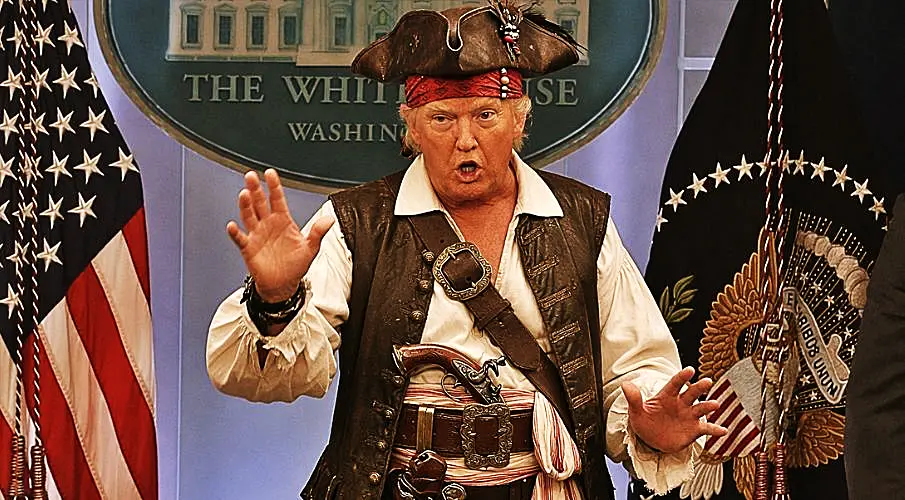
Donald Trump did not say it quietly, awkwardly, or by accident. He said it publicly in West Palm Beach, with that same crude excitement that always becomes audible whenever power no longer needs to be explained, only displayed. The American Navy, he said, now operates “like pirates” when seizing ships as part of the blockade of the Strait of Hormuz. The United States had taken over the ship, taken over the cargo, taken over the oil. It was a very profitable business. “We’re like pirates,” Trump said in substance, only to immediately add that America is not playing games.
That is exactly what makes it disturbing. Trump does not use piracy as an accusation, but as bragging. He speaks about state violence, confiscated cargo, blocked sea routes, and economic coercion as though he were describing a particularly successful business model. What once at least remained hidden behind the language of security, order, and international responsibility suddenly stands fully exposed in his rhetoric. Not as a slip of the tongue, but as a political worldview.
For months, Washington has been reshaping maritime order in ways officially described as protecting freedom of navigation, but which increasingly resemble seizure, coercion, and plunder. On September 1, 2025, the Pentagon launched “Operation Southern Spear,” a campaign of airstrikes and interception operations across the Caribbean. Officially, it was justified as part of the fight against drug cartels and smugglers from Venezuela. The operation has since expanded all the way to Ecuador’s Pacific coast. Fishermen there have reportedly been killed, abducted, and tortured. More than 170 people are believed to have died already.

Then, on January 3, 2026, came an operation that stands out as exceptionally brutal even in the long history of American intervention in Latin America. U.S. special forces abducted Venezuelan President Nicolás Maduro. More than 100 people were killed. Delcy Rodríguez, also from the Chavista movement but apparently viewed by Washington as more manageable, replaced him. After negotiations in Caracas over opening Venezuela’s energy sector to foreign capital, Interior Secretary Doug Burgum returned to the United States carrying gold worth $100 million - reportedly intended for domestic refineries.
Why We Are Having the US Military Operation Reviewed by International Bodies

We did not take this step lightly. Filing a complaint before international bodies is not a symbolic act, not a political statement for in between, and certainly not a convenient undertaking. It means real work, legal precision, careful weighing - and the knowledge that resistance is certain. That is precisely why we filed it. We are addressing three international courts and oversight bodies at the same time: the International Criminal Court in The Hague, the Inter-American Commission on Human Rights in Washington, and, in addition, the Inter-American Court of Human Rights in San José. Not out of political activism, but because the legal complexity of the facts requires parallel consideration by several international bodies. Read the full article and complaint before the International Court of Human Rights here
Read also our documentation article: USA Oust Maduro: Military Strike Shakes Venezuela and America’s Lies to the World
Panama also became entangled in this new maritime strategy. On January 30, the country’s Supreme Court revoked the decades-long concession held by the Chinese company CK Hutchison for the Balboa and Cristóbal container terminals. The move was widely interpreted as the result of American pressure. The infrastructure did not return to Panama, but was instead handed to the Danish corporation Maersk. The United States now appears to be pursuing a similar strategy in Peru around the port of Chancay.
On February 28, Trump finally launched “Operation Epic Fury” against Iran - and the military effort almost immediately collapsed into a strategic dead end. Since the fragile ceasefire, a bizarre new reality has emerged at sea. Iran now demands fees for safe passage through the Strait of Hormuz. At the same time, the U.S. Navy attempts to intercept ships that previously loaded cargo in Iranian ports while threatening companies with sanctions if they pay Iranian transit fees.

This is producing a system that can barely still be explained through traditional security policy. The United States is using military, legal, and political tools to disrupt trade flows, push out rival capital, and bind allied capital to American interests. On paper, this is about freedom of the seas. In practice, it is about control over ports, oil, transit routes, refineries, and entire supply chains.

Read also our article: Sirens over the Gulf - and we count the dead like weather
Trump calls this piracy as though it were a joke. But the word points toward an older and darker truth. Powerful nations have always behaved this way at sea when they wanted to impose their interests through force. In the sixteenth and seventeenth centuries, Spain used similar interception tactics in the Mediterranean against the Ottomans while simultaneously fighting over South American ports and trade routes. Piracy was never simply the image of a man with an eyepatch and a saber. It could mean rebellion, survival, proxy violence, or state power operating through unofficial force.
Who was called a pirate was rarely determined by the act itself alone. It was determined by the power assigning the label. In the Netherlands, Piet Hein is still celebrated as a hero. In Spain, he is remembered primarily as a pirate. The same principle still operates today. One state speaks about securing trade routes. Another sees theft. One government describes pressure against criminal networks. Those targeted experience abduction, confiscation, extortion, and death. That is precisely why Trump’s statement is so revealing. It exposes not only a president trivializing violence. It reveals an imperial power increasingly unwilling even to wrap its actions in the language of law anymore. Earlier this week, the United States was still defending Panama’s alleged sovereignty against Chinese economic pressure while simultaneously promoting an international coalition to liberate the Strait of Hormuz. Days later, Trump openly bragged about taking ships, cargo, and oil.
This is not an order based on freedom. It is an order based on force. The old words remain in place - sovereignty, security, maritime freedom, the fight against terrorism and drug trafficking. But behind them, another principle increasingly emerges: whoever controls the fleet takes whatever can be enforced. Pirates have always served as useful enemy images. In earlier centuries, they justified wars, trade monopolies, and colonial violence. Today, terms like narco-terrorists serve the same purpose. They transform people into targets, ships into spoils, and foreign coastlines into operational zones. They turn violence into administrative language and theft into strategy.
Trump barely even bothers disguising it anymore. His phrase “to the victor belong the spoils” describes his foreign policy more accurately than any official White House statement ever could. At sea, what now emerges is not strength, but the condition of a power that increasingly takes by force because it can no longer persuade.
Updates – Kaizen News Brief
All current curated daily updates can be found in the Kaizen News Brief.
To the Kaizen News Brief In English


Piraterie als Teil einer Handelspolitik.
Das ist das Jahr 2026.
Ein demented Präsident, mit dem IQ und Benehmen eines Dreijährigen freut sich über „Beuteschiffe“.
Als ob es hier um Sandkastenspiele und nicht um Menschenleben und die freie Schiffahrt geht.
Ernst gesagt, wo ist da noch der Unterschied zu den Huthi-Piraten?
Die Frage ist, wie lange andere gut militarisierte Großmächte zusehen.
China wird seine Interessen durchsetzen (wollen).
Auch Russland wird diesem Treiben nicht ewig untätig zusehen…..
Ein irrer mit dem Atomkoffer drangsaliert die Welt.
Mit seinen Allmachtsfantasien.
Hitler konnte jahrelang in Deutschland das Terroregime mit all seinen Gräueltaten halten.
Aus dem Ausland kam nicht viel.
Auch nicht, als er den Krieg begann.
Aber als Hitler Russland Angriff begann sich etwas zu ändern.
Der Mehrfrontenkrieg war dann letztlich sein Verderben, zum Glück.
Wann ist Trumps „Verfalldatum“ durch seine Aktionen erreicht?