
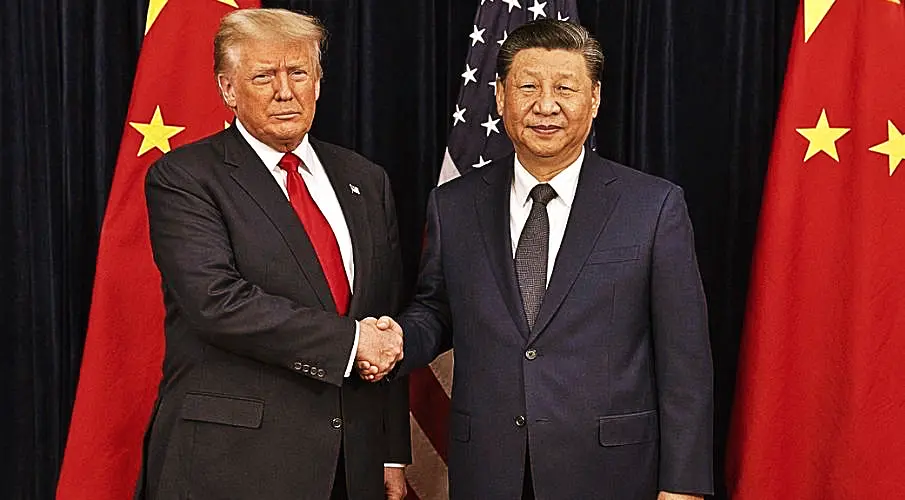
Donald Trump arrived in Beijing like a president selling a performance more than conducting diplomacy. Outside the Great Hall of the People, Xi Jinping welcomed him with military ceremony, an honor guard, the American national anthem, and a 21-gun salute. Children stood waiting with flowers and American flags, and Trump briefly stopped to applaud. It was a reception designed to project strength - on the Chinese side, above all the control Xi Jinping holds over state, party, and military, and on the American side, Trump’s attempt to present himself as the man of grand deals.
The opening moments already revealed how differently both presidents intend to use this visit. Xi spoke about stable relations between China and the United States and said the shared interests of both countries were greater than their differences. A stable relationship between Beijing and Washington, he argued, is good for the world. He did not mention Iran, the blocked Strait of Hormuz, or other crises in his first remarks. Xi stayed with the grand formula, the carefully controlled language, the attempt to frame the meeting as a historic moment between two world powers.
Trump, by contrast, immediately sounded like Trump. He praised the size of his economic delegation and declared that he had invited the thirty most important business leaders in the world, and every one of them had accepted. He said he did not want second-tier or third-tier executives, only the CEOs themselves. They had come to show respect to China. Seated in the back rows were indeed some of America’s most powerful corporate leaders, including Elon Musk, Tim Cook, and Jensen Huang. Eric Trump and Lara Trump were also present. The visit therefore resembles not merely a summit between governments, but a political business trip wrapped in national symbolism.
Trump also claimed that his relationship with Xi is the longest relationship ever between an American president and a Chinese president. What exactly he meant remained unclear. He may have been referring to the period stretching back to his first term in office. Because of the four-year interruption between his two administrations, his official contact with Xi now extends across more than a decade. But the statement fit the tone of the day: Trump placed not the issue itself at the center, but himself and his personal relationship with the Chinese leader.
Xi used his welcome differently. He spoke about changes the world has not witnessed in a century and invoked the concept of the “Thucydides Trap.” The term refers to the old idea that an established power and a rising power almost inevitably move toward conflict. Xi asked whether China and the United States could avoid that fate and create a new model of great power relations. It was a sentence aimed at historians, diplomats, and strategists - and at the same time a signal showing how deeply Beijing views this meeting as a fundamental geopolitical question.

But beneath the ceremonial welcome, the actual conflicts remain fully exposed. Trump is seeking economic agreements with China. At the same time, his visit is overshadowed by the war against Iran, which remains an important oil supplier for China. Secretary of State Marco Rubio already stated during the flight to China that Washington wants Beijing to play a more active role in reopening the Strait of Hormuz. China has its own interest in doing so, Rubio argued. If the global economy collapses because of the crisis in the strait, other countries will also buy fewer Chinese goods.
That places one of the central problems of the visit directly on the table. Trump needs China not only as a trading partner, but also as a possible lever against Iran. Beijing, meanwhile, can derive its own demands from the situation. The United States blocks, threatens, sanctions - and ultimately still needs the help of the rival it simultaneously seeks to contain. That is what makes the meeting in Beijing so contradictory. It projects power, but also dependence.
Another issue closely watched in Beijing is Taiwan. For Xi Jinping, the democratically governed island is not some secondary foreign policy matter, but a central pillar of Chinese state doctrine. For Washington, the situation has deliberately remained ambiguous for decades. The United States recognizes the government in Beijing as the government of China while politically and militarily supporting Taiwan without formally treating the island as an independent state. Even small changes in Trump’s wording could trigger major concern in Taipei, Tokyo, and other capitals. If Trump were to say in Beijing that the United States “opposes” Taiwanese independence instead of merely saying it does not “support” it, the difference would go far beyond language. It would accommodate Beijing and increase pressure on Taiwan.
Human rights also remain part of the discussion, though not at the center of Trump’s trip. Before leaving, the president stated that he intended to raise the case of Jimmy Lai. The 78-year-old Hong Kong media entrepreneur was sentenced in February to twenty years in prison. Beijing holds him partly responsible for the large protests in Hong Kong. Trump said Lai had caused a great deal of unrest, but had tried to do the right thing. He said he intends to raise the case again. Trump also said he plans to discuss the case of Christian pastor Ezra Jin, who was arrested in China in October. Whether those discussions become more than brief mentions remains uncertain.
More than one hundred lawmakers in Washington had urged Trump in a bipartisan letter to advocate for Jimmy Lai directly with Xi. Supporters of the imprisoned Chinese journalist Dong Yuyu are also pressing for American assistance. Dong is reportedly seriously ill and may be suffering from lung cancer. But Trump’s primary focus clearly remains trade, deals, and geopolitical advantage. Previous presidents regularly spoke in detail at China summits about Hong Kong, Tibet, Xinjiang, and political prisoners. With Trump, it remains unclear how much space such issues will actually receive.
While the two presidents greet each other with extended handshakes, ceremony, and carefully crafted language, the societies of both countries continue drifting further apart. In earlier decades, cultural gestures belonged naturally to meetings like this. George W. Bush rode mountain bikes with cyclists in China in 2005. Xi Jinping received a football jersey from students in Tacoma during his 2015 visit to the United States. Musicians, students, scientists, and athletes created connections over decades that at least partially survived political crises.
Very little of that remains today. The number of American students studying in China has collapsed dramatically. Only a few years ago, the number stood at roughly 11,000. Today it is fewer than 2,000. Chinese students are also increasingly turning away from the United States because of fears involving visa denials, political suspicion, and open hostility. India has now surpassed China as the leading country of origin for international students at American universities.
Scientific cooperation has suffered as well. American and Chinese researchers long worked closely together in energy, particle physics, cancer research, and other fields. Today, security concerns, mistrust, and political controls stand in the way. American cultural programs have been cut, Chinese authorities have canceled performances by foreign artists, and even longstanding relationships like the Philadelphia Orchestra’s historic visits to China would likely be difficult to establish today.
This visit to Beijing therefore exists somewhere between grand ceremony and growing distance. Xi speaks about stability, Trump talks about businessmen, Rubio talks about Iran, Taiwan watches every word, human rights groups hope for at least one clear statement, and the people of both countries encounter each other less and less. On paper, the two most powerful leaders in the world are meeting face to face. In reality, two systems are confronting one another that need each other, fear each other, and increasingly no longer understand each other at all.
Updates – Kaizen News Brief
All current curated daily updates can be found in the Kaizen News Brief.
To the Kaizen News Brief In English


Ich erwarte mir für die Welt(wirtschaft) nicht viel von dem Treffen.
Man muss klar sagen, dass sich weder Xi noch Trump für Menschen bzw Menschenrechte interessieren.
Ebenso steht Machterhalt bei Beiden ganz oben.
Xi ist ein Autokrat, aber im Gegensatz zu Trump ist er wortgewandt und kann sich auf diplomatischen Parkett bewegen.
Man darf ihn aber bicht als den „freundlicheren“ ansehen.
Er schlägt leisere und wohl gewählte Worte an. Er stellt nicht sich in den Mittelpunkt.
Damit ist oder wirkt er berechenbarer.
Trump ist dagegen Trump.
Laut.
Stellt sich und Deals in den Mittelpunkt.
Redegewandtheit eines Dreijährigen.
Ob es wohl zum Eklat kommt?
Je länger Trumps Aufenthalt, desto wahrscheinlicher ist das.