
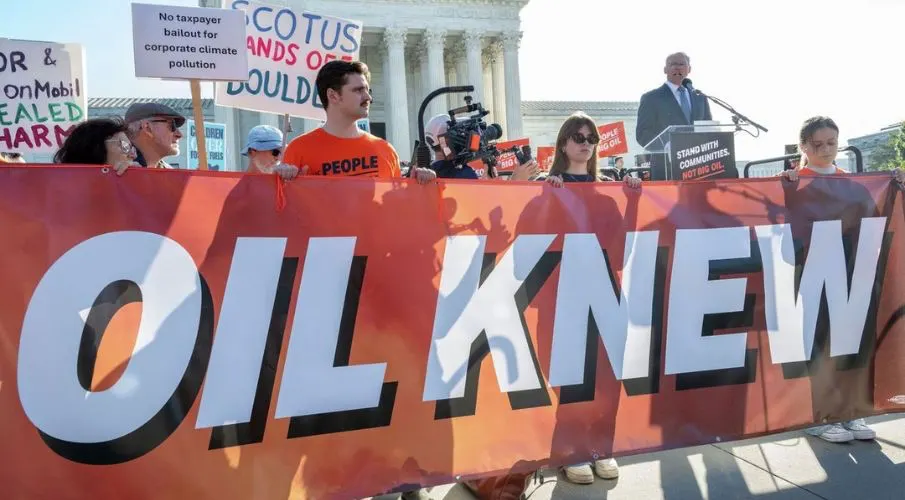
Washington, D.C. (KB) - On the first Monday in October, the Supreme Court of the United States opened its new nine-month term and immediately took up a question bigger than its dry case title. Can a city hold the oil industry liable for the fact that the Earth is getting warmer? Boulder, Colorado, has tried, against U.S.-based ExxonMobil and Canada-based Suncor Energy. The state’s highest court allowed the lawsuit to proceed. The companies took the case to the nation’s highest court, and Donald Trump’s administration is standing behind them.

The companies are relying on a simple barrier. The federal government regulates air pollution, so state courts have no business in this matter. Boulder’s city and county governments accuse them of helping drive global warming and misleading the public about the dangers of fossil fuels. They are seeking unspecified monetary damages. Boulder wants to hold the companies responsible for the costs caused by global warming, past and future. Repairs to damaged roads and disaster response are part of that. So are the public health burdens left behind by fires and droughts, and the floods that come with hotter years.

This is not just about Boulder. Nearly 60 states and municipalities have filed dozens of similar lawsuits seeking billions of dollars, and more are coming. If the Supreme Court sides with the companies, many of those cases could collapse. For two decades, the fossil fuel industry has almost always come out on top before this court. Its supporters warn that if the justices side with Boulder, a single state would gain power over conduct far beyond its borders. That burning oil and coal releases greenhouse gases such as carbon dioxide, which trap heat and warm the Earth over time, is not in dispute here. The fight is solely over jurisdiction.
Chief Justice John Roberts showed doubts about both sides. He told Kannon Shanmugam, the companies’ lawyer, and Sarah Harris, representing the Justice Department, that state courts have been allowed to rule on cross-border harms in comparable cases. He said he was not sure what made this case different. He asked Boulder’s lawyer, Kevin Russell, what would happen if Boulder won. The very next day, a municipality in every state would file a lawsuit, simply copy the pleadings, and then there would be at least 50 cases on the table. He wanted to know how that was supposed to work in practice. The chief justice’s concern is the number of plaintiffs, not the number of fires.

The other questions cut across the court. Liberal Justice Sonia Sotomayor told Shanmugam that under the Clean Water Act, the court had long allowed state lawsuits, and she did not see why it should be any different under the Clean Air Act. Conservative Justice Brett Kavanaugh leaned toward the other side and spoke of a wall of precedent holding that cross-border air and water pollution is a matter of federal law unless Congress explicitly protects state law. Liberal Justice Ketanji Brown Jackson called the case premature and suggested the court might be stepping in too early. Several justices left open which legal standards should even apply here and whether the case should be sent back to the lower court for further clarification.
The court has a 6-3 conservative majority. In this case, however, only 8 justices are deciding because Samuel Alito recused himself. He owns stock in several oil and gas companies, though not Exxon or Suncor. That means the case could end 4-4, leaving the lower court’s ruling in place. The fact that a justice has to step aside because his investment portfolio touches the industry says more about the closeness of money and law than any hearing ever could.

Shanmugam pushed for a quick ruling. The matter, he said, was extraordinarily important, billions of dollars were at stake in each of these cases, and an answer was needed soon. The lower court, he said, had already resolved the federal-law questions. Still waiting for the court later this term are Trump’s hardline immigration policies and state bans on assault-style rifles. A decision in the Boulder case is expected by the end of June. What is being argued is whether a municipality is even allowed to ask who set its world on fire and knew it. The fire outside is not waiting for the answer.
Updates – Kaizen News Brief
Alle aktuellen ausgesuchten Tagesmeldungen findet ihr in den Kaizen Kurznachrichten.
To the Kaizen News Brief In English


