
Samuel Gonzalez Terrones was 21 and wanted to become a graphic designer. Two months after Immigration and Customs Enforcement, ICE, took his mother from their shared home, he was dead. In the letter he left behind, he addressed the agent who had taken her away. “To the ICE agent who took away my mother: I hope it was worth it.” What came before that sentence was later called an error by the Department of Homeland Security by a federal court. By then, that error already had a coffin trailing behind it.

Samuel was far more than the crisis that eventually overwhelmed him. The second youngest of 7 siblings, someone who laughed easily and was generous to the people around him. He liked video games and chocolate conchas. On good days, he helped his father with yard work and sat around with his siblings. Despite years of emotional suffering, he had held on to a lighter side of himself. Shortly before everything fell apart, he had started treatment for depression and schizophrenia. His mother Minerva, the family says, was the one who stayed with him and carried him through his worst hours. The life he had pictured for himself was one filled with colors and screens, not waiting rooms and glass partitions.
Samuel was far more than the crisis that eventually overwhelmed him. The second youngest of 7 siblings, someone who laughed easily and was generous to the people around him. He liked video games and chocolate conchas. On good days, he helped his father with yard work and sat around with his siblings. Despite years of emotional suffering, he had held on to a lighter side of himself. Shortly before everything fell apart, he had started treatment for depression and schizophrenia. His mother Minerva, the family says, was the one who stayed with him and carried him through his worst hours. The life he had pictured for himself was one filled with colors and screens, not waiting rooms and glass partitions.

Minerva Terrones Dominguez was on her way to a grocery store in San Bernardino in June when federal agents stopped her. In her federal court petition, she says they told her she “looked like someone” they were looking for. The agents allegedly went through her belongings and mocked her when they found her EBT food assistance card before arresting her. She had never been arrested or convicted, her attorney says, and had never before been in deportation proceedings. There was no warrant. One third of her life in this country, 33 years, ended on a street corner because a face looked roughly familiar.

Samuel was at home in Rialto with his sister Sari when the news came. An ICE agent called, Sari says, and gave her one hour to pick up Minerva’s belongings and say goodbye before they took her to a detention center. One hour for a goodbye no one had been prepared for. Samuel broke down. She had never seen him cry like that, his sister says. The hand that had held him up until then was gone with a phone call. No one asked what that would do to a young man who had only just begun getting help.

From that point on, the detention consumed the entire family. His siblings and father took on extra work to pay the lawyer. The money went to the attorney, their free time into the drives to Adelanto. Samuel, whose illness made steady work difficult, spent more and more time alone in the apartment and withdrew further into himself. For more than two months, the family watched him slip farther away. On Sundays, he drove with his sisters to the detention center, arriving hours early to wait for the visit. On the drive there, he was visibly happy, Sari says. Afterward, they would all leave the building crying. The person who had carried him through his crises was now someone he could reach only through a visitation window.
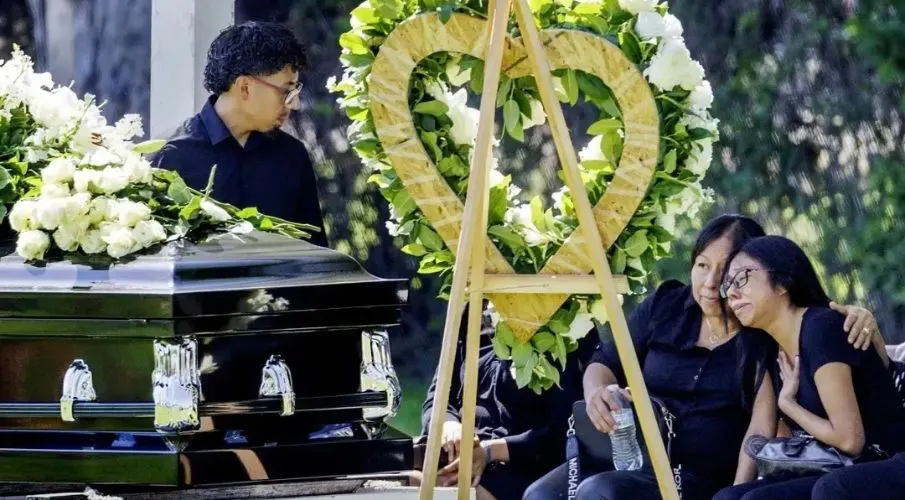
Two months after the arrest, Samuel took his own life. Early on the morning of August 12, San Bernardino police responded, and the 21-year-old was pronounced dead at the scene. In his farewell letter, he wrote that losing his mother to ICE had left him feeling as though he had hit one final wall. Then came the sentence addressed to the agent. Samuel was buried at the cemetery in Rialto, surrounded by friends and relatives.

His mother was still in detention when the family had to tell her that her son was dead. Sari had to wait until after an upcoming hearing, then was given about 10 minutes in a visitation room to tell her. As Minerva cried, the officers did not allow her daughter to hug her or even touch her. A state that holds a mother in detention denies her even her own daughter’s hand at the worst moment of her life.
Three days later, on August 31, a federal judge ordered her immediate release. The habeas petition was granted, and Minerva was released that same day. The court found that the Department of Homeland Security had unlawfully detained her “solely because of an error” by the agency. No immigration judge had ever found that she posed a danger or a flight risk. When government lawyers argued that she could remain locked up until she became eligible for a bond hearing months later, the judge called that prospect “more than cruel.” The detention had been cruel from the first day. The court found a word for it only when the government tried to prolong it.
Case Information
Mircheff
Alien Detainee
Habeas Corpus (federal)
Docket Entries
Release: August 31, 2026
Final court judgment: September 1, 2026
One individual agent has this letter on his conscience, but it was an entire apparatus that wrote it. It takes a woman off the street after 33 years while she is on her way to buy groceries and mocks her poverty because of the food assistance card in her belongings. It rations a goodbye to 60 minutes and refuses to let a daughter embrace her crying mother. In the end, it records a dead child as an error in a file. Nothing here went off the rails. This is how a state wears down people who were never on a wanted list.
The detention inflicted a second wound in the legal proceedings themselves. Minerva’s attorneys had prepared a motion to terminate the deportation case, based on the extraordinary hardship her deportation would have caused Samuel, her son and a U.S. citizen. They never got to file it. With his death, the legal path they had built around his need for his mother collapsed. The child whose protection was supposed to stop the deportation could no longer be protected himself. The hardship they would have had to prove in a deportation case had already happened, and it was worse than any legal filing could have captured.

Friends and relatives gather for Samuel Gonzalez Terrones’ graveside service at Rialto Park Cemetery.
By the time Minerva stood at her son’s grave in September, a court had already ruled that she should never have been detained that way. The order could not give back the two months Samuel spent without the mother who, according to the family, had kept him stable. It could not undo the decline his relatives had been forced to watch, and it could not erase the final letter in which the agent is named. The state corrected its error only after Samuel was gone. The case against Minerva is not over, and the damage to this family did not end with her release. On paper, it was an administrative error. In this family’s home, it is an empty room.
Out of respect for the family and at their explicit request, the story was only brought to a wider public in Mexico, the United States and Europe in recent days.
Amerika, was ist nur aus Dir geworden · America, what the hell happened to you? · América, ¿qué demonios te pasó?
Updates – Kaizen News Brief
Alle aktuellen ausgesuchten Tagesmeldungen findet ihr in den Kaizen Kurznachrichten.
To the Kaizen News Brief In English


Das ist erschütternd und unendlich traurig.
Diese Regierung und ihre „Helfer“ besitzen keine Empathie oder Gewissen.
Schrecklich…..
.. es ist so eine schlimme Tragödie, die man kaum noch beschreiben kann …
Einfach nur krank, was dort passiert(e)!