
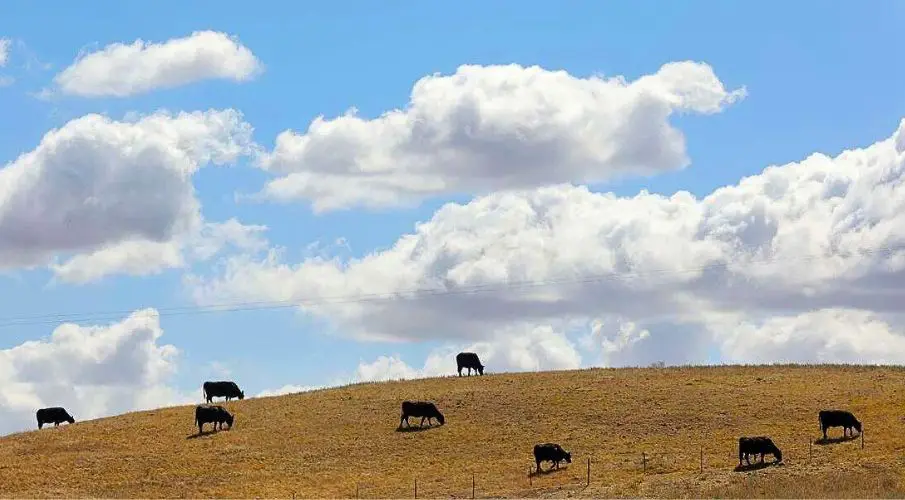
A post online takes seconds to write, but trust in what ends up on the plate grows over generations. Donald Trump said Friday on his Truth Social platform that farmers and ranchers have always been his top priority, that they work hard and are, as he puts it, "spotlessly clean." For years, he said, he has heard about their anger with the big processors, which many call a "nasty Monopoly." There are basically only 4 of them, a number that hardly qualifies as competition, and they make life miserable for farmers, something he cannot allow, as he himself added in the form of a question. To break their dominance, much of which is owned outside the United States, he is having legal documents drawn up that would give farmers and ranchers the right to slaughter and process their own animals in the future instead of using facilities inspected by the US Department of Agriculture. "This should move quickly," he wrote. Getting rid of something always moves quickly; inspecting was the slow part, and the slow part was the whole point. Calling farmers "spotlessly clean" while at the same time wanting to eliminate the inspection that guarantees that cleanliness is the contradiction carried in his own words.

The proposal was born 2 days earlier, on Glenn Beck's show. Beck, himself a cattle rancher, railed against a "meat-processing cartel" and demanded that the president "break the back" of those plants. Trump replied that this was a very big thing, that Beck had just given him a very good idea. This is how government policy gets made when praise in a studio is enough to set a law in motion. A president who gets his ideas from whatever conversation he had in the past hour turns the reach of chance into the policy of a country. What was a host's opinion on Wednesday is an assignment for the Justice Department on Friday. This time, the law is being put to work clearing things away, and the detour through the courts gives a whim the dignity of a legal process.

The inspection he wants to eliminate is the invisible thing behind every package. Nobody notices it as long as it works, and people only notice it when it is gone. The facility that stamps every animal is part of the quiet machinery that makes sure dinner does not become a danger. Between the farm and the kitchen stands a series of inspections nobody sees and whose absence everyone tastes once it is too late. What an inspection like that catches remains invisible and is still dangerous, a germ in the meat, an illness that only gets its name days later. If federal inspection disappeared, food would reach the plate without any trained hand having looked at it, and the result would be Americans getting sick more often. Illness does not care about political loyalties; it also hits the people who applauded the post.
The image of the independent farmer at his own slaughter block sounds like freedom, like a country that can take care of itself. But the knife nobody inspects anymore is also the knife that carries along what the eye cannot see. Slaughter with no second set of eyes watching saves the cost of care and passes the risk on to someone else's table. What one person saves, another pays for with their health, without ever having been asked. The loss of a safeguard is being sold here as liberation, and people only miss that safeguard once the first ones get sick. The price of independence is printed in small type, right where the inspection seal used to be.
Opposition came Friday from the National Cattlemen's Beef Association, the cattle producers' group. It supports more competition and more room for small and regional processors; unnecessary regulations can go too. But weakening federal meat inspections and food safety is not the answer. For generations, America's cattle producers have built consumer trust in domestic beef, and that trust should not be put at risk for a short-term political fix. When the very people whose freedom is supposedly at stake are the ones issuing the warning, the idea already carries its own contradiction. The association speaks for the same farms the president claims he wants to free, and they are explicitly asking to be spared. Trust is slow money; it gets paid in over years and can be blown in a single morning.

Nobody disputes that the complaint has a real basis. Four processors control around 85 percent of the market, Tyson Foods and Cargill from the United States, plus JBS and National Beef in Brazilian hands. The concentration is real, and the anger over it is justified. An animal a rancher spends years raising does not bring him much if a handful of buyers dictate the price. The few companies standing between pasture and grocery shelf push down the price paid to producers and raise the one at the register. The Justice Department already opened an investigation into those 4 in May, and in June the Agriculture Department made $60 million available to support small processors. The tools were already sitting on the table when the president reached for the quick answer. Instead of breaking up the concentration, the inspection is supposed to disappear; the roof gets hit while the weight on top of it stays exactly where it is.
The move also runs into another one that contradicts it in a peculiar way. The same administration wants to allow beef into the country tariff-free, a plan the American Farm Bureau Federation has sharply attacked. So far, the administration will not say which countries the beef is supposed to come from. The foreign ownership the president rails against when it comes to domestic processors, whose owners are in Brazil, is suddenly not supposed to bother anyone when it comes to imports. So the gate opens for beef of unknown origin while ranchers at home are supposed to butcher their own cattle. A market that is supposed to be protected from cheap imports and opened to them in the same breath soon no longer knows who it is supposed to serve.
Above all of it, prices keep rising. The shrinking cattle herd can barely keep up with demand, and farmers in the Midwest, long among the president's most loyal supporters, are in their worst crisis in decades. He tells them they should take care of it themselves from now on and calls hardship a gift. The people already standing at the edge are handed self-help as a present. A country that took a long time to learn to trust its own meat is supposed to give up that trust because a TV show wanted it that way. The inspection that protects them is supposed to disappear so things can move quickly, and nothing about this moves as quickly as the damage.
Updates – Kaizen News Brief
Alle aktuellen ausgesuchten Tagesmeldungen findet ihr in den Kaizen Kurznachrichten.
To the Kaizen News Brief In English


