
The sun sparkled on the waves off the coast of Alaska. Violet Anniskett was 19 years old when she spotted four walruses on the beach near Point Lay on September 11. All four lay motionless in the sand. She moved closer. One was noticeably smaller than the others. Its belly was moving. Then the animal opened its eyes. Violet was so startled she caught her breath. Three walruses were dead. The fourth was still alive.

It was a male calf about five months old. His mother was gone, and nobody knew how long he'd been lying among the carcasses. Polar bear tracks were visible in the sand all around him. Seagulls circled overhead, and the exposed flesh of an injured young animal was unlikely to have escaped their attention. Violet later recalled how quiet the little guy had been. Maybe that was what saved him from the bears. A living creature too frightened to move can still be fighting for its life, even while lying perfectly still.

Violet is a member of the Indigenous Iñupiat people and was doing an internship with Anthony Fischbach, a wildlife biologist with the U.S. Geological Survey (USGS). She called him over. Right in front of them, the baby walrus pressed his head against one of the dead bodies. Whether he was looking for comfort, nobody could know. Just watching him make that contact was hard enough. Fischbach later explained that female walruses and their calves come ashore along this stretch of coast every year. The three dead animals could have been killed in a stampede or by polar bears. The cause of death had not been established.

Simply picking up the little guy and carrying him away was out of the question. He already weighed 185 pounds, about 84 kilograms, at least as much as Fischbach himself. And then there was his slippery skin. So the two gently placed their hands against his back and tried to guide him away from the dead animals. Violet made walrus sounds. The unfamiliar noises were her attempt to reach a frightened animal in his own language. Whether he understood what she meant was impossible to say. But her voice seemed to calm him down. And then something happened that, amid all the despair on that beach, must have felt almost unreal: He followed them.
Violet later said she'd felt a connection, as though he knew they weren't going to hurt him. She'd had to earn his trust just as much as he'd had to earn hers. An animal probably born in May, who had likely never seen a human being and never felt grass beneath his body, went along with two strangers. They couldn't promise him anything. Still, he stayed with them. That was exactly what made this rescue so fragile. One step too fast, one touch too rough, and the little guy might have gone looking for shelter among the lifeless bodies again. Violet and Fischbach had to temper their own desire to get him to safety as quickly as possible with patience. For the animal, every yard was unfamiliar ground.

They found shelter in an abandoned building. Fischbach alerted the Alaska SeaLife Center, the only permanent facility in Alaska that cares for injured marine mammals. But a storm was approaching. Flying was becoming dangerous, and it would be roughly three days before veterinarians could arrive. For Violet and Fischbach, that marked the beginning of a task no internship could have prepared them for: keeping a baby walrus alive without his mother.
At that age, walruses feed exclusively on their mother's milk. The two had no suitable substitute. They mixed honey into water and gave it to the little guy while they waited for help. It was a makeshift solution under circumstances where simply making it to another morning was already a victory. Neither of them could replace his mother's milk or know when the experts would finally arrive. The animal depended entirely on their care. For a human being, a beach is a place you can leave whenever you want. For an orphaned baby walrus, that abandoned building near the ocean was, for the time being, his entire world. And the little patient soon developed some ideas of his own about how those days ought to be spent.

When Fischbach tried to set up his cot, the walrus claimed the spot for himself. Three times, he chased the biologist away. Eventually, Fischbach gave in. When you weigh almost 84 kilograms and make your wishes known with your entire body, you don't need much negotiation. But even the cot he'd conquered apparently wasn't enough for the little guy. Fischbach rolled out his sleeping bag, crawled inside, and closed his eyes.

A little while later, he felt something touch his shoulder. When he looked up, the baby walrus was standing over him. He was shivering. The little guy crawled into the sleeping bag, and the two spent the night in it together. Fischbach now had to share his warmth with a nearly 84-kilogram guest who had already fought him for the cot. The dispute over where to sleep had been settled in a way neither of them could have planned. Outside lay the coastline where his mother had disappeared. Inside, he could snuggle up against a human being who, just a few hours earlier, had been a complete stranger. Maybe all that mattered to this animal that night was that someone beside him was breathing again.

Meanwhile, the Alaska SeaLife Center was desperately searching for a plane. One operator wanted $100,000 for the flight, far more than the facility could afford. Eventually, they managed to charter an aircraft. Jane Belovarac, who oversees the care of rescued wildlife there, flew north with another veterinarian. They brought enough equipment for about a week in case the weather prevented them from flying back. They also brought a transport crate. After all, as Belovarac dryly explained, nobody wants a walrus roaming freely around an airplane.

After four days with his rescuers, the little guy was placed in the care of the Alaska SeaLife Center. The veterinarians first made sure he was getting enough fluids. But how do you teach a walrus to drink from a bottle when he's never even seen one? Belovarac knew how closely these animals live together. In their herds, they often lie piled on top of one another, constantly seeking physical contact. Here, though, was a lone calf surrounded by people he didn't know. The caregivers sat quietly with him and waited until he approached them on his own. It wasn't until the fourth or fifth day that he finally accepted a special milk formula from a bottle.

He was given the name Annautaq, pronounced roughly Ah-Nau-Tuk, after Violet's father, who is also Iñupiat. Spokeswoman Kaiti Grant reported that Annautaq was only the twelfth walrus calf to be successfully rescued in the Alaska SeaLife Center's 30-year history. A rescue like this, without the mother, rarely succeeds. But even after surviving the danger, Annautaq still needed somewhere he could grow up. Across the entire United States, only four facilities have the resources to care for walruses.
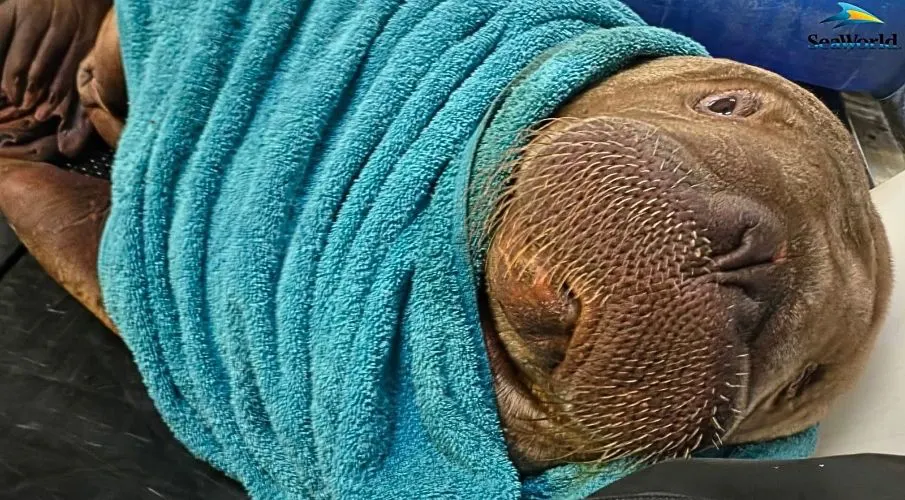
The choice fell on SeaWorld in Orlando, Florida. Uki, a female walrus rescued as a calf in 2024, was already living there. Annautaq now weighed around 252 pounds, about 114 kilograms. With his magnificent whiskers, he explored a purple tunnel filled with ice. He snuggled up to the staff, and videos of him delighted people on social media. He didn't know anything about Uki yet.
Now his path leads him down a concrete hallway. Behind a metal gate, another walrus was waiting. Annautaq raised his heavy young body against the metal bars. Uki waited on the other side. The two sniffed each other and touched one another with their whiskers. SeaWorld wrote alongside the footage that this was just the beginning.

A few weeks ago, Violet had spotted a tiny belly still rising and falling among dead walruses on a lonely beach. Now Annautaq stood in front of Uki, far from the ocean where he was born. Metal bars stood between them. Their whiskers could still reach each other.
(Footage: Alaska SeaLife Center, United States Geological Survey (USGS), SeaWorld Orlando)
Updates – Kaizen News Brief
Alle aktuellen ausgesuchten Tagesmeldungen findet ihr in den Kaizen Kurznachrichten.
To the Kaizen News Brief In English


Welch eine schöne und berührende Geschichte von gelebter Menschlichkeit in grausamen Zeiten, danke dafür. Annautaq, live long and prosper…
.., wir fanden diese Geschichte auch so richtig schön, und hatten das bereits seit September verfolgt …
Ich habe diese Geschichte schon länger hier auf Facebook verfolgt und bei jedem Video ging mein Herz so weit auf, wie ein Scheunentor.
Ich dachte nur: „Endlich ein kleines Wunder, das einen Hoffnungsschimmer gibt“ ❤