
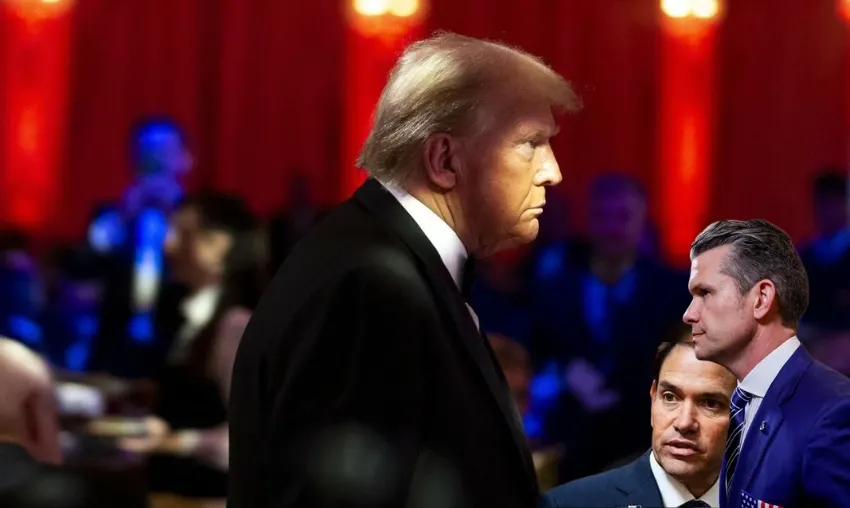
The deadline is here, the law is clear, yet nothing is happening in Washington. Sixty days after the start of military operations against Iran, Congress should have acted. Instead, it leaves town, once again rejects any limits on the war, and hands the decision entirely to the White House. Even those Republicans who raised doubts in recent weeks are now falling in line or waiting.
The basis is the War Powers Resolution of 1973, a law from the Vietnam era. It requires the president to obtain congressional authorization for military operations within sixty days or to end them. A one time extension of thirty days is possible, but that too requires clear communication. None of that has happened. Just before the deadline expired, the Senate rejected another Democratic attempt to halt the operation - for the sixth time.
The administration now claims the deadline no longer matters. Defense Secretary Pete Hegseth told the Senate that the current ceasefire means the clock has stopped. A senior administration official goes further and says the war is effectively over because there have been no direct combat operations since April 7. That claim, however, ignores what is actually happening on the ground: Iran still controls the Strait of Hormuz, while the U.S. Navy maintains a blockade to prevent Iranian oil exports. Military presence has not disappeared, it has only changed form.

In the Senate, two lines are emerging. Majority Leader John Thune makes it clear that he is not planning a vote on war authorization at this time. Other Republicans show more openness, but only under conditions. Kevin Cramer says openly he would agree if Donald Trump asks for it, but at the same time questions whether the law is even constitutional. The debate is not resolved, it is postponed. Some senators draw a line, at least rhetorically. Lisa Murkowski announces she will introduce her own bill after the recess if the administration does not present a clear plan. She emphasizes that military operations cannot run indefinitely without oversight. Susan Collins goes a step further and votes with Democrats against the operation for the first time. For her, the deadline is not a recommendation, but an obligation.
John Curtis, Thom Tillis, and Josh Hawley also signal that they want to see a vote. Curtis announces he will not support further funding without prior authorization. But all of these statements remain without consequence as long as no vote is forced. Democrats clearly reject the administration’s argument. Tim Kaine says the law leaves no room for an interpretation under which a ceasefire stops the clock. Adam Schiff points out that warships and military assets are still being used. For him, the key point is that the operation was never fully ended. Adam Smith puts it more bluntly: the expectation that this administration would follow the law was always low.
Legally, the White House position is also widely criticized. Attorney Katherine Yon Ebright of the Brennan Center calls the interpretation a significant expansion of previous arguments. Neither the wording nor the structure of the law suggests that a deadline can be paused by a ceasefire. Previous presidents tried to classify military operations as too limited to trigger the rule. In the case of Iran, that argument is difficult to sustain.
In the background, political pressure is intensifying. Rising energy prices are hitting the public directly and hard, dissatisfaction is growing. At the same time, Republican leadership sticks to its line of giving the president time. The result is a political condition in which a war is formally declared over while military measures continue and the legally required oversight does not take place.
Washington has made a clear decision without stating it. It is not only the president crossing a line. It is Congress choosing not to defend it.
Updates – Kaizen News Brief
All current curated daily updates can be found in the Kaizen News Brief.
To the Kaizen News Brief In English


Irgendwie auffällig, dass der Kongress immer abreist oder verfrüht in die Feroen geschickt wird, wenn es um wichtige unaufschiebbare Entscheidungen geht. 😞
Das „…Selbst jene Republikaner, die in den vergangenen Wochen Zweifel formulierten, ordnen sich jetzt ein ..“
Wundert mich überhaupt nicht.
So war es bisher die ganze Zeit.
Wenn es darum geht Farbe zu bekennen, knicken die Republikaner ein. Kein Rückgrat, Hauptsache Trump gefällt es.
Was passiert nun?
Läuft alles, entgegen des Gesetzes, weiter.
Der Argumentation Trump und Hegseths folgend, dass die Waffenruhe die Frist stoppt?
Werden sich die Demokraten endlich mal auflehnen und Klage einreichen?
Ggf mit diversen Organisationen in den USA?
Wenn das so durchgeht, dann kann sich der Kingress wegen Nutzlosigkeit auflösen und die USA sich offiziell Diktatur nennen.
…den kongress in dieser form kannst du auflösen