
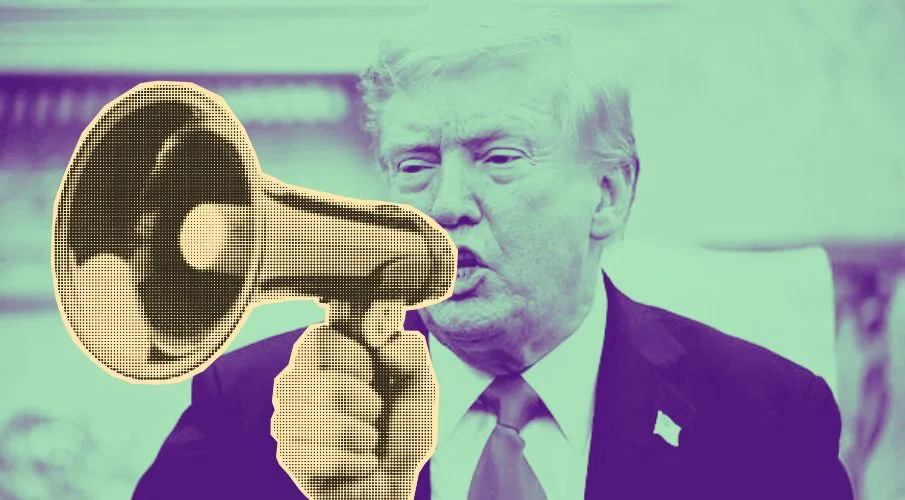
A trade war can be built on a number you simply make up yourself. Asked about plans for new talks with Canada, Donald Trump said in the Oval Office that US banks were not allowed to do business with the neighbor to the north. The claim is false. He praised "big, beautiful banks" and counted the Bank of Canada among the country's major banks, even though it is Canada's central bank, the counterpart to the Federal Reserve, not a competitor. Mistaking your neighbor's central bank for a rival is a bad starting point for judging its banking system. A false assumption becomes national policy. He said they had "6 or 7" big banks in the US, while American banks were not allowed to go over there. A false statement from the highest office travels faster than any correction, and it carries tariffs with it. An excuse does not need evidence, it just needs a microphone.
"They basically don't allow American banks to operate in Canada. That's sort of emblematic of the way they treat us. They have their banks here, the Bank of Canada, all their big banks - big, beautiful banks. I think they have six or seven major banks here. We don't have our banks there. You know why? They don't allow it."
The numbers say the opposite. According to the Canadian Bankers Association, 15 US banks are currently operating in Canada, either as branches or subsidiaries. Certain restrictions make it harder for them to compete up north, but they are not banned from the market. Going the other way, the latest Federal Reserve data show 8 Canadian banks operating in the United States. The rules slow them down, they do not shut them out. A difficult competitive environment does not mean the door is closed. Fifteen to eight, that is the real balance across the border. Banning and making things harder are two different things, and only the second is true. The claim of a ban falls apart against a registry full of names.
Those names are hardly unknown. They include J.P. Morgan Chase Bank and Citibank. Bank of America and Capital One are on the list. Wells Fargo does business there too. According to spokeswoman Nathalie Bergeron, their assets total around 124.6 billion Canadian dollars, more than half of what foreign banks hold in Canada. They serve customers with cross-border business as well as the domestic market, from corporate lending to mortgages. That does not look much like a locked door. A market that supposedly nobody is allowed to enter is already being served by some of the biggest names on Wall Street.
The reason the number is relatively small comes down to the economics, not a ban. James Thompson of the University of Waterloo in Ontario explains that US banks absolutely are allowed to operate in Canada, but the way they enter the market determines what they are allowed to do. Canada has 3 categories; Schedule I is for domestic banks, Schedule II and III for foreign ones. Most US banks enter under Schedule III, as branches with high minimum deposit requirements. Jeremy Kronick of the C.D. Howe Institute explains that those branches are not allowed to accept deposits below $150,000, making them largely useless as everyday banks; a Schedule II subsidiary, meanwhile, has to maintain its own capital in Canada, something that is rarely worth the cost for the bank. The categories show restrictions, not a gate with a lock on it. The difference between difficult and forbidden disappears in Trump's version.
The market itself explains the rest. The United States has more than 3,700 domestic commercial banks, while 15 of them are present in Canada. Six major Canadian banks hold more assets than the country's 28 smaller banks combined. Canada is a small market, Thompson says, and the established banks are large, with well-known brands and dense branch networks; for a US bank, building up a presence would be expensive and the eventual market share would be small. Canada's banks have grown over time, while American banks would have to start from scratch. It is not a law keeping US banks out, it is the size and familiarity of the competition. Competition makes that decision, not a government order. The entire truth of this issue lies between "not allowed" and "not worth it."
So the dispute begins with a mix-up. Trump mistook a central bank for a rival and a business decision for a foreign ban, then attached a trade war to it. The White House initially did not respond to a request for comment. That is how a dispute with billions of dollars at stake begins, with a mistake about a central bank. A fact-check can correct the number, but it cannot correct the anger. A mistake becomes policy, and policy becomes a tariff. Once a claim has been made, it keeps working no matter how many times it is disproved, and the tariff still hits even after the justification for it has long since fallen apart.
Updates – Kaizen News Brief
Alle aktuellen ausgesuchten Tagesmeldungen findet ihr in den Kaizen Kurznachrichten.
To the Kaizen News Brief In English


