
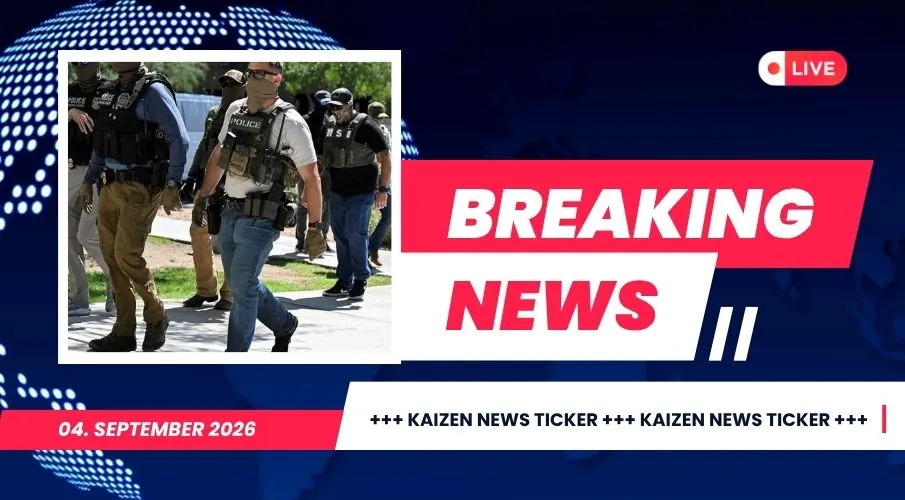
Today in the news briefs: New voting rules right as voting gets underway, another Supreme Court fight over mail-in ballots, Volkswagen planning to cut 50,000 jobs, a setback for Trump's new congressional map in Missouri, political roadblocks affecting flights between Russia and Israel, video games as government propaganda from the White House, and a Pentagon that pulled its own testosterone policy just days after rolling it out.
Trump goes back to the Supreme Court - with voting already starting, mail-in ballots could suddenly be subject to new rules

The Trump administration is once again trying to push through its new rules for mail-in voting just weeks before the midterm elections, and once again it is taking the fight to the Supreme Court. A federal judge had initially blocked the rules because it remains completely unclear whether the technical system the entire policy depends on is even ready to use. This is not some minor detail. It is a system that is supposed to process tens of millions of mail-in ballot materials and determine whether ballots are even sent out. The administration filed its emergency application the day before North Carolina was set to begin mailing ballots. From there, the most intense phase of the election is now beginning step by step in other states as well. Trump's order requires states to use a standardized envelope design and upload their lists of mail-in voters to an online portal. If the data there does not match the information on the envelopes, the materials are not supposed to be sent. That very portal apparently still was not working on Thursday. Federal Judge Indira Talwani repeatedly asked the Justice Department lawyer whether the system was even ready. She never got a clear answer. She finally said the administration appeared to be treating the upcoming election like a test run.
What makes this especially serious is that many election offices have already printed their envelopes and voting materials. For them, this would mean a complete change in the middle of an election process already underway. Election officials have been warning for weeks that the requirements would be nearly impossible to put in place in time. A whistleblower inside the Postal Service has also warned that faulty barcodes could cause entire batches of mail-in voting materials to be rejected. According to that account, a single technical error could be enough to keep tens of thousands of valid ballot materials from ever being sent. The Postal Service is also requiring all mail-in ballot materials to first be physically brought to postal facilities before they are sent to voters. The administration still describes these changes as manageable and lawful. Its argument is that states may run their own elections, but they cannot demand to use the federal Postal Service while at the same time ignoring its rules. Democrats, civil rights groups and voting rights experts argue that the president has no authority to rewrite election rules through an executive order. The Constitution gives that authority primarily to the states and, in part, to Congress. The Supreme Court lifted an earlier block in late August, but only because the Postal Service had not yet published its final rules at that point. The Court explicitly did not decide whether Trump's plan itself is legal.
After the Postal Service published the new rules, opponents immediately sued again. Talwani then temporarily blocked the rules once more. Now the administration is trying to get that block removed before the large-scale mailing of ballots begins. The timeline alone shows how close this has become. Justice Ketanji Brown Jackson gave the plaintiffs until September 8 to respond, meaning a Supreme Court decision is not expected before the middle of next week at the earliest. By then, mail-in voting procedures will already be underway in several states. It is also striking that not a single Republican-led state has publicly said it wants to use the new system voluntarily. Even among the 12 states defending Trump's authority to impose it in court, not one has announced that it plans to join voluntarily. When Missouri's representative defended the system, Talwani openly asked why a state would support a process that could cost its own voters their ballots. The ACLU says the entire rush is self-inflicted. Its attorney Sophia Lin Lakin put it this way: The only emergency is the one the administration created itself. Trump has fought mail-in voting for years and, after his 2020 defeat, repeatedly blamed it for election fraud without evidence, even though he regularly votes by mail himself. Now, immediately before a crucial congressional election, his administration is trying to impose a new system whose technical foundation is not even reliably working. The question is therefore not just whether the rules are legal. The much more immediate question is how many people will actually receive their voting materials if Washington launches an experiment in the middle of an election process already underway when even the administration itself cannot say whether the machine is actually running.

Volkswagen plans to cut 50,000 jobs - four plants are under pressure

Volkswagen Group's supervisory board has approved a sweeping restructuring plan that calls for cutting 50,000 jobs. The decision was unanimous. The cuts will not affect Volkswagen alone, but the entire group, including brands such as Porsche and Audi. Management says the move is driven by growing international competition, changing demand and the rapid pace of technological change in the auto industry. Internally, the company says its targets will be nearly impossible to reach without a significant reduction in its global workforce. Volkswagen has not yet given a specific timetable, and it is also unclear how the job cuts will be distributed across individual countries and locations.
The situation is especially serious at four German plants. According to the company, Emden, Zwickau, Hannover and Neckarsulm can no longer count on secure capacity utilization for the years 2031 through 2034. Volkswagen is already looking at other possible uses for those sites. That means this is not just about jobs, but also about the future of entire plants. The scale shows just how deep the cuts could go. Another 50,000 jobs on top of cost-cutting programs already underway would not be a minor adjustment, but one of the toughest restructurings in the company's history.
Volkswagen is not alone. Other major German automakers are also preparing job cuts. BMW recently announced plans to eliminate around 8,000 jobs by the end of 2027. Much of the pressure is coming from China, where German automakers made enormous profits for years but are now increasingly losing ground to domestic competitors. On top of that come US tariffs and the economic consequences of the war in the Middle East. For Germany's auto industry, it is becoming increasingly clear that the old certainties are gone. The Chinese market no longer carries the industry the way it once did, costs remain high, and new competitors are producing faster and cheaper. Volkswagen is now responding with 50,000 fewer jobs and an open question over which plants will even still be needed a few years from now.
Missouri Supreme Court blocks Trump's new congressional map - now voters themselves will decide

Missouri's Supreme Court has unanimously blocked the new congressional map backed by Donald Trump and ordered that voters in the state be allowed to decide the issue themselves. That means the map adopted after the 2020 census will once again be used for the November midterm elections. The new map was already used in the August primaries, but it cannot be used in the general election unless voters approve it. For Republicans, it is a rare setback in their nationwide effort to redraw congressional districts in the middle of the decade and gain additional seats in the House of Representatives.
The dispute began with a petition signed by more than 300,000 people. Opponents of the new map used it to demand that the issue be put to a vote. Republican Secretary of State Denny Hoskins declared only on the day of the primary that such a referendum was not even allowed when it came to congressional districts. A lower court initially sided with him. Missouri's Supreme Court has now overturned that decision. The justices said the petition was legal, sufficient and filed on time. That means the law establishing the new districts never took effect and cannot take effect unless voters approve it. That is exactly what Republicans had not expected. The 5th Congressional District around Kansas City is especially affected. Democrat Emanuel Cleaver has held that seat for years and won at least 60 percent in each of the last two elections. After Trump urged Republican-led states to redraw their districts to their own advantage, Governor Mike Kehoe had the district stretched far east into rural, heavily Republican areas. According to an Associated Press estimate, around 59 percent of voters in that district would have been new. The goal was clear: make Cleaver's seat competitive and give Republicans another advantage in the House of Representatives.
Republicans are reacting accordingly. Attorney General Catherine Hanaway is calling it a "complete constitutional crisis" and says she will immediately appeal to the United States Supreme Court. Hoskins said he would continue the "war to preserve our constitutional republic." Republican candidate Rick Brattin claims the ruling effectively takes away the votes of thousands of primary voters because they will now once again end up in different districts. Cleaver sees it the other way around: People fought back against an attempt to politically silence their neighbors, and they won. That is exactly what this is about now. Politicians will not be the only ones deciding what the districts look like. For the first time in this fight, the voters themselves will.
Russia denies El Al flights to St. Petersburg - apparently in response to Aeroflot ban

Russian aviation authorities have apparently refused to allow Israeli airline El Al to begin direct flights between Tel Aviv and St. Petersburg. The route was supposed to provide an alternative to suspended flights to Moscow after El Al scaled back its Russia service because of drone attacks and repeated restrictions at Russian airports. According to reports from Israel, Moscow justified the decision by pointing to the fact that Israel still does not allow Aeroflot to fly to Tel Aviv. Israeli transportation officials see this as an attempt to pressure Jerusalem and punish the country for restrictions that have kept Aeroflot out for years.
The timing is especially striking. Just hours earlier, Russian media had still been reporting that direct flights between Tel Aviv and St. Petersburg were about to begin. El Al itself suspended its Moscow flights on June 25 after several drone attacks and later extended the suspension through at least October 22. Direct flights between Russia and Israel still exist, but they are currently operated by the Russian airlines Red Wings and Azimuth. Aeroflot, meanwhile, has not flown to Israel since the spring of 2022. The Russian side has argued for years that Israel is keeping Aeroflot out by citing European safety requirements and blacklists. Israeli aviation authorities have not ruled out Aeroflot's return in principle, but the decision apparently rests with the Foreign Ministry. A normal airline route has now become a political pressure tool. El Al wanted to return to St. Petersburg after more than eleven years, but the route is now caught up in a dispute that has very little to do anymore with demand or commercial viability.
For travelers, that leaves an unnecessarily complicated situation. El Al is avoiding Moscow for security reasons, St. Petersburg is being blocked for political reasons, and Aeroflot remains shut out of Israel. In the end, flight routes are not being opened where people need them, but where governments believe they can use them as bargaining chips against each other.
The White House is turning Trump's policies into video games - including wall-building and MAGA Sega

The White House has released five simple retro video games on its official website promoting different parts of Donald Trump's political agenda. Under the name "Arcade," there are now games styled after old classics that build political messages directly into the gameplay. "Build the Wall" is modeled after "Tetris" and turns the familiar stacking game into a mission to protect the border from a supposedly approaching mass of people. In "Rio Run," which is similar to "Snake," a Trump character moves across the screen collecting suspected border crossers. Government messaging is being turned into entertainment, except this time it is coming directly from the White House.
Other political projects have also been turned into games. In "Supply Line," food moves along a conveyor belt and the player is supposed to remove products that do not meet "Make America Healthy Again" standards. "Flappy Bill" has an eagle carrying a piece of legislation across the National Mall. In "Trump Savings Tycoon," players collect money to fund the so-called Trump Accounts for children. That savings program provides $1,000 for every child born during Trump's term in office. The games are technically simple, but the political message is not hidden. It is built directly into the task, the objective and the language. The promotion makes it even more obvious. The White House released animations imitating the startup screens of Xbox, PlayStation and Nintendo. In one post, the familiar Sega logo is simply turned into "MAGA." The administration is not just using the style of old video games, but deliberately borrowing familiar imagery from pop culture to make Trump's politics easier, more playful and, above all, more shareable.
The fact that a government is selling its own agenda through five little video games is unusual enough. Even more striking is how openly political language and enemy images are built into them. Border policy becomes a points game, building the wall becomes a skill challenge, and government savings plans become an arcade objective. The White House is no longer presenting politics only through speeches and press releases, but as something people are supposed to click, play and share.
Pentagon pulls testosterone policy for US troops just days after rolling it out

The Pentagon has temporarily pulled newly published guidelines calling for mandatory testosterone screening for US service members. The document containing the new medical recommendations had already been published on the websites of the Defense Department and the Defense Health Agency. On Thursday, both the guidance and the accompanying statement from Pentagon spokesman Sean Parnell disappeared. Anyone trying to access the old pages now gets a "page not found" message. According to people inside the department, the policy is being revised and is expected to return later in a new version. Until then, the previous interim medical guidance remains in effect.
The withdrawn version would have significantly changed medical screenings for service members. Screening for possible testosterone deficiency was supposed to begin immediately and become part of annual health examinations for both men and women. Men over 30 were first supposed to fill out a questionnaire. If the answers suggested testosterone levels might be too low, blood tests could then be ordered. If a deficiency was confirmed, testosterone treatment could also be considered. Women were likewise supposed to begin with a questionnaire. Treatment could then be considered for hormone-related conditions. Testosterone was specifically listed as a possible treatment for abnormally low sexual desire.
Defense Secretary Pete Hegseth had announced the plans back in July and had previously spoken publicly in favor of testosterone. That raised questions among doctors early on because there is still very little solid evidence supporting widespread screening of otherwise healthy service members. Doctors also warn that mass testing will inevitably identify abnormal values in people who do not actually have symptoms requiring treatment. That increases the risk of service members receiving medications they do not medically need and that can come with side effects. So far, there is no solid evidence that testosterone screening across large parts of the armed forces would improve military readiness.
Then there is the timing. In mid-September, the US Food and Drug Administration is scheduled to hold an expert meeting on the medical use of testosterone. So the Pentagon published sweeping new guidance while the medical debate over its benefits, risks and proper uses is still ongoing. Now the document has disappeared again, at least for the time being. It remains unclear whether only individual sections will be changed or whether the entire plan will be rewritten.


Danke für die guten Artikel.
Nicht nur Trump rennt zum Supreme Court, nein auch die republikanischen Bundesstaaten, wenn ihnen das Ergebnis des eigen Supreme Court nicht gefällt.
Sabotage der Midterms auf allen legalen (und illegalen) Wegen.
Man kommt aus dem Kopfschütteln nicht raus.