
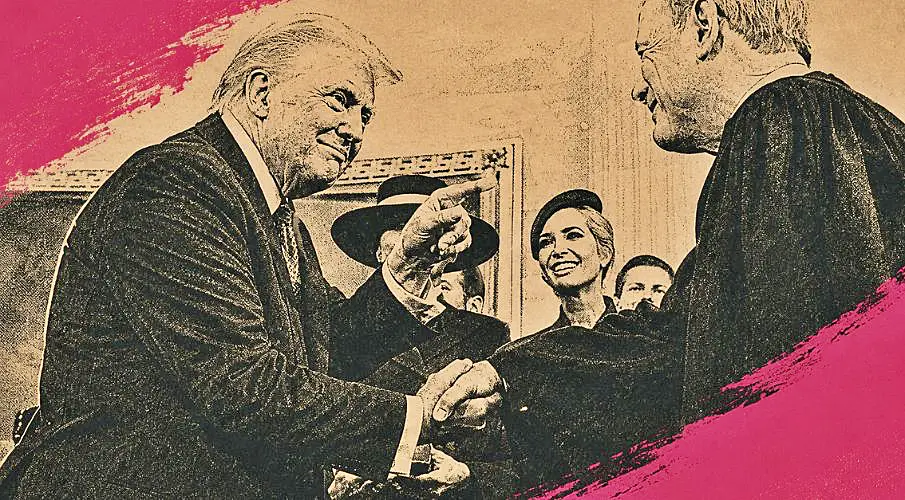
There are moments in the history of a democracy when what it still is is decided not by noise, but by silence. June 29, 2026, was one of those moments. In a single Monday, the Supreme Court of the United States reshaped the distribution of power in America more profoundly than any election in decades. Six conservative Justices dismantled a ninety-one-year-old foundation of the constitutional order. Three liberal Justices dissented. The record reflects no debate, no compromise, no middle ground. Only: six to three.
The ruling that changed America the most that day is not called Carroll and not Cook. It is called Humphrey's Executor - and most Americans have never heard of it. That is no accident. The law has its deepest impact where it remains invisible.
Since 1935, the United States has operated under the principle that a President cannot remove the heads of independent federal agencies at will - that there must be cause before someone responsible for regulating markets, protecting workers, or shielding consumers from monopolies can be dismissed. That principle was never about protecting agency officials themselves. It protected the idea that certain government decisions should be made without regard to the political winds of the day. It was the legal expression of an idea Montesquieu had articulated two centuries earlier: that liberty dies where the same hand both creates and enforces power - where political will and government oversight become concentrated in a single person. In 1935, Franklin D. Roosevelt tried to remove a member of the Federal Trade Commission and lost. From that point forward, the independence of those agencies became settled law. Ninety years of legal history erased in one Monday.
This principle is now history
The ruling came in the case of Rebecca Slaughter, the former Federal Trade Commission commissioner whom Trump removed without explanation even though federal law explicitly requires cause for dismissal. Slaughter had previously served as chief counsel to Senate Majority Leader Chuck Schumer. The Court's reasoning automatically extends to the National Labor Relations Board, the Merit Systems Protection Board, and the Consumer Product Safety Commission, where Trump had also dismissed members. Chief Justice John Roberts, writing for the conservative majority, concluded that such removal protections violate the separation of powers established by the Constitution. It is a sentence that argues the opposite of what it says: that the separation of powers is strengthened by freeing the executive branch from meaningful institutional restraint.
Trump celebrated the decision on Truth Social: "It is my Great Honor to have WON this Historical and Unprecedented Case, one of the most important ever brought before the Supreme Court with respect to Presidential Power." In that respect, he is right. No President before him had ever attempted to bring these independent agencies under direct presidential control. None had even seriously tried because the political cost was considered too high. Trump has demonstrated that the cost no longer exists.

Justice Sonia Sotomayor read her dissent aloud from the bench - a step Justices reserve for decisions they consider historically significant. It was already the second time in just a few days that she had done so - following her dissent in last week's TPS decision that stripped deportation protections from 350,000 Haitians and 6,100 Syrians. That Sotomayor chose to read from the bench twice in one week has no recent parallel in the Court's modern history. "The President emerges with more power than ever before. That power has been given to him by six Justices of this Court, not by the people or by the Constitution," she said. She warned of "subservience, instability, and even oppression." In the presidential immunity decision in 2024, Justice Neil Gorsuch wrote that the Court was issuing a ruling "for the ages." Sotomayor appears to understand exactly what those ages may look like. FCC Commissioner Anna Gomez, one of the few Democratic commissioners to remain after Trump's wave of dismissals, warned that consumers would "pay the price" through higher costs, fewer choices, and slower progress. Schumer put it bluntly: Trump had been handed "a free pass to turn independent federal agencies into country clubs for his golfing buddies and political loyalists." Slaughter, he added, had been fired because she was doing her job protecting consumers.

The only exception the Court made involved the Federal Reserve - and it is significant because that is where the Court drew the line, where global financial markets are directly affected. By a five to four vote, the Justices ruled that Federal Reserve Governor Lisa Cook may remain in office while she challenges Trump's attempt to remove her. Roberts wrote that her immediate dismissal would mean a President could remove a member of the Federal Reserve at any time, for any reason, without notice and without judicial review. "That would reduce removal protection to mere at-will employment."

Donald Trump claimed that the Supreme Court had merely sent the Lisa Cook case back on procedural grounds and announced that he would immediately take further action to remove her from office. Even though no court has made any final finding regarding the allegations against Cook, Trump publicly declared that someone who has "committed wrongdoing" should not be making vital decisions for the United States - effectively prejudging the outcome before the legal process has run its course.
Cook was dismissed by Trump last August. The alleged reason, one she says is entirely fabricated, was that she listed two properties in Michigan and Georgia as her "primary residence" on mortgage applications in 2021, allowing her to qualify for lower interest rates. Cook has denied any wrongdoing and has never been charged with a crime. Solicitor General D. John Sauer - the same attorney who previously argued as Trump's personal lawyer that a President could theoretically order the assassination of a political rival, and who now represents Trump's cases before the Supreme Court - described the documents as evidence of "gross negligence at best." In her own statement, Cook left no doubt about what she believes is really at stake: "This was never about mortgage documents. It was an attempt to remove me under a false pretext because I refused to yield to political pressure and continued setting interest rates based solely on what is best for the American people."

Trump responded that he would "take appropriate action immediately." Roberts noted in a footnote that nothing prevents Trump from "trying again," provided Cook is given proper notice. The door has been left ajar. Trump has already announced that he intends to walk through it. The purpose behind this campaign has never been a secret: Trump wants lower interest rates. The Federal Reserve has kept its benchmark rate unchanged this year while a growing number of central bankers have even discussed raising rates because inflation remains stubbornly high. Trump had previously threatened to fire former Federal Reserve Chair Jerome Powell. The Justice Department even opened a criminal investigation into Powell before quietly closing it just as Kevin Warsh's confirmation as the next Chair moved forward. Cook, the first Black woman ever to serve as a Federal Reserve Governor, was supposed to become the next target. For now, she has not.
In the day's second major ruling, Trump lost. By a five to four vote, the Court ruled that states may continue counting mail ballots that arrive after Election Day as long as they were postmarked by Election Day. The decision preserved election laws in nearly thirty states and the District of Columbia from being forced to change just months before the November 2026 midterm elections. Justice Amy Coney Barrett wrote the majority opinion, joined by Roberts and the Court's three liberal Justices. The federal statutes establishing a single Election Day, Barrett wrote, "leave open when those ballots must be received." Congress remains free to change that rule if it chooses.

Trump called the ruling "a GREAT LOSS" and publicly named five Republican Senators whom he blamed for blocking his SAVE America Act: Lisa Murkowski, Susan Collins, Thom Tillis, Bill Cassidy, and Mitch McConnell. The legislation would effectively eliminate widespread mail voting and require proof of citizenship during voter registration. "There is only one reason to be against it - FRAUD!" Trump wrote. More than sixty court decisions, along with Trump's own Attorney General at the time, William Barr, concluded that there had been no widespread election fraud in the 2020 election. California Secretary of State Shirley Weber called the ruling "a victory for voters, the rule of law, and democracy." Stephen Richer, the former Republican election administrator for Maricopa County, described it as "a sigh of relief" for election officials across the country.

At the same time, the Court agreed to hear a challenge involving Arizona election laws enacted after the 2020 election that require strict proof of citizenship. Lower courts had ruled those laws conflict with federal law. Trump joined the appeal. Arizona had already attempted to enforce a similar law in 2013, but the Supreme Court struck it down. Today, Arizona still allows people to register as "federal-only" voters without proof of citizenship, while state and local elections require additional documentation. In 2024, the Court had already handed Republicans a partial victory by temporarily allowing the citizenship requirement for state elections. Now it will decide the issue in full. The Court will hear the case after the 2026 midterm elections, meaning the challenged laws will not directly affect voting this November. Available data show that voting by non-citizens in the United States is extraordinarily rare. Trump's repeated claims that millions of non-citizens voted illegally have never been substantiated by any court.
In the Carroll case, which we covered in detail earlier today in "The Verdict Stands: A Jury Found Trump Liable for Sexual Abuse - And No Court Has Overturned It," the Supreme Court rejected Trump's petition without explanation and without a single recorded dissent. Not one of the nine Justices believed the case even warranted review. Trump's attorneys argued that allowing testimony from two additional women who also accused Trump of sexual misconduct had been "highly inflammatory." Carroll's attorney, Roberta Kaplan, wrote that the issue was "not worthy of review." The Court remained silent - and in this case, silence meant agreement. Trump's attorney, Justin Smith, who argued that "this mistreatment of a President cannot be allowed to stand," has since been nominated by Trump to serve on a federal court of appeals. Trump declared that he would continue fighting "with all my strength and power." Carroll responded that his "repeated appeals have all failed." The $5 million judgment remains in place. The separate $83.3 million judgment is still pending before an appellate court.
Finally, the Court also rejected Alan Dershowitz's $300 million defamation lawsuit against a news network. Dershowitz, who defended Trump during his first impeachment trial, argued that the network had distorted one of his statements regarding presidential power. Justices Gorsuch and Thomas dissented from the denial of review and urged the Court to reconsider the landmark 1964 decision in New York Times Co. v. Sullivan, which established the high legal standard that public figures must meet in defamation cases. Their effort failed - this time.

What this Monday ultimately means cannot be measured by wins and losses alone. It is not a simple story of victory or defeat. Trump reshaped the structure of the American government more fundamentally in a single day than any President since Franklin D. Roosevelt - ironically, the very President whose failed attempt to remove a federal official in 1935 led to the legal protections that six Justices have now dismantled. History is rarely this precise in its irony.
And yet, on the same day, Trump lost to a woman he insists he never assaulted. He lost to a Federal Reserve Governor he accused of mortgage fraud. He lost to the millions of Americans who vote by mail. The large and the small stand side by side on this Monday - and the small is not small at all. Carroll represents every woman who stood up to a powerful man and refused to back down. Cook represents every public servant who chose to do her job without yielding to political pressure. Mail voting represents every citizen for whom access to democracy cannot simply be taken for granted.

On Truth Social, Trump celebrated, threatened, and singled out members of his own party by name. He hailed the Humphrey's Executor ruling as a historic triumph while never mentioning that the very same Court rejected his Carroll appeal without a single dissent. He called the mail voting decision "a GREAT LOSS" but never explained what specific fraud he was referring to - because the answer remains the same: none that has ever been proven. He announced that he would try once again to fire Cook, but never explained what new justification he would use. Roberts left that door open in a footnote. It may be the most polite invitation to expand presidential power ever hidden inside a judicial opinion.

The fact that Alan Dershowitz also lost his $300 million defamation lawsuit against a news network almost became an afterthought. Yet the decision carried an important message beneath the surface. Justices Gorsuch and Thomas urged the Court to reconsider the landmark 1964 decision in New York Times Co. v. Sullivan, which has long set a high constitutional standard for defamation lawsuits brought by public figures. Their effort failed today. But Gorsuch and Thomas made clear where they believe the law should go. Trump himself has repeatedly declared that he wants to "open up" America's libel laws. Today, two Justices he appointed voted to begin moving in that direction.
That is the defining feature of this presidency: it keeps score only of its own victories. What was permanently lost on this Monday does not appear in Trump's Truth Social posts. It appears instead in Sotomayor's dissent, which she read aloud from the bench for the second time in a single week because she understands that silence is no longer an option. From the bench, Sotomayor said that this power was not granted to the President by the American people. That is the sentence that will endure. Six Justices answered a question that no election had ever asked - because no election had ever asked whether a President should be able to dismantle an independent agency charged with protecting consumers simply because he wished to do so. That question never appeared on a ballot. The answer is now written into federal law. Ninety years of legal history erased in a single afternoon.
Trump praised himself, celebrated, and threatened people on Truth Social - all in one day. He was talking about Cook, Carroll, mail voting, and five Republican Senators. He could just as easily have been talking about the Republic itself.
Updates – Kaizen News Brief
All current curated daily updates can be found in the Kaizen News Brief.
To the Kaizen News Brief In English


Jemand der Unrecht begangen hat, dürfe keine wichtigen Entscheidungen für die USA treffen … und was mit ihm, mehrfach verurteilt wegen diverser Straftaten ?
Wie kann man Trump noch mehr Macht geben?
Wo er sie jetzt schon schamlos ausnutzt.
Legal, aber auch nicht legal.
Dennoch spricht sich der Supreme Court mehrheitlich dafür aus, dass ein Präsident künftig Behördenleiter nach belieben entlassen kann.
Cook hat nur einen Aufschub, dank Robert’s Fußnote.
Und auch das Thema Verleumdnungsklageschutz ist noch nicht vom Tisch.
Wahrscheinlich werden die Richter, die gegen die Klage gestimmt haben, jetzt „bearbeitet“.
Durch die Überprüfungsanordnung eines anderen Supreme Court Urteils halten sich Trumps Loyalisten im Supreme Court die Tür offen, das Ganze nochmal aufzugreifen und anders zu entscheiddn.