
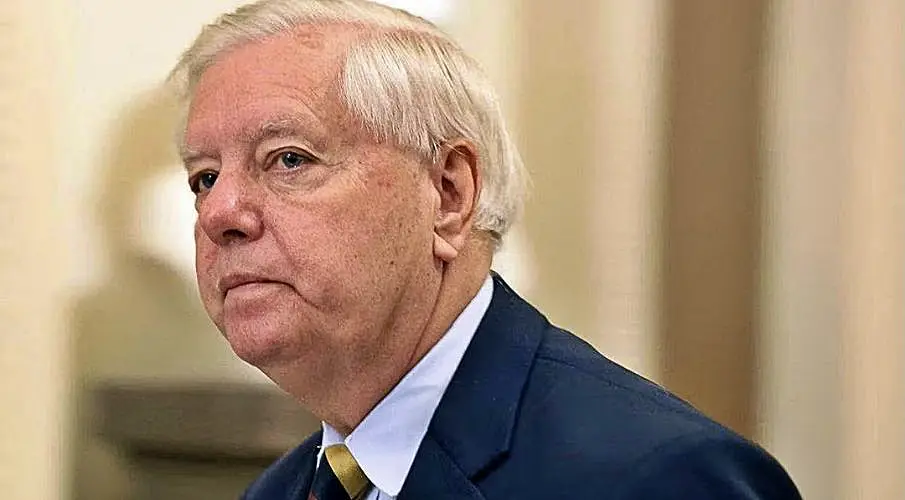
As we reported yesterday morning Central European Time on the death of Lindsey Graham, the preliminary medical explanation for his death has now become known. Lindsey Graham is dead, two days after his 71st birthday, from a tear in the aorta, the major artery that originates directly from the heart and supplies blood to the body. His office initially spoke only of a sudden illness. The preliminary finding of the medical examiner has now been released: an aortic dissection, aggravated by hardened arteries. If the aorta ruptures completely, the body loses so much blood within minutes that the heart comes to a stop, a cardiac arrest against which even rapid emergency treatment is often powerless. The official cause of death will not be determined until toxicological and microscopic examinations have been completed.
Read also our report in the Short News from July 12, 2026.
Anyone who watched the senator from South Carolina over more than three decades will recognize a bitter irony in the way he died. Graham was the man who called Trump unfit for office in 2016 and harshly condemned him after his attacks on John McCain. He was also the man who stood on the Senate floor on the evening of January 6, 2021, declaring that he was out, that enough was enough. And he was the man who returned only weeks later, became the president's most reliable foreign policy adviser, and was regularly seen beside him on the golf course, while McCain, his closest friend in the Senate, remained a critic until his death.
Alexis de Tocqueville wrote in the nineteenth century that in American democracy, personal loyalty often outweighs institutional office, that friendship can erase the distance from power that a republic actually requires. Graham's career reads like a commentary on that observation. He himself explained his change of course in 2018 by saying that McCain had taught him that one must help the duly elected president. As he put it, one could be a better critic while also being seen as helpful. That logic became a guiding principle that transformed him from a prosecutor during Bill Clinton's 1998 impeachment into Trump's most loyal defender through two impeachment proceedings.
Most recently, Graham was the leading voice defending America's willingness to wage war. Just last Friday, he traveled to Kyiv, where, according to Ukrainian President Volodymyr Zelenskyy, he had visited the country ten times since Russia's invasion in February 2022. Zelenskyy called him a true defender of freedom. Israeli Prime Minister Benjamin Netanyahu likewise honored him as a friend whose understanding of the inseparable security of both nations had been irreplaceable. That same Friday, Graham announced an agreement with the administration on a package of sanctions against Russia, a measure that Democratic Senator Richard Blumenthal said Graham had worked on with genuine enthusiasm.
Graham was also one of the strongest supporters of Trump's war against Iran and defended even the fragile ceasefire reached in June, while members of his own party warned against billions of dollars in payments to Tehran. He said he preferred attempting diplomacy rather than ruling it out from the beginning. That willingness to justify every foreign policy reversal by the president after the fact became characteristic of the second half of his political career. Domestically, as chairman of the Senate Budget Committee, he led the reconciliation process that allowed Republicans, with their narrow 53 to 47 Senate majority, to pass major legislation without the possibility of a Democratic filibuster. Earlier, as chairman of the Senate Judiciary Committee, he oversaw the confirmation of Amy Coney Barrett to the Supreme Court in 2020 and had already announced that, if Republicans retained control after the midterm elections, he intended to confirm as many conservative judges as possible.
It remains remarkable that this same man was part of the bipartisan group in 2013 that pushed a comprehensive immigration reform bill through the Senate with 68 votes, including a pathway to citizenship for people without legal status. The House of Representatives allowed the legislation to die. That episode fits uneasily with the foreign policy hawk who later integrated himself without objection into an administration whose immigration policy pursued the exact opposite course.
Graham never married and had no children. He grew up behind the counter of a bar in South Carolina, where, after the early deaths of his parents, he helped raise his younger sister, Darline. In June, he won the Republican primary with 57 percent of the vote and was set to face Democrat Annie Andrews in November. Governor Henry McMaster must now appoint a successor, with a special election to follow within weeks. Possible candidates include Representatives Nancy Mace, Ralph Norman, and Russell Fry, as well as Lieutenant Governor Pamela Evette.
In the end, the obituary of this senator must tell the story of two different men: the one who followed McCain and maintained his distance from power, and the one who learned that political proximity to power yields greater rewards than steadfast adherence to principle.
Updates – Kaizen News Brief
All current curated daily updates can be found in the Kaizen News Brief.
To the Kaizen News Brief In English


Das einzig Gute war sein Kreml-kritischer Kurs und seine Unterstützung für die Ukraine.
Mehr Gutes ist nicht zu sagen.
Daher schweige ich.
Von Trump gewünscht wird jetzt Grahams Schwester den Posten übernehmen. Bis zum Ende von Grahams regulärer Amtszeit Anfang nächsten Jahres.
Eine Frau ohne jegliche politische Erfahrung.
Eine Frau, die Trump sicher perfekt für seine Kongressvorhaben manipulieren kann.
Vetternwirtscgaft.
Wie in Königshäusern wird ein Posten quasi vererbt.