
The detention system in the United States has grown faster than anyone planned for it. Since January 2025, Immigration and Customs Enforcement, ICE, has driven its capacity up at a pace that basic order could not keep up with. The U.S. Government Accountability Office, GAO, says the agency pursued 6 major expansion projects involving billions of dollars without the planning that sums like that demand. There was plenty of money. For the people behind the fences, the basics were missing. From the start, there was a gap between the money and the people being locked up, and nobody closed it.

Another nightmare: the Adams County Correctional Facility in Mississippi.
Congress gave ICE around $45 billion just for detention capacity through fiscal year 2029, part of roughly $75 billion the 2025 spending law allocated to the agency. As soon as the money started flowing, the number of people in detention went up. On January 20, 2025, an average of 39,314 people were being held. By April 1, 2026, that number had climbed to 67,204, an increase of 71 percent. The number of authorized facilities rose from 134 to 239. In a matter of months, something a country under the rule of law should take time with had nearly doubled. There was no plan behind it. The GAO said it could not identify fixed goals, neither for the scale of detention nor for the types of facilities. How long-term costs should be assessed, and whether expensive new construction should be chosen over cheaper space already available in the system, was left open too. That lack of planning alone had already cost millions, according to the watchdog. Building without a goal gets expensive, and both taxpayers and the people being locked up paid for it.
The warehouse purchases show it most clearly. Starting in late 2025, ICE bought warehouses around the country to turn them into detention centers, with as many as 24 planned. Between January and April 2026, the agency bought 11 of them for around $1.07 billion. By June, officials said 7 would be sold again. Walking away was not free. ICE reported $7.7 million in nonrefundable purchasing costs for those 7 warehouses, plus another $12.8 million through August for electricity and security. More than $20 million, before any additional loss from selling buildings for less than the $707 million paid for them. Bought to hold people, put back on the market before a single person ever sat inside.

The waste did not stop with the warehouses. The expansion reached military installations and temporary camps, federal prisons and state-run sites, wherever beds could be found. At Guantanamo Bay, millions went into preparing immigration detention space, including tents that were later taken down after the Department of Homeland Security, DHS, decided they did not meet ICE's own detention standards. The site was occupied far below the capacity officials had publicly boasted about. Tents for people, put up and torn down again before the agency itself considered them fit for use.
The largest camp is in Texas. Camp East Montana at the Fort Bliss military installation near El Paso became ICE's biggest facility. The U.S. Army and ICE rushed it into operation, according to the GAO. The $1.3 billion contract was awarded through a procurement process that had never before been used for detention services, to a company with no experience at all in detention. The camp opened in August 2025. The order was to fill beds, the rules came afterward, when they came at all.
People were housed there before ICE had met its own requirements and completed the facility's inspection. Cameras along the perimeter fence were missing, and so was an outdoor recreation yard. There was no adequate space for visits from attorneys and family members. After the facility opened, ICE itself reported more problems, including gaps in medical care and unsanitary conditions, and a loaded firearm went missing. Serious risks for both detainees and staff, the GAO concluded. A loaded gun disappears inside the country's largest detention camp, and nobody took that as a reason to stop and think.

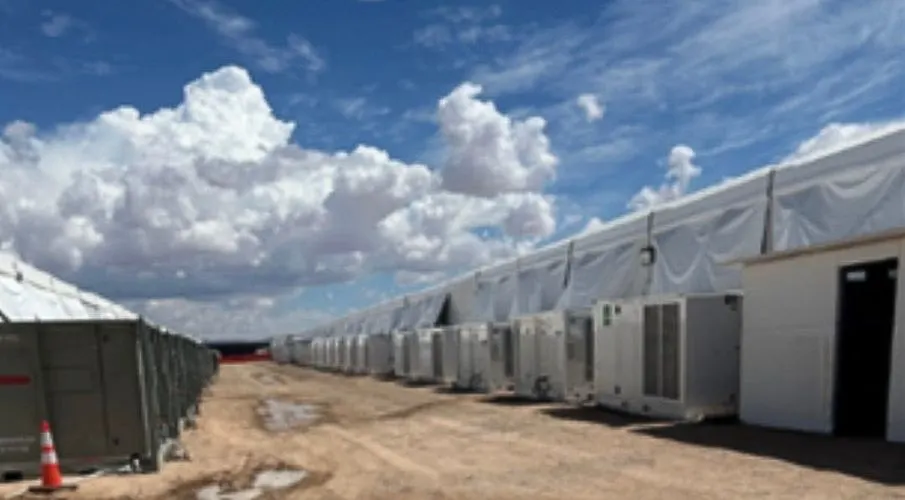
Air conditioning units outside the detention areas at Camp East Montana in Fort Bliss, Texas. Dozens of individual outdoor units cool the detention areas in the Texas heat. From an energy standpoint, it is a crude solution: high electricity use, a lot of waste heat directly on the grounds, and instead of an efficiently planned central cooling system, row after row of individual units. How efficiently the specific units actually operate cannot be determined from the photo alone.
At the same time, ICE was paying for services nobody needed. The original contract called for payments for meals and operations that did not go down when occupancy fell far below the 5,000-bed capacity. It still required full payment even when there was not a single person being held at the facility, and even after the contractor changed, payments for unnecessary meals kept going. Better pricing rules could save tens of millions of dollars, the GAO estimates. Meals for empty cells while the full ones are missing a doctor. The same contradiction runs through the entire expansion. Billions were available for buildings and beds. Inside, investigators found no outdoor recreation and visitation rooms that were too small. There were also gaps in medical care and filth. Security and oversight remained weak. Where the money went shows what mattered, the walls and the beds. The speed at which they went up mattered too. The people inside came last.
Heather MacLeod, who handles homeland security and justice issues at the GAO, described the whole thing as a broad failure of planning. The office recommended that ICE create a comprehensive plan for goals and resources. The Department of Homeland Security agreed, but ICE does not expect to finish it until August 31, 2027. Faster action would be better, the GAO warned, given the amount of money involved and the risk of further waste. Senator Dick Durbin called the findings incompetence and waste and demanded that DHS and ICE be held accountable. The department defended the pace, saying it was moving quickly and cheaply to carry out the administration's mass-deportation policy. The money had a purpose, lock more people up faster, and it accomplished that goal while everything else fell short.
The question of responsibility goes far beyond 7 warehouses and a few meal contracts. Why did a system holding tens of thousands of people grow with such urgency before the oversight and protections needed to support it were in place? For the people being held, bad planning hits immediately. It means no doctor and no clean cell. It means a visit with no room, detention in a camp that opened before it had been inspected. Tens of thousands of people are sitting inside this system, and the watchdogs leave open where the billions went and what life is like for the people inside. A bed was ready faster than a doctor, a warehouse faster than a plan. The expansion continues. The urgency was for the cell, never for the person inside.
To be continued ...


Eine sinnlose Geldverschwendung, die zudem der eigenen Wirtschaft und der Bevölkerung schadet UND gegen Menschenrechte verstößt.
…aber so etwas von Verstößen gegen Menschenrechten, Umwelt … die lassen nichts aus – und wir haben uns das vor Ort ja angeschaut