
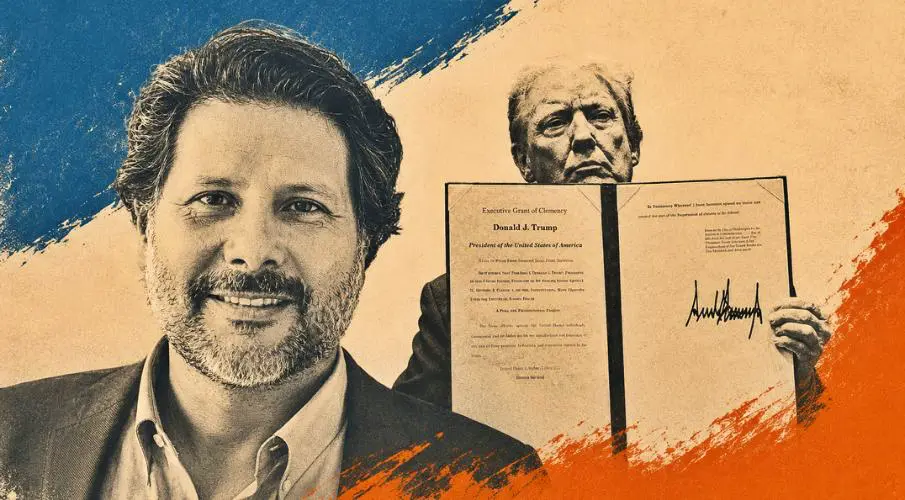
Federal prosecutors had begun asking how a convicted fraudster was able to leave prison after less than two weeks and who, if anyone, had been paid to make that possible. Then the question reached the White House - and the question was made to disappear.
Clemency is the rarest power a state keeps for itself, an intervention in justice that stops it with its own hand, answers to no court, and asks no one for permission. In the United States today, that power rests with a man who treats it like many other things, as an asset with a market. And when federal prosecutors began asking whether his mercy had found a buyer, his own appointees made sure the questions stopped. People familiar with the events describe an early criminal investigation into one of the president’s commutations - quietly opened and then quietly killed.
The man who benefited was David Gentile, a private equity manager whose firm GPB Capital ran a fraud that the government valued at more than one and a half billion dollars. A jury convicted him in 2024 after an eight week trial on securities and wire fraud charges. Prosecutors said he had deceived more than ten thousand investors by lying about the performance of his funds and the source of monthly distributions. The victims were the ordinary people the agency named in court - small business owners, farmers, caregivers, teachers, and veterans, some of whom had invested the savings meant for their old age.

Gentile was sentenced to seven years and reported last November to the low security prison camp in Otisville. He did not stay long. Within two weeks, the president commuted the sentence, wiping away not only the prison term but also more than fifteen and a half million dollars the government had sought to seize.
The speed of his release sent prosecutors back to the matter. People familiar with his communications from inside the camp say Gentile told other inmates his release was imminent because a priest was advancing his case with the president. He spoke about payments, about two and a half million dollars or more that were to flow to people and firms to push the commutation forward, and led the men around him to understand that money had already reached the priest. A few days later, he was free.

The priest is Reverend Frank Mann, retired, from Queens and a friend of the president for years. He had tended the graves of the president’s family and sent a photo of the work to the White House - a courtesy that led to a phone call and over time to genuine closeness. He delivered the closing benediction at last year’s inauguration and has since dined at the White House.
For prosecutors, Mann was a person of interest because people familiar with the prison correspondence say he wrote to Gentile about lobbying the president. With a parishioner at a church in Brooklyn, he was less restrained and said Gentile had been wrongfully convicted and that he himself had advised the president. The commutation, he said, had come at his own suggestion. To the press, he responded with outrage. There was no way, neither in hell nor in God’s universe, that he had anything to do with it. That was delusional nonsense, he wrote, and all he had ever given were his prayers.

The investigation was led by career prosecutors in Brooklyn, the same office that had secured the conviction. By late February, they were examining how the commutation had come about and reviewing possible offenses such as wire fraud. By May, it was over. The turn came after reporters brought their questions to the White House and the U.S. Attorney’s Office. An associate deputy attorney general, Aakash Singh, called U.S. Attorney Joseph Nocella to express concern, and shortly afterward the career prosecutors were told to stop their work. Singh is not a bystander but the department’s enforcer, the one who steers federal prosecutors toward the president’s critics and away from his friends. The department’s answer was that its prosecutors operate within its priorities and spend taxpayer money responsibly - the modern phrasing for: there is nothing to see.
Nothing to see - that is the recurring verdict. The same Justice Department has made cases against the president’s allies disappear, including against the former mayor of New York, Eric Adams, while moving against his opponents, including former FBI Director James Comey. Around his clemency decisions, a small and dirty market has emerged - lawyers and lobbyists with access to him collected millions from people who would never have met the department’s own standards for a pardon. The president says he finds it disgusting if anyone profits from his mercy, and his press secretary Karoline Leavitt says every petition is rigorously reviewed before it reaches his desk. The record shows something else: his mercy repeatedly went to people with money and the right connections.
As for the president himself, there is no indication that he was a target of the investigation, and no one can say a crime was committed or that charges would have been filed. That is exactly the point that must be held on to. The investigation that could have answered these questions was not allowed to ask them.
When the White House learned that the priest may have been paid, the president did not flinch. He called Mann and asked him directly whether he had taken money. Mann said no, and the friendship remained undisturbed. Within days, the priest was seated at a dinner at the White House near Vice President JD Vance. A day later, after dialing a wrong number, he left a stranger a small boast. He had been in Washington, he said, at an Easter dinner with the president.
There is an old belief that mercy is the one power money cannot reach because it is mercy and mercy has no price. A man drained the accounts of ten thousand people and was released after fourteen days, and a priest carried the plea to a president who calls the sale of pardons disgusting and still granted one. When the law turned its head to look, the president’s own people gently turned it away again.
The people Gentile ruined will not get their money back, and the question of who paid whom what to get him released now lies where the powerful prefer such questions to lie - unasked. The corruption does not consist in mercy being sold, because that is the oldest story of all. It consists in the asking being forbidden.
Updates – Kaizen News Brief
All current curated daily updates can be found in the Kaizen News Brief.
To the Kaizen News Brief In English


Dieser Sumpf an Skrupellosigkeit scheint keine Grenzen zu kennen. Wie der ausgetrocknet werden kann ist mir schleierhaft. Was machen all die Staatsanwälte, Richter, Wissenschaftler, Beamte die ihre Ämter und Jobs verloren. Schlucken die das einfach????
…man wird wieder dagegen vorgehen – es läuft alle über das Justizministerium und der laden ist korrupt ohne ende mittlerweile
Aber die Mehrheit der Veteranen liebt Trump.
Traurig, denn er begnadigt einen Mann, der auch massiv den Veteranen geschadet hat.
Die vielen anderen Geschädigten, die vielleicht sogar ihre Existenz verloren gaben.
Der Täter wird begnadigt.
Weil er Geld hat und zahlt.
Wahrscheinlich gibt es dafür ein geheimes Off-Shore- Konto.
Von Trump.
Vom Priester.
Und es ist ja leider nicht der erste Fall dieser Art.
Erinnert mich doch sehr an den Ablasshandel.
Zitat von Tetzel: „Wenn das Geld im Kasten klingt, die Seele aus dem Fegfeuer springt“
Die moderne Form heißt, „wenn mein Off-Shore-Konto klingelt, hast Du die Begnadigungskarte gekauft“.