
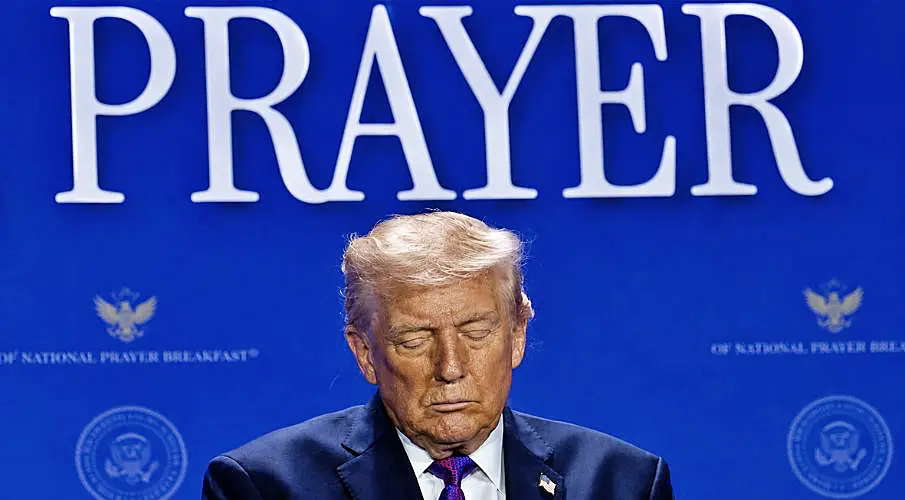
"Religion is back in our country, bigger and stronger than it has been in many years," Donald Trump declared on June 26 before the Faith and Freedom Coalition. If it were a stock, they would all be rich. Where God is absent, things simply do not work out very well, do they? It sounded like a threat. On that same day, his Religious Liberty Commission released a 224-page draft whose centerpiece consists of twelve recommendations: a task force within the Department of Justice, "Know Your Rights" posters, the repeal of the Johnson Amendment, which prohibits tax-exempt churches from engaging in partisan politics, and reporting portals for alleged violations of religious liberty.

The commission, housed within the Department of Justice and created by executive order last year, is tasked with advising the White House Faith Office. It is chaired by Texas Lieutenant Governor Dan Patrick, with Ben Carson serving as vice chair. Its members consist largely of right-wing activists. Alongside a handful of legal scholars sit clergy, politicians, authors, and Dr. Phil. Constitutional scholar Micah Schwartzman called the document embarrassing. Shameless would be more accurate. Yet a public official does not have to be intelligent or serious to cause damage. However carelessly drafted it may be, it fulfills its purpose - to demonstrate how religious liberty can be used to advance right-wing political goals.
For more than two decades, the Christian conservative legal movement, backed by wealthy organizations such as Alliance Defending Freedom and supported by the Roberts Supreme Court, has reshaped the very meaning of religious liberty. The strict separation of church and state is giving way, while the free exercise of religion has become a tool for conservative Christians. If implemented through the power of the Department of Justice, these recommendations would represent the next step toward restricting civil rights and dismantling public institutions while shielding favored groups from accountability.

The blueprint for reshaping religious liberty seeks more than legal provisions - it seeks to create an entire culture. It argues that it is no longer enough to defend religious rights after they have allegedly been violated. Instead, society itself must once again value religion as indispensable to a flourishing nation. Wherever religious liberty and the public good collide, as in the three Supreme Court cases involving a baker, a website designer, and a counselor in which Alliance Defending Freedom secured exemptions from Colorado's civil rights laws, faith is placed in direct conflict with the rights of others, especially LGBTQ people. The report ignores the fact that private privileges can indeed conflict with the common good - when businesses refuse service to customers, when public education funds are diverted to exclusionary institutions, or when public health measures are disregarded during a pandemic. Instead, it argues that because religion is inherently good, its freedom benefits everyone; because faith is an essential aspect of being human, it deserves priority; and because church and state should not remain strangers to one another but instead strengthen and support each other. No wall separates them, the commission concludes, but rather a bridge.
The report is divided into fourteen chapters drawn from seven hearings that served primarily as a stage for those presented as victims of religious persecution, each one another emerging celebrity in the cause of religious liberty. Several were plaintiffs in high-profile lawsuits brought by Alliance Defending Freedom and First Liberty Institute, whose own Kelly Shackelford and Allyson Ho sit on the commission. The final recommendation proposes a Presidential Medal of Religious Liberty along with First Freedom Hero awards, and each chapter concludes with photographs of their recipients. The document reads like a book of martyrs followed by executive directives. In On the Genealogy of Morality, Nietzsche described how powerlessness transforms itself into virtue and resentment toward the strong into a morality of innocence. Here, however, it is not the powerless who rise up. It is the powerful who drape themselves in the garments of the persecuted.

As the United States marks the 250th anniversary of its independence, Catholic historians remember the nation's founding father as a central figure in the history of religious liberty in early America.
What this looks like in practice is illustrated by twelve-year-old Shea Encinas. In fifth grade, he says his school required him to explain gender transition to his kindergarten buddy using the book My Shadow Is Pink. He did not refuse. Only afterward did his family object, at which point, according to their account, other children began harassing him and his brother because of their faith while the school failed to intervene. There was no option to opt out of the assigned reading. Later, the school held a "Pink Against Hate" day in solidarity with LGBTQ students. More than half the students wore pink, and Shea said he felt completely alone. In the end, his family transferred him to a private school. In the country envisioned by the commission, it would not only be Shea's rights that are protected, but also his feelings. It seeks to instill pride in religion and, more importantly, to ensure that certain people no longer feel shame and that intolerance is stripped of the stigma it has traditionally carried. As religious studies scholar Donovan Schaefer writes, for some it is easier to cast off shame than to endure the moral challenge that shame demands.
Trumpism is the answer to the fear that someone is taking away what rightfully belongs to you. As a response to perceived threats, Trump's illiberalism - which restricts or rejects liberal principles such as the separation of powers, minority rights, independent courts, and fundamental civil liberties - gives its followers a sense of security. Threats are said to be everywhere, from vaccine mandates to what they call "bad actors in government and institutions," with so-called "transgenderism" at the center of it all. But the Department of Justice, they promise, will provide protection. Posters will remind citizens of their rights. Teachers will receive instruction in religious liberty. Anyone who feels threatened will be able to report it through an official portal, and authorities will follow up.
Anyone who believes these ideas are uniquely American needs only to look at Germany. There, too, the AfD has spent years promoting reporting platforms. Names such as Neutrale Lehrer Niedersachsen, Neutrale Schule in Berlin, and the Thuringian portal Gewalt an Schulen all follow the same underlying principle: citizens are encouraged to gather information about other citizens and pass it on to political actors. Officially, the stated purpose is neutrality, violence prevention, or the protection of rights. In reality, however, they create an atmosphere in which people begin to weigh every word because someone may always be taking notes. Reporting portals do not merely change the behavior of those who are reported. They change the relationship between people themselves. When denunciation is presented as a democratic instrument, trust loses its place.
That is precisely why the proposed reporting portals deserve close attention. Germany already has comparable examples in the form of the AfD's own reporting platforms. For years they have been criticized by teachers' associations, labor unions, and civil rights organizations as instruments of intimidation and denunciation, yet they remain in operation without any fundamental judicial ruling on their legality.
In the United States, comparable government measures are challenged in court far more frequently by civil rights organizations, investigative journalists, and other plaintiffs. Encouraging citizens to report one another because of their beliefs or what they teach gradually alters the relationship between the state and society. Trust becomes surveillance. Dissent becomes suspicion. That is where a development begins that should never become normal in a free democracy.


Even during this period of renewed religious momentum, some still lose. In the Supreme Court's most recent religious liberty case, Landor v. Louisiana Department of Public Safety and Corrections, the plaintiff lost, and a federal law enacted in 2000 to protect the religious rights of incarcerated people was significantly narrowed. Damon Landor, a devout Rastafarian, wears his hair uncut as part of his faith. After entering prison, he presented officials with documentation confirming his religious exemption. The guards threw it into the trash. They forced him to the ground and shaved his head. His lawsuit against the individual correctional officers, the Court held, exceeded the scope of the statute. Writing for the majority, Justice Neil Gorsuch concluded that prison employees could not be sued personally because they had not voluntarily consented to such liability - a standard that, as legal scholar Elizabeth Reiner Platt observed, no government employee would ever agree to. Just three days after that ruling, the commission recommended that the Department of Justice issue updated guidance on the very same law. In her dissent, Justice Ketanji Brown Jackson wrote that correctional officers empowered by the state now have little reason to comply with federal law. The commission's recommendations are written for Shea Encinas and his parents, not for Damon Landor.

At its core, the report is a tribute to Christian nationalism. A coalition of multiple religious organizations has already filed suit against the commission, arguing that its membership is overwhelmingly Christian. Look behind the supposedly pious curtain and the reality quickly becomes clear: this is not about religious liberty but about building a Christian nationalist culture designed to divide people and turn them against one another. According to the Public Religion Research Institute, 11 percent of Americans embrace such ideas, while another 21 percent sympathize with them. In a 2021 survey, 10 percent fully agreed and another 21 percent somewhat agreed that, in cases of conflict, the rights of Christians should take precedence over the rights of non-Christians. One-third of Americans therefore favor preferential treatment for Christians. It does not take much imagination to understand who those reporting portals are ultimately meant for.

In the end, the commission is less a product of Christian nationalism than a broader right-wing political project. Wherever it seeks Christian dominance, that goal serves primarily to empower private actors to undermine the common good. Certain people - Christians, yes, but above all conservatives - are to be shielded from accountability and relieved of any shame for restricting the rights of others. Public education funding is to be redirected into private institutions under the banners of school choice and parental rights. Citizens are encouraged to monitor and report their neighbors rather than tolerate them, while the proposed task force would send cease-and-desist letters to school districts with LGBTQ-inclusive policies. This is how a climate of fear is created, one that eases the isolation felt by anti-pluralists while removing the moral restraints associated with excluding others.
The message is simple: Become religious. And if you do not, then things simply will not work out very well, will they?
Updates – Kaizen News Brief
All current curated daily updates can be found in the Kaizen News Brief.
To the Kaizen News Brief In English


