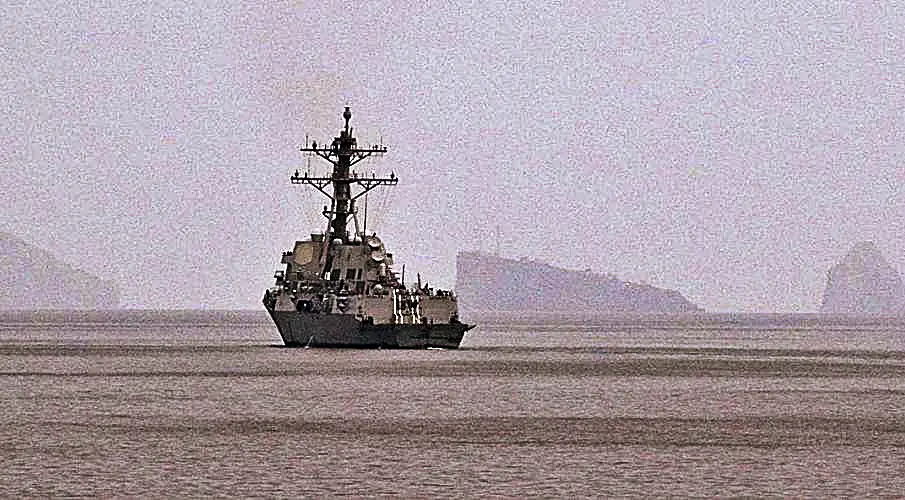
The assessment comes from London, and it leaves no room for interpretation. The British military body United Kingdom Maritime Trade Operations, UKMTO, classifies the situation in the Strait of Hormuz and the Persian Gulf as “critical” - the highest risk level there is. The reasoning points to an unusually high level of naval activity in the region, to movements that do not look like routine but like preparation. At the same time, the military warns of a real risk of attacks or miscalculations in a very confined space. When London uses that word, it is not caution, it is a warning to anyone who still believes this passage can simply be crossed.
Extreme movements are currently visible in the Strait of Hormuz
Exactly where the water is narrowest, the situation condenses to the point of becoming unrecognizable. Iran has once again heavily restricted transit, while the United States is simultaneously enforcing a blockade against Iranian ports and waters. Two lines that are not supposed to touch, and yet they do - visible to every ship attempting the passage, tangible for every captain who starts his engine without knowing whether he will reach the other side. The strait, through which a significant share of global oil trade moves, is no longer a neutral space. It is a stage on which every movement is observed, evaluated, and answered. And on this stage, there are currently too many actors at once, with too many weapons and too little distance.
On Saturday, according to UKMTO, there were multiple attacks by Iranian forces on ships using the passage. That means the danger is no longer a possibility. It has arrived. Every transit is conditional, every decision can shift within minutes, and between calm on a bridge and impact on a hull there may be nothing more than a radio call and a wrong second. What makes this especially volatile is that many of these situations unfold in real time - approaches, transmissions, reactions that leave almost no room and no space for what diplomats call restraint. What is building in this strait follows no timetable. It follows its own dynamic, one that becomes harder to slow with every hour.
The British assessment captures what sets this situation apart from other tensions. It is not a single incident that makes these waters so dangerous, but the combination of military presence, political decisions, and immediate actions at sea, layered on top of one another like strata, each of which might be manageable on its own - but together form something no one fully controls anymore. In a body of water that at its narrowest point measures less than fifty kilometers, a single moment of misreading, misreaction, or miscommunication is enough to turn control into an open incident that sends waves far beyond these waters.
Something is currently building in the Strait that goes beyond the tensions seen so far. We are investigating. Parts of the information landscape are difficult to access, there are indications of a partial information blackout. What we know, we publish. What we cannot yet confirm, we hold back. But the signals coming through are clear enough not to ignore.
And while the strait is on fire, right through the middle sail the Mein Schiff 4, the Mein Schiff 5 from TUI Cruises, and the MSC Euribia of the Swiss company MSC. Cruise ships. With no passengers on board.
To be continued ...
Updates – Kaizen News Brief
All current curated daily updates can be found in the Kaizen News Brief.
To the Kaizen News Brief In English


Ich bin froh jm jedes Schiff, dass die Passage unbeschadet durchqueren konnte.
Die Anspannung für die Besatzung muss unerträglich gewesen sein.
Leider fürchte ich auch, dass sich da was Großes zusammenbraut.
Abseits der „Öffentlichkeit“
Abseits der Diplomatie.
Mit Akteuren, die wahrscheinlich, nicht alle Bekannt sind.
Ich hoffe intending, dass Trump keine Atombombe in die Strasse von Hormus wirft.
Auf Japan hat die USA zwei Atombomben geworfen.
Ohne dass man sich im Krieg befand.
Japan hatte auf der „Mighty Mo“ seine Kapitulation unterzeichnet.
Die Atombomben hatten keine Konsequenzen … schon da schaute die Welt weg.