
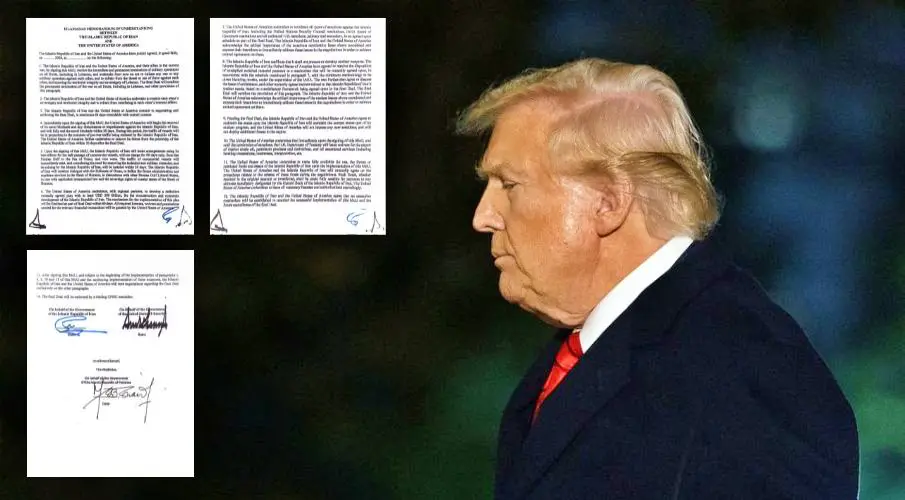
The signed agreement between Iran and the United States ends the war on paper and postpones almost everything else to a deal that still has to be written. The date and place of signing were left blank.
Anyone reading a document that promises peace looks first for the date. This one has none. In the opening, it says that Iran and the United States have agreed in good faith to what follows, on a day in the year 2026 and in a place, yet where both should appear there are only lines of dots, with nothing filled in. That is how the Memorandum of Understanding between Iran and the United States begins, concluded in the name of the diplomatic format, meaning Islamabad, mediated and witnessed by the government of Pakistan, a peace made in good faith whose day has not yet arrived.
Fourteen paragraphs follow. The first declares the immediate and permanent cessation of hostilities on all fronts, including Lebanon, and the promise not to attack one another in the future and to refrain from threats and force while preserving Lebanon’s territorial integrity and sovereignty. The second commits both sides to respect each other’s sovereignty and not interfere in internal affairs. The third sets a deadline to negotiate the final deal within no more than sixty days, extendable by mutual agreement. Already here the architecture of the whole document becomes visible, almost every sentence ends with the note that the final deal will confirm what is only being declared here.

What America gives immediately appears in the fourth paragraph. It begins at once to lift its naval blockade and all restrictions against Iran and ends the blockade within thirty days, measured by the restoration of prewar shipping levels. Within thirty days after the final deal, it withdraws its military forces from the vicinity of Iran.
The fifth paragraph gives Iran what only a few weeks ago was considered unacceptable. Iran makes every effort to ensure safe passage of commercial shipping, free of charge for sixty days, from the Persian Gulf into the Gulf of Oman and back, clears mines and removes technical and military obstacles within thirty days. More than that, it is to determine future administration of the Strait of Hormuz together with the Sultanate of Oman and the other coastal states, within the framework of international law and the sovereign rights of coastal nations. The waterway that during the war was its sharpest weapon is now assigned back to it as a matter of its own administration.

The sixth paragraph contains the largest figure. The United States commits itself, together with regional partners, to design a binding plan worth at least three hundred billion dollars for the reconstruction and economic development of Iran, with procedures to be defined in the final deal within sixty days, and to grant all necessary licenses and exemptions for the financial transactions. According to sources, this sum is not intended as direct government aid and not as reparations, but as a private investment fund whose substantial share is expected to come from private and international capital. The gift, then, is not one from the state but an invitation to investors, and the reparation that does not carry its own name is meant to be paid by outside hands.
The seventh paragraph promises the end of all sanctions, the resolutions of the UN Security Council and the Board of Governors of the IAEA, along with all unilateral American punitive measures, both primary and secondary, according to a schedule agreed in the final deal. The eighth addresses the reason the war was fought. Iran reaffirms that it will not acquire or develop nuclear weapons and agrees to dilute enriched material in place and under IAEA supervision, while the question of enrichment itself is left only for discussion, tied to a framework that the final deal alone is meant to provide. The ninth paragraph preserves the status quo until then: Iran maintains the current state of its nuclear program, America imposes no new sanctions, and no additional troops are deployed to the region.
The tenth and eleventh paragraphs contain what is tangible. Immediately after signing and until the sanctions end, the U.S. Treasury grants exemptions for the export of Iranian crude oil and its refined products together with all related services, banking and insurance transactions, transportation, and the like. Iran’s frozen funds and assets become fully accessible with implementation of the memorandum and may be used for any payment to a recipient designated by the Central Bank of Iran.

The rest governs the process. An executive body is to supervise implementation, negotiations on the final deal begin only once the concrete provisions are already in motion, the ceasefire and the blockade, the oil and the funds, and in the end a binding resolution of the Security Council is meant to reinforce the entire arrangement. That is how the order is set. What is tangible flows first, the difficult questions are postponed.
At the bottom then, the signatures. One in blue ink for Iran, beside it a jagged line for the United States, and below them, as mediator and witness, the signature for the government of Pakistan. The word memorandum means that which is to be remembered. But what is remembered here above all is a promise to negotiate, because the essential matters, enrichment and the sanctions timeline, together with the procedures governing the funds, are not yet written but wait for the deal that is meant to define and confirm what today is only declared. It is the old order in which words take the place of action, and perhaps the date was not left blank by accident. A peace that still has to be negotiated has not yet reached its day.
Updates – Kaizen News Brief
All current curated daily updates can be found in the Kaizen News Brief.
To the Kaizen News Brief In English


Danke für die genaue Auflistjng dieser Absichtserklärung.
Dumm nur, dass Netanyahu andere Pläne im Libanon hat.
Vor allem liest sich die Erklärung nicht wie eine vollständige Kapitulation des Iran, wie Trump es immer wieder gefordert hat.
So gut, wie mit dieser Absichtserklärung stand der Iran noch nie da.
Eingefrorene Gelder werden frei gegeben.
Alle Sanktionen fallen gelassen
Die Strasse von Hormus unter anderem der iranischen Kontrolle überlassen.
Wofür nochmal genau wurde der Krieg angezettelt?
Wofür genau starben die unschuldigen Zivilisten?
Wofür genau starben die amerikanischen Soldaten?
Wofür genau wurde die Umwelt auf Jahrzehnte massiv geschädigt?
Ach ja, damit Trump und seine Entourage kräftig verdienen konnten und auch sicher in Zukunft mit Deals gut verdienen werden.
… gerne, man sollte sehen können über was geschrieben wird, und die dokumente zeigen nur eines auf: kaum sicherheit