
Some places carry their memory like a scar, and anyone who chooses them also chooses what they remember. The AfD selected Erfurt for its federal party conference on the first weekend of July, the very city where the NSDAP gathered exactly one hundred years ago. People may argue about how much intention can be hidden in a date on the calendar, but Jens-Christian Wagner, director of the Buchenwald Memorial, left no room for doubt on the sidelines of the protests. He said it was certainly no coincidence, and that he found it repulsive. Nothing needs to be added to that statement. A party that has been officially classified in part as confirmed right wing extremist has chosen to gather on ground where German history once began to slide into catastrophe, while insisting at the same time that it is nothing more than a party like any other.

The opening unfolded as a carefully staged display of self discipline. At exactly ten o'clock the party conference began, and that punctuality was not an organizational detail but the first message. Tino Chrupalla, the party's co chairman, immediately turned it into a victory over his opponents. Antifa, he mocked, had overslept its own attempt to disrupt the event. The early bird catches the worm. What sounded like a harmless proverb was, in reality, the central idea of the entire weekend. A party whose conventions had for years dissolved into internal conflict now wanted to project the exact opposite. Order. Reliability. The calm face of a mainstream party. We are more united than ever before, Chrupalla declared, and that sentence was less a description than a carefully chosen costume.

Yet beneath that costume, the old face remained clearly visible. The leadership duo of Chrupalla and Alice Weidel was confirmed, but the numbers revealed more than the leadership would have liked. Weidel received eighty one percent, surpassing even her result from two years ago. Chrupalla, by contrast, fell to seventy percent, roughly ten points below the result he achieved at the party conference in Essen. He accepted it with the strained optimism of someone trying to turn a bruise into a medal, declaring that they had won two to one rather than two to zero. The crack, however, remains, a quiet warning delivered by his own delegates right in the middle of the carefully choreographed display of unity.
That day, Weidel demonstrated how to wrap harshness in soft cotton. We will carry out rigorous deportations, she said, because Germany deserves better. That single sentence contains the entire strategy of the new AfD. The severity remains untouched, but it dresses itself in the language of concern for the country, as though this were about care rather than exclusion. Weidel called 2026 a super election year and prepared the delegates for victories and their first milestones. More remarkable, however, was what was missing. Migration, for years the beating heart of every AfD speech, stepped into the background. In its place came the word energy, a term that sounds far less threatening and fits comfortably into more living rooms. That, too, is a disguise. The party now chooses its issues according to how broadly they appeal, no longer according to how provocative they are.

It is therefore no surprise that the real winner of the conference was not the loudest voice but the smoothest one. Ulrich Siegmund, thirty five years old and the party's lead candidate in Saxony Anhalt, represents a highly troubling new generation that remains uncompromising in substance while becoming polished in appearance. After the state election in September, he could become the first AfD politician to enter government. Björn Höcke, meanwhile, the far right leader of the party in Thuringia, has officially accepted the brown political sideline, yet now operates as the leader in the shadows, a role that not only suits him but describes him perfectly. His close ally Stefan Möller, co leader of the state organization and a member of the Bundestag, was elected one of the deputy federal chairmen with just over seventy six percent of the vote. Höcke's influence therefore continues to grow while he himself remains in the half light, and that is precisely what makes it more difficult to grasp. Anyone who no longer needs to stand at the front in order to shape events has reached the more dangerous form of power.
Möller made every effort to present himself as the moderate voice, yet in doing so delivered a sentence that revealed more than he intended. He said he had been with Höcke for twelve years and married for twelve years, just not to each other, and insisted that he certainly was no puppet. At the same time, he described what he claimed was the transformation of his party. Between 2015 and 2017, he said, demonstrators had still chanted that all migrants had to leave. Today, however, they understood that their own voters were not demanding that at all. It is the language of redemption, yet it describes no genuine change, only a calculation. The ideology has not changed. Only its packaging has.
How fragile that packaging really is became clear whenever the script fell apart. Kay Gottschalk, the outgoing deputy chairman who refused to step aside quietly, seriously blamed the defeats of Germany's national soccer team on open borders. Before the borders were opened, he claimed, the old squad would have swept Ecuador and Paraguay aside. The statement is so absurd that it almost invites laughter, until it becomes clear that it exposes the mindset still beating beneath the polished exterior. Gottschalk lost the contested vote to Sven Tritschler, who argued for moderation, modernization, and organizational structures worthy of a mainstream party. Throughout the day, a quiet struggle unfolded between those who wanted to manage radicalism and those who still preferred to display it openly.

If one party incites the people against outsiders while the government simultaneously strips the public of its ability to hold that party accountable, two paths meet at the same point. The AfD promises purity and delivers enemies. Germany's governing coalition promises order while dismantling the transparency that makes any order accountable in the first place. Anyone who turns off the public light never does so by accident. In confronting Trump's America, we learned how that story ends, where taking a photograph can land someone in detention and a sentence posted online can bring federal agents to the front door. Darkness never begins with the prohibition of seeing. It begins with becoming accustomed to no longer wanting to see.
Read also our article: An American, an Artist, a Friend - and Suddenly Gone
Most revealing, however, was what the leadership prevented from happening in the first place. At the very beginning, a motion concerning the so called incompatibility list quietly disappeared from the agenda. That list identifies organizations whose former members are barred from joining the party, whether they come from the far left or the far right. Some delegates, including Höcke, wanted to weaken those rules and had signed a proposal that would significantly loosen the restrictions. An open debate would have handed the party another public image of its own extremism just before important elections, so the issue was postponed. Weidel recommended that the newly elected executive board revise the list within one year, while at the same time criticizing the fact that this should have happened long ago. Radicalization, therefore, is not being prevented. It is merely being scheduled, delayed until after the elections, when public attention has already moved elsewhere.

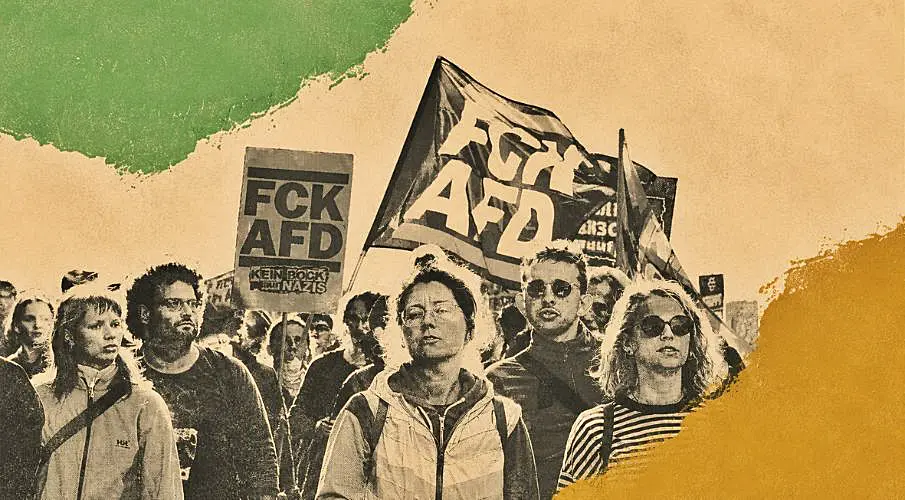
While the party inside carefully polished its image of order and unity, the real story of the weekend unfolded outside. At its peak, police counted as many as thirty one thousand people protesting against the party conference through demonstrations, rallies, and church services. Luisa Neubauer and Christoph Bautz of Campact described the protests as a festival of resilient democracy. According to Neubauer, they had prevented the conference from passing quietly, proving that resistance to the AfD remains deeply rooted in civil society. DGB Chair Yasmin Fahimi appeared, as did former state premier Bodo Ramelow, who declared that Erfurt stands for freedom, diversity, and a shared colorful life. Above the city, a small airplane towed a banner simply stating that Nazis are annoying, while demonstrators unfurled a large rainbow flag outside the convention center.
Police concluded that the overwhelming majority of the protests remained peaceful. Incident commander Thomas Quittenbaum thanked participants for exercising their constitutional rights responsibly. By evening, the preliminary assessment was sober and favorable for the demonstrators. Forty eight criminal offenses and eleven administrative violations had been recorded among tens of thousands of participants. Anyone capable of bringing that many people into the streets while remaining below fifty criminal offenses demonstrated that outrage and decency are not mutually exclusive.

And yet honesty requires us to acknowledge that these were very few exceptions, and that not every action carried out under the banner of democracy was itself democratic. A reporting team from the right libertarian outlet Apollo News, and we should call the publication by its proper name, was attacked after leaving a march organized by the alliance Widersetzen. First came the verbal abuse. A woman repeatedly shouted that they should, well, you know exactly what we mean. Then came the pushing, the pursuit, and finally the blows. One staff member was reportedly kicked in the back of the head, according to the editor in chief. His colleagues were treated for cuts, abrasions, and bruises, and the assault reportedly ended only when police arrived. Whether those reported injuries correspond to the actual facts could not be independently confirmed. Earlier in the day, two journalists had already been injured by bottles thrown from within a demonstration, with one requiring treatment in an ambulance. At the train station, federal police seized batons and pyrotechnics from four individuals, while an AfD constituency office was targeted with paint and pyrotechnics.

These incidents belong in this article. Anyone who takes to the streets in defense of democracy loses that cause the moment its rules are broken. Freedom of the press applies even when people dislike a media outlet's political direction. Apollo News is not affiliated with the AfD, but it is highly critical of the government and of migration policy, and many groups on the political left regard it as an adversary. We reject the outlet as well. That changes nothing about the simple truth. Wrong remains wrong. The police are investigating, and that is exactly how it should be. A democracy proves its resilience not by silencing its opponents, but by refusing to do so even when it has the power.

This is where the real tension of the weekend lies, and it is older than any day's politics. The AfD is betting that repetition will eventually be mistaken for normality, that familiarity will quietly shift the boundaries of what a country still considers acceptable to say. Höcke himself expressed it with striking openness in his welcoming remarks. Inside the hall, he said, there was positivity and happiness. Outside there was hatred and agitation. The political firewall had made his party stronger, and now they had become the strongest political force in the country. He described those outside as the losers of history and those inside as its winners. It is a complete reversal of reality in which those who warn become the agitators and those who exclude become the victims, and that reversal is as old as temptation itself.
The question hanging over Erfurt, however, was never a question of the day. It was a question of conscience. Whether a society is still capable of reading its own history while it is writing it. One hundred years after the NSDAP party conference in the very same city, watching a party that has been officially classified in part as confirmed right wing extremist gather there while speaking of a great and sovereign Germany is reason enough for vigilance. History does not return as an exact copy. It returns as a possibility, as an invitation to allow it to happen once again. What Erfurt revealed was both sides at once. A party that has learned to manage its own radicalism, and a society that has learned to stand against it.
In the end, two images remain, and they cannot be reconciled. Inside, the delegates, untouched by the protests outside, celebrating their unity inside the closed convention hall. Outside, the many thousands who showed that dissent is still alive. Between them stood the firewall that Björn Höcke mocks, claiming it was the very thing that made his party strong. Perhaps that is the bitterest lesson of these days. A wall alone offers no protection when complacency grows behind it. What offers protection are the people - the investigative journalists and everyone else who looks where others look away, who refuse to be intimidated, who call things by their proper name when they must be called by their proper name, and who stand up without becoming what they are standing up against. Both were on full display in Erfurt that weekend - the danger and the answer to it. Which of the two prevails will not be decided by the party inside the convention hall. It will be decided by those standing outside who are still watching tomorrow, long after the television cameras have moved on.
Updates – Kaizen News Brief
All current curated daily updates can be found in the Kaizen News Brief.
To the Kaizen News Brief In English


