
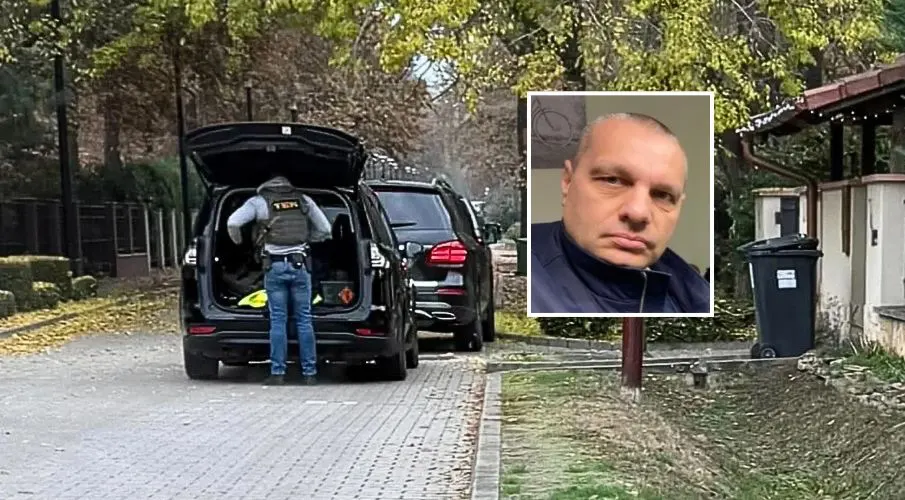
On Monday morning, investigators descended on a property in Fótliget linked to a company associated with Áron Orbán. The younger brother of Hungary's ousted Prime Minister Viktor Orbán once again found himself at the center of a scandal in which visas apparently came with a price tag and political connections carried a value all their own. Prime Minister Péter Magyar announced on November 9, 2026, that Áron Orbán had been arrested in connection with human trafficking. Viktor Orbán confirmed his brother's arrest and immediately called it a "political witch hunt." Investigators were still conducting their searches. The former prime minister had already reached his verdict.

According to Hungary's National Bureau of Investigation (NNI) and the National Asset Recovery and Protection Authority (NVVH), joint operations were underway Monday in 2 criminal investigations. Several people were arrested and homes searched in Budapest and 2 locations in Pest County. The official statement did not name anyone. Anna Unger, head of the NVVH, also declined to confirm or deny the operation at the property linked to Áron Orbán. She did, however, confirm further investigative measures in a case that also involved him. The operation was confirmed by people close to him. The question of the connections between the former prime minister's brother and the businesses under investigation can hardly be hidden behind the walls of a private home anymore.
Viktor Orbán sees himself as the target. He wrote that this dirty political game was intended to eliminate opponents and create a one-party state. His younger brother was merely being used to get to him. A swift defense from a man who spent years at the head of a government apparatus whose ties to his own family are now under investigation. The change of power in April has turned former government connections into the subject of criminal investigations. That is uncomfortable for those involved. For a country governed by the rule of law, however, it would only become unusual if a family name were allowed to determine which businesses could be investigated.
The case goes back years. As early as 2024, an audio recording surfaced in which Áron Orbán spoke with Dávid Héjj, a confidant of Viktor Orbán, inside the then-prime minister's office. They discussed visas and applications that authorities had blocked. Investigations published in 2025 subsequently traced a business involving the arrangement of such documents. Men from Orbán's circle allegedly took money for the service and promoted their political connections. Some customers never received their visas and demanded their money back. One filed a criminal complaint. He handed over numerous internal messages and audio recordings. The Central Investigating Chief Prosecutor's Office opened an investigation. At first, there was little sign of progress. The man who filed the complaint later died unexpectedly. The documents he had collected survived.

Particularly explosive is a 2024 audio recording in which Áron Orbán tells government commissioner Dávid Héjj: "Viktor told me to come here so we could discuss who threatened me." The then-prime minister's brother was directly invoking Viktor Orbán while complaining about blocked visa applications. The applications involved short-term Schengen visas for Vietnamese and Indian nationals, and Áron had personally approached consular officials to get them approved. Héjj spoke about suspended procedures and how certain companies had been allowed to resume operations earlier than others. Orbán's business associates had also been affected. One detail stands out: The public company register contained no corresponding ownership stake that would explain his extensive efforts to secure the visas. Even more uncomfortable for the family was a suspicion circulating within Áron's own circle. Hungarian authorities might have been deliberately obstructing his business activities, possibly even with Viktor Orbán's tacit approval. Some confidants had long considered the younger brother a political liability. The very man who invoked the prime minister's name may therefore have encountered resistance within his own family's power structure. Two years later, Viktor Orbán confirms his brother's arrest and complains of a political witch hunt. The old recording tells the story of a man who apparently believed his family name could open doors behind which ordinary applicants were left waiting.
The Audio Recordings
The Audio Recording of Áron Orbán and Dávid Héjj
Summary of the recorded conversation in 3 parts. Visa deals, political connections, threats, and allegations against Hungarian government officials.
Threats, Rejected Visas, and Viktor Orbán
At the beginning, arrangements are being made for someone's arrival. One person is on the phone with someone waiting outside. At approximately 01:03 , he asks whether the other person can hear everything. The reply is essentially: "I can hear everything. I'm listening and recording everything." This establishes right from the start that the conversation is being recorded.
At approximately 04:20 , the actual conversation begins. It initially concerns an alleged threat that anyone who crossed certain people would end up in the Danube or in the woods. One of the participants denies having made such a statement. The other insists that those words were spoken.
At 05:52 , Áron Orbán brings up his business problem. He explains that another 60 people have been rejected. He also says the Hungarian consul in Vietnam defamed his company in a letter.
At 07:19 , a particularly important passage follows. Áron Orbán explains:
Paraphrased Translation · 07:19"Viktor told me to come here so we could discuss who threatened me."
He then names several people whom he holds responsible for the difficulties. They include a businesswoman named B. Radosztina, government official Levente Magyar, and consular officials Gábor Lehócz and Alexandra Pető.
At 08:49 , he claims that Levente Magyar is influencing the 2 consular officials, who are consequently blocking Category C Schengen visas.
The participants discuss which instructions are coming from the Hungarian Foreign Ministry and who is carrying them out at the consulates.
Visa Deals, Péter Magyar, and Allegations Against the Intelligence Services
The second part begins with a discussion about Vietnamese travelers' documents. They talk about invitation letters, biometric passports, departures from the Schengen Area, and whether people who have entered the country comply with the conditions of their stay.
At 01:29 , they discuss the external visa service provider TLS. Áron Orbán explains that applicants first went through its procedures but were subsequently rejected by the Hungarian consulate anyway.
At 02:37 , the possible connection between businesswoman B. Radosztina and the circle surrounding Minister Antal Rogán comes up. The participants explicitly acknowledge that it is unclear who is actually working with whom.
At approximately 03:43 comes the most politically explosive passage of this part. One of the participants develops the theory that Antal Rogán's circle and the intelligence services under his authority are passing information to opposition politician Péter Magyar.
He essentially asks how else secret information could reach Magyar. This claim is presented as speculation during the conversation. No evidence of any actual information leak is provided.
At 04:43 , the conversation returns to the alleged threat involving the Danube. One participant emphasizes that he does not joke about statements like that.
Later, they discuss business partners, the role of the Vietnamese intermediary company, and why certain visa categories are being blocked while others can still be processed.
At 09:19 , the participants try to determine whether the Vietnamese company is being specifically targeted. Indian and Chinese applicants are also mentioned for comparison.
Toward the end of the second part, one participant explains that although he can provide the necessary documents, he has no way of monitoring travelers inside an airport or personally ensuring that they actually leave the country.
Departure Checks, Political Connections, and Influence Over Government Agencies
At the beginning, the men discuss their practical responsibility for people who have entered the country. As an example, they mention a traveler flying from Budapest to Frankfurt.
One participant explains that his responsibility ends with properly arranging the journey or departure. After all, he is neither the police nor a government authority.
At 01:30 , the conversation again turns to who might be behind the company's difficulties. The suspicion is raised that the businesswoman under discussion is not acting alone and may have powerful people backing her.
At 03:09 , one of the participants explicitly describes the business activities as completely legal. The other essentially agrees that, in his assessment, the relevant regulations are being followed.
At approximately 04:19 , Foreign Minister Péter Szijjártó is mentioned. The participants speculate about why he is being targeted and how certain documents could become public. Here, too, these are political theories discussed during the conversation.
At 05:44 , one of the participants explains that he will put the matter in writing and pass it along by the following day at the latest.
The final major topic begins at 07:12The participants discuss regulations governing the employment of foreign workers in Hungary.
In particular, they discuss the jurisdiction of regional government agencies when it comes to approving such employment arrangements.
At 08:35 , the suspicion is raised that a regulation was deliberately designed so that certain decisions could be controlled through political influence, possibly even with a single phone call.
The 2 men then discuss whether all responsible authorities actually have to approve an application or whether individual regional decisions are sufficient.
What Can Be Established Directly From the Conversation
Áron Orbán explicitly invokes Viktor Orbán to explain his personal meeting with Dávid Héjj.
The conversation discusses the rejection of numerous visas for people from Vietnam. Specific government officials and consular officers are accused of deliberately blocking the procedures.
The conversation includes the allegation that information from Antal Rogán's circle or the intelligence services could be reaching Péter Magyar. This allegation remains unsubstantiated in the conversation.
The men discuss how political connections could help resolve problems involving visa procedures and government approvals.
Just how profitable the visa business could become is illustrated by an agreement between Áron Orbán's company Multi Shoot and the University of Pécs. Vietnamese nationals were supposed to attend 2-day first-aid courses there, with 20 participants completing 16 hours of instruction in each group. Multi Shoot paid the university €30,000 per group. Áron Orbán personally signed the contract. Additional documents show that 50 Vietnamese nationals were accommodated at the István Király Hotel between March 20 and April 5, 2024. The invitation letter addressed to the Hungarian consulate in Ho Chi Minh City also bore his signature. According to the investigations conducted at the time, considerably more people may have entered Hungary through similar arrangements. Participants received proof of training completed in an EU country, which could help them in their subsequent job searches. Within the business network, responsibilities were clearly divided: János M. managed the finances, while Garay B. handled legal matters. Áron Orbán brought something that is difficult to put into a contract and was apparently especially valuable in this business: the prime minister's family name. Ironically, the very short-term Schengen visas that this name was supposed to help secure were later blocked by Hungarian consular officials.
A Vietnamese interpreter living in Budapest knew about the business dealings and the people involved. He had contact with G. B. and János M., known as "Macsek," and met Áron Orbán twice. He personally accompanied him to a business meeting in Veszprém. According to the available investigations, the man also knew about the role of Orbán's partner and testified before the National Bureau of Investigation. Following the defeat of Viktor Orbán's party in the April election, G. B. and Macsek were arrested. The NVVH later took over the investigation. G. B. has since been released. According to the available information, Macsek did not implicate Áron Orbán during questioning. Nevertheless, the investigation continued to reach deeper into the business circle surrounding the former prime minister.

People involved in the case have accused investigators of deliberately slowing down the proceedings before the election. Influential figures allegedly wanted to prevent an investigation into a businessman with strong connections to the Interior Ministry. After the change of government, authorities allegedly pushed for a quick conclusion to prevent further connections to higher levels of government from becoming visible. The picture painted by these statements is profoundly bleak. Even the pace of a criminal investigation may have been subject to political interests. When public offices remain entangled with private business dealings long enough, even asking why an investigation barely moved forward for years can eventually become dangerous.
On November 9, Áron Orbán himself finally became the focus of the police operation. Prime Minister Magyar announced his arrest, Viktor Orbán confirmed it and declared it persecution of his family. Police did not identify the arrested individuals in their public statement. The human trafficking allegation comes against a background in which visas were allegedly arranged in exchange for money and business connections reached all the way into the former government's headquarters. An audio recording from 2024 now takes on new significance. A conversation about blocked applications, held in the very place where his brother governed. Today, that brother is no longer in office. Investigators are standing outside a property connected to his family's business circle. And the former prime minister is talking about a witch hunt while the old recordings still exist.
Updates – Kaizen News Brief
Alle aktuellen ausgesuchten Tagesmeldungen findet ihr in den Kaizen Kurznachrichten.
To the Kaizen News Brief In English


