
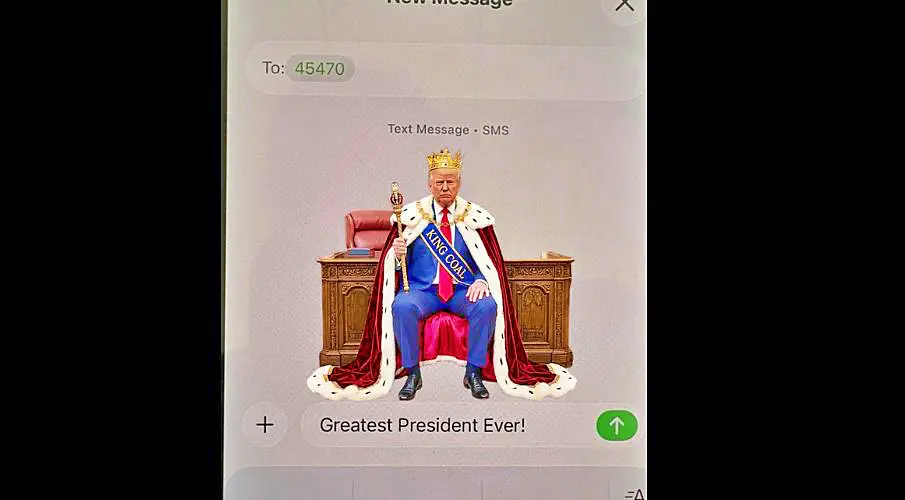
Government employees have begun downloading the official White House app. It allows something that until now belonged mostly to private life: you can send a message to the president, almost as if writing to an acquaintance. But when users open the text field, they do not find it empty. It fills itself in automatically, with the words “Greatest President Ever.” One should first appreciate the practical benefit. Anyone wishing to express admiration for the head of state no longer has to come up with the proper words themselves. They are already there, neatly prepared, requiring nothing more than pressing send.

But this raises an old question in a new form. Praise has always drawn its value from the fact that the person offering it could also have chosen not to. Someone who praises another person voluntarily reveals something about themselves. Someone who sends a prewritten sentence reveals nothing because they contributed nothing. The software has already completed the approval before the sender has even approved. A default setting is not an opinion. It is the absence of the need to have one. What appears here as a personal message is in reality the same text multiplied across countless devices. The more people send it, the less each individual actually says.
The fact that government employees of all people appear to be among the first users gives the episode its own character. They are paid by the state, and the state now supplies them with the words they are supposed to send upward to its leadership. What is remarkable is not the technology itself but what it suggests about expectations toward one’s own people. Admiration that no one has to formulate anymore is no longer admiration at all but an act without an author. And unlike a feeling, a function can be executed with a single tap.
Updates – Kaizen News Brief
All current curated daily updates can be found in the Kaizen News Brief.
To the Kaizen News Brief In English


Dazu fällt mir nur ein „Wenn der realest Irrsinn die Satire überholt“, ist was mächtig schief gelaufen.
Wahrscheinlich muss künftig jeder Regierungsmitarbeiter die App auf seinem Handy haben und selbstverständlich jeden Morgen, noch auf der Bettkante sitzend, diese Nachricht an Trump senden.
Damit der genialste aller Präsidenten (ironie) im Lob baden kann ……
Der Trend zum Zweithandy dürfte ansteigen 🤣