
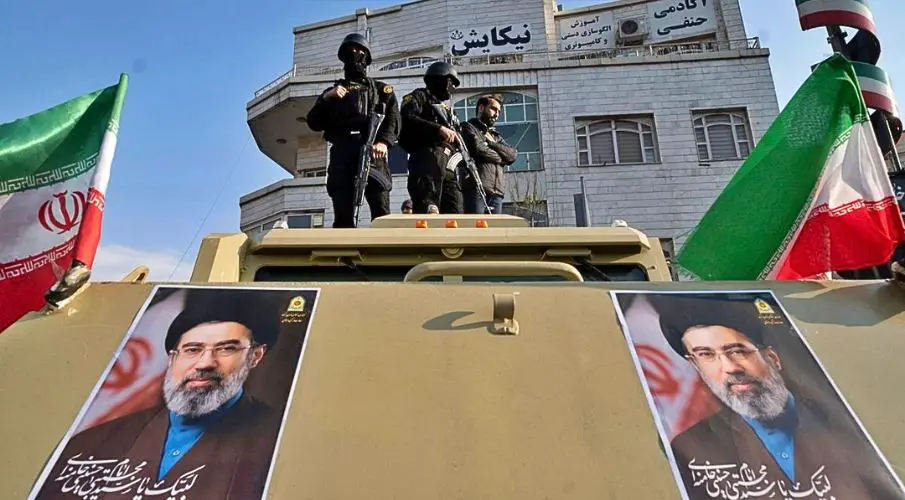
While Washington and Tehran appeared to be cautiously moving closer together this week, a very different battle was unfolding inside Iran. It is not being fought between the United States and the Islamic Republic, but within the country’s own power structure. A vocal group of hardliners is doing everything it can to prevent a possible agreement with the United States and derail the negotiations. Whether a deal will actually be reached remains uncertain. Donald Trump spent hours on Friday meeting with his cabinet in the White House Situation Room to discuss the next steps. In the end, he postponed a final decision. At the same time, Iran’s lead negotiator, Mohammad Bagher Ghalibaf, made clear how deep the mistrust remains on the Iranian side. No step would be taken, he said, until the other side acts first.

But the real confrontation is now taking place in Tehran.
There, conservative politicians, religious hardliners, and parts of the state apparatus have spent days trying to create the impression that talks with Washington are doomed from the start. State media amplify those messages almost daily. Demonstrations are organized. Speakers publicly call for confrontation instead of negotiations.

At a rally in Tehran, participants waved flags and chanted slogans against the United States and Israel. Some told television reporters that Iran should not back down but continue the fight. Others pledged support until their last drop of blood. Conservative lawmaker Ebrahim Azizi even declared that Donald Trump must understand that Iran, as the victor of the conflict, would set the terms.
Those statements stand in sharp contrast to the course being pursued by President Masoud Pezeshkian.
This week, the president openly criticized state television in unusually direct terms. During a meeting with senior executives of the broadcaster, he accused them of deepening divisions and creating the impression that negotiations are inherently wrong. Particularly noteworthy was his reference to former Supreme Leader Ali Khamenei. Even Khamenei, Pezeshkian said, had agreed that Iran must come to the negotiating table. That made it all the more difficult to understand why the same state institutions were now publicly promoting the opposite message.

According to several Iranian analysts, the hardliners do not represent the majority view within the population. Nevertheless, they retain influence. Many of their supporters have been among the Islamic Republic’s most loyal backers for decades. That is precisely why the government cannot simply ignore them.
Concern within Tehran is now becoming increasingly visible. Political observers warn that these groups could become a serious threat to the country’s internal stability if their activities spiral out of control.
Even the new Supreme Leader, Mojtaba Khamenei, has not been spared criticism from within his own ranks.
Conservative cleric and lawmaker Hamid Rasaee published a social media post titled “Who Is Worthy of Supreme Leadership?” In it, he referenced the Prophet Noah and his unbelieving son. Many observers interpreted the comparison as an indirect attack on Mojtaba Khamenei. The backlash was so severe that Rasaee later attempted to walk back his remarks, claiming they had been misunderstood.
Even more explosive are reports of internal power struggles within the Supreme National Security Council.

Ali Bagheri Kani, one of the country’s best-known hardliners and a former nuclear negotiator himself, reportedly wrote a letter to Mojtaba Khamenei, according to senior Iranian officials. In the letter, he allegedly accused the negotiating team of being too accommodating toward the Americans. At the same time, he urged the Supreme Leader to establish stricter limits for the talks. Political circles viewed the move as a direct challenge to Ghalibaf. The two men have represented different factions within the system for years. Far more than foreign policy prestige is at stake for Iran’s leadership.
According to senior Iranian officials, President Pezeshkian and Ghalibaf had already warned the Supreme Leader this spring about the country’s economic situation in a joint letter. Budget problems were described as severe. The financial situation continues to deteriorate. Without an agreement, they warned, new social tensions and possibly even broader unrest could emerge. That is precisely why the political leadership has continued to support negotiations.
Mojtaba Khamenei has publicly and privately stood behind the negotiating team. In a recent statement, he urged members of parliament not to inflame political disputes and not to deepen social divisions. Anyone doing so, he said, would ultimately be serving the interests of Iran’s adversaries.
Meanwhile, contacts between Washington and Tehran continue.
Foreign Minister Abbas Araghchi held talks with his counterpart from Oman. Among the topics discussed was the future administration of the Strait of Hormuz. The waterway is one of the most important trade routes in the world. For weeks, there has been speculation that Iran and Oman could eventually introduce a joint system of fees for vessels passing through the strait.
Pakistan also continues to play an important role. Foreign Minister Ishaq Dar met with U.S. Secretary of State Marco Rubio in Washington. Pakistan has become one of the key mediators between the two countries and has spent weeks trying to keep the negotiations alive.
At the same time, Donald Trump is increasing the pressure.
The president said on Friday that he was close to making a final decision. He also renewed his demands toward Tehran. Iran must permanently renounce nuclear weapons. The Strait of Hormuz must remain open. Washington is also continuing to demand the transfer of Iran’s enriched uranium. Until those conditions are met, no money will be released, Trump said.
On the Iranian side, the language is hardly more conciliatory.

Mohammad Bagher Ghalibaf stated bluntly that concessions are not achieved through negotiations but through missiles. There is no trust in American guarantees, he said. No action will be taken until Washington acts first.
That is where the greatest danger to any potential agreement now lies. While diplomats on both sides search for a path out of the conflict, influential groups inside Iran are fighting against any form of rapprochement. The political struggle is no longer focused solely on the United States. It is increasingly becoming a debate about what direction the Islamic Republic intends to take after war, sanctions, and economic crisis.
Updates – Kaizen News Brief
All current curated daily updates can be found in the Kaizen News Brief.
To the Kaizen News Brief In English


Im Iran sind es die religiösen Hardliner, in den USA sind es Trump (und Hegseth) die ein Friedensabkommen verhindern.
Wenn man während Verhandlungen den Gesprächspartner bombardiert und behauptet, dass es Selbstschutz war, schürt das auf der Gegenseite weiter Misstrauen.
Das widerrum spielt den Hardlinern in die Hände.
Extremisten (egal welcher Coleur) verhandeln nicht.
Sie drohen und erprrssen.
Da nehmen sich die Mullahs und Trump nicht viel.