
At a luxury resort above Lake Lucerne owned by Qatar’s sovereign wealth fund, Vance and Iran’s envoys are negotiating an agreement whose most difficult issue, Iran’s nuclear program, they postponed. While they meet, Washington and Tehran are arguing over whether the Strait of Hormuz is open or closed, and in Lebanon they are counting the dead.
On Sunday, the American and Iranian delegations arrived at the Bürgenstock, a mountain above Lake Lucerne near Lucerne, to expand the preliminary agreement meant to end the war against Iran. They have sixty days to settle the technical details, and the place itself says something about the matter. Since 2007, the resort has belonged to Katara Hospitality, a hotel developer owned by Qatar’s sovereign wealth fund, which spent nearly a decade rebuilding it. Qatar is also serving as mediator in these talks. Switzerland, its Foreign Ministry said, provides a discreet and reliable setting for implementing the memorandum between the United States and Iran.

Vice President JD Vance is leading the American team, which includes special envoys Steve Witkoff and Jared Kushner, the President’s son in law, who had already reviewed the technical sections in advance. The Iranian side is led by Mohammad Bagher Ghalibaf, Speaker of Parliament, joined by Foreign Minister Abbas Araghchi, Deputy Secretary of the National Security Council Ali Bagheri, and ministry spokesman Esmail Baghaei, accompanied by representatives of the central bank and the oil sector. Pakistan arrived as mediator, represented by Prime Minister Shehbaz Sharif and Army Chief Asim Munir, alongside Qatar. Vance received Sharif and his meeting began, but when a reporter asked whether he had a message for Benjamin Netanyahu regarding operations in Lebanon, he ignored the question.
The framework agreement was signed a week ago, the Memorandum of Islamabad. It immediately allows Tehran to sell its oil freely and opens the path to billions in frozen assets. It provides for a sixty day ceasefire during which the United States lifts its blockade of Iranian ports and Iran allows shipping through the Strait of Hormuz, through which one fifth of globally traded oil and gas passes. It demands an end to the fighting in Lebanon. What it does not settle is precisely the issue for which the President claimed the war had to be fought, the nuclear program. That question was pushed to the next round. Already on Saturday Iran shook the agreement twice. Angered by Israel’s continued strikes in Lebanon, it declared the Strait of Hormuz closed and made clear that while its negotiators would travel to Switzerland, little was likely to happen there. Its primary concern remained ending the war on all fronts. The American military disagreed, saying traffic continued, and Central Command rejected the closure with the statement that Iran does not control the strait. Vance said millions of barrels had passed through in recent days. By Sunday morning, the British maritime authority monitoring the strait had not updated its assessment since the previous day, when it declared the southern route navigable. The agreement allows commercial vessels to pass free of charge for sixty days but does not rule out later fees, and on Saturday Trump threatened to impose tariffs on the strait himself if no agreement exists after sixty days. The money, he wrote, would pay for services rendered as guardian angel of the countries of the Middle East.

The Iranian delegation led by chief negotiator Bagher Ghalibaf and Foreign Minister Seyed Abbas Araghchi met with Swiss Foreign Minister Ignazio Cassis during the first official visit of a delegation of the Islamic Republic of Iran to Switzerland.
In Lebanon, the Israeli military struck the south on Saturday after Hezbollah fired more than fifty projectiles at Israeli soldiers overnight. Hezbollah said it was observing the ceasefire but acknowledged that its fighters had ambushed Israeli infantry attempting during the night to advance onto a ridge roughly seventy five kilometers south of Beirut. A few hours after Iran’s declaration regarding the strait, Israel announced late Saturday that it had received new instructions from its political leadership to stop offensive operations in Lebanon and would operate only defensively inside the security zone, a strip in the south extending roughly ten kilometers north of Israel’s border. It reserved the right to respond if Hezbollah broke the calm. Neither Israel nor Hezbollah signed the agreement between Washington and Tehran. Netanyahu has vowed to keep his troops in Lebanon until every threat to Israel has been removed, and Hezbollah refuses to halt its attacks unless Israel commits to withdrawal. In the first days after the agreement, forty seven people were killed in Lebanon, along with four Israeli soldiers.

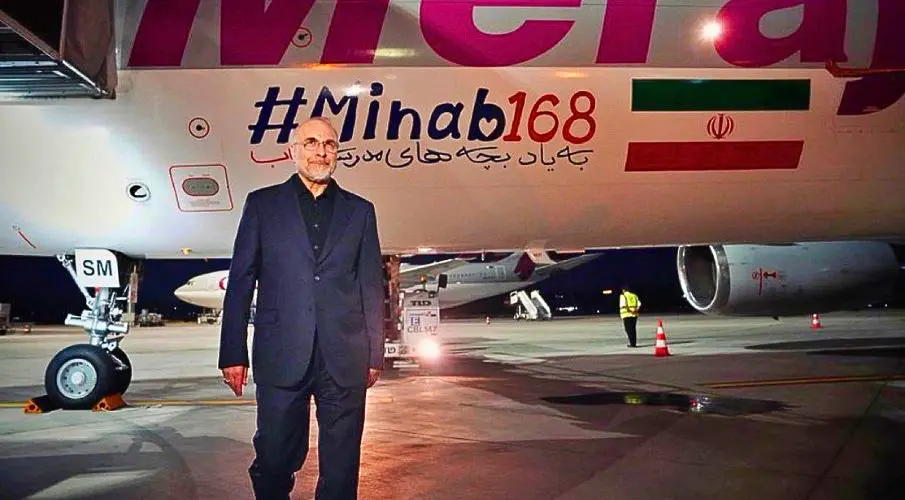
The Iranian negotiating delegation carrying the designation “Minab 168” arrived in Switzerland. According to Iranian accounts, the designation is meant to commemorate the 168 children killed in Minab and was displayed visibly on the aircraft.
The most difficult issue, the nuclear program and the uranium stockpile, was left for the next round, and it breaks into several parts. On enrichment, Washington demands that Iran suspend all enrichment for at least twenty years, while Tehran offered ten. On June 14 Trump suggested he could accept fifteen years but said he did not want to negotiate through the press and proposed limiting Iran permanently to low levels. Vance said the goal was a complete ban on enrichment throughout that period. Obama’s agreement allowed Iran to enrich, this one will not. Obama’s 2015 agreement, which Trump tore up during his first term, limited enrichment to 3.67 percent, enough for research and medicine, while a weapon generally requires around ninety percent.
As for the stockpile, the issue concerns what Iran accumulated after Trump withdrew from the agreement in 2018, enough material for at least ten bombs. In June 2025 the United Nations nuclear agency estimated that Iran possessed about four hundred forty kilograms enriched to sixty percent, plus roughly eleven tons at other levels. Last year the United States struck three major facilities, including a complex near Isfahan where, according to the agency, most of the material was stored, but since inspectors were locked out, its condition remains uncertain. Washington demands that Iran eliminate the stockpile entirely and offers to downblend it with the nuclear agency to safe levels. Another possibility would be shipping it abroad, as Iran did under the 2015 agreement with ninety eight percent of its stockpile. Tehran has not publicly stated whether it would surrender the entire stockpile. At the same time Washington insists on dismantling the facilities in Natanz and Fordow along with the storage tunnels at Isfahan, while Iran resists because that would mean giving up the right to enrich and insists that at least one facility must remain. Inspectors, who have had no access since last year’s attacks, are also expected by Washington to conduct inspections anytime and anywhere without notice. Rafael Grossi, head of the agency, said both sides wanted it to play a role in verification.
Iranian President Masoud Pezeshkian said Sunday at a conference in Tehran that the country would never abandon its right to enrich and that the United States would ultimately have to accept that. The talks, he said, were also a good way to resolve the economic situation, and the prospect of years with inflation above fifty or sixty percent was unacceptable to him. Whether all this can be settled in sixty days is doubted by Darya Dolzikova of the Royal United Services Institute in London. First, both sides must determine what Iran actually possesses today, an extensive task. She said she would not call it impossible, but the questions are extremely complex and sixty days is very little time. The deadline can be extended by mutual agreement, and Trump called it this week not a hard limit.

Vance’s performance is under particular scrutiny because he is openly considering a presidential run in 2028. Sharp criticism is coming from within his own ranks, and Republican hardliners in particular compare the agreement with Obama’s deal, which Trump and his party always claimed failed to end Iran’s nuclear program. Markets pushed oil futures down nearly eight percent after last week’s announcement, and when trading opens Sunday evening they will follow the talks closely. The administration is trying to reassure markets that the war was only a short disruption for oil prices while Americans complain about rising gasoline costs ahead of the summer travel season.

The place where all of this is being negotiated speaks its own language. The Bürgenstock has welcomed the richest and most powerful people for nearly one hundred fifty years. The Grand Hotel opened in 1873, built by Swiss entrepreneurs Franz Josef Bucher and Josef Durrer, who leveled the mountain ridge and created a retreat overlooking the lake and the Alps, accessible by funicular and a path cut into the cliff. Today it includes a spa, a golf course, tennis courts, a museum, an infinity pool above the lake, and restaurants, including one serving Persian cuisine, spread across nearly sixty hectares of forest. Audrey Hepburn married there in the mountain chapel in 1954, she and Sophia Loren kept residences there, and in 1964 the property appeared in the James Bond film Goldfinger. Jimmy Carter came here, along with Indian prime ministers Jawaharlal Nehru and Indira Gandhi, Israeli prime ministers David Ben Gurion and Golda Meir, and Konrad Adenauer. In 2024 it also hosted the conference intended to end Russia’s war against Ukraine, with around one thousand participants and fifty seven heads of state, the largest diplomatic gathering in Swiss history.
It is its own order of the world in which a war over nuclear weapons is negotiated in a wellness resort with a Persian restaurant owned by a Gulf state that is simultaneously acting as mediator. Between the mountain and the strait lies the entire distance of these days. On the mountain they say reliable and discreet, in the strait one side says open and the other says closed, and nobody knows which word governs the water. The only question for which the war was supposedly fought, whether Iran can ever build the bomb, is the only one they are not asking this Sunday. They postponed it the way people postpone the hardest thing and rode up into the heights where the air is thin and the view broad, while below, forty seven people and four soldiers can no longer count how long a ceasefire lasts.
Updates – Kaizen News Brief
All current curated daily updates can be found in the Kaizen News Brief.
To the Kaizen News Brief In English


Schutzgelderpressung, typische Mafiamethoden.
Es bleibt beim Hin- und Her.
Die angeblich wichtigste Frage zur Urananreicherung, die ja angeblich der Grund für den Angriffskrieg waren, wird weder gestellt noch wird darauf eingegangen.
Fakt ist, der Krieg hat nichts von dem „erbracht“, was Trump als Begründung angibt.
Aber MAGA feiert ihn, als den Mann, der den Iran in die Knie gezwungen hat.
Am höhnischten finde ich den Satz von Trump „er überlegt selber Zölle für Hormus zu erheben (mit Sicherheit verstößt das gegen internationales Recht und ist nicht verfassungsgemäß). Das Geld, schrieb er, sei für geleistete Dienste als Schutzengel der Länder des Nahen Ostens“
,,,schon schräg, wir arbeiten aktuell an dem artikel darüber für die Nacht MEZ