
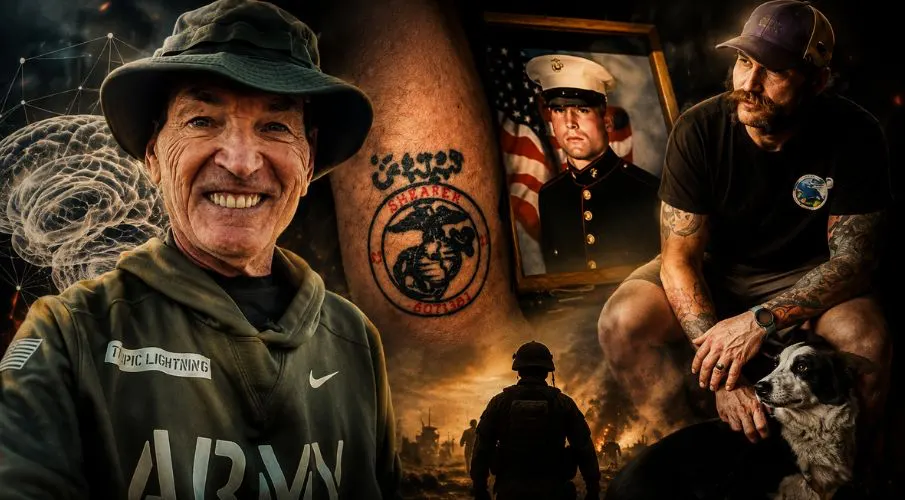
As a Marine in Iraq in 2005, Joe Shearer was knocked to the ground by the blast of an enemy mortar round. He became nauseous and vomited. Even so, he got back up and went right back on patrol, his head pounding with pain. Months later, a roadside bomb struck his Humvee convoy, and the blast wave tore through his entire body. As long as you could get back up and keep moving, he says, that's exactly what you did. Today he is 40 and lives in Colorado Springs. He was only diagnosed recently. What remains are dizziness, migraines, and sensitivity to light. His memory fails him, and he even forgets responsibilities to his wife and children.

The war with Iran is bringing those fears back. Nearly 700 U.S. service members have been wounded so far by drone and missile attacks on bases across the Middle East. Most suffered traumatic brain injuries and then returned to duty. Pentagon spokesman Sean Parnell described the vast majority of the cases over a two week period last month as mild concussions. That single word - mild - contains the entire minimization.
More than 500,000 U.S. service members have been diagnosed with traumatic brain injuries (TBI) since 2000, yet many cases go undetected or are initially classified as mild concussions. In its comprehensive review, the RAND Corporation analyzed 480 scientific studies published between 2015 and mid 2025, along with the funding behind this field of research. The findings are mixed. While more than $2.1 billion has been invested in military TBI research since 2015, the work remains highly fragmented and is often poorly coordinated. Most research focuses on diagnostics, imaging, and biomarkers, while treatment, rehabilitation, and long term care receive far less attention. Particularly surprising is that Special Operations Forces, despite facing especially high exposure to blast injuries, have been the focus of only a small number of dedicated studies. Most patients also suffer from additional conditions, especially PTSD, neurological disorders, mental health conditions, and sleep disorders. Long term consequences such as memory loss, cognitive impairment, and neurodegenerative diseases are receiving increasing attention, but they are still considered insufficiently understood. The authors therefore conclude that future research should place much greater emphasis on prevention, rehabilitation, long term outcomes, and the underlying causes of blast related brain injuries.

Traumatic brain injuries rarely occur alone. They are most commonly studied alongside PTSD, neurological disorders, mental health conditions, and sleep disorders.
A concussion is classified as a mild traumatic brain injury, and many people recover within a few weeks. Others carry the symptoms for months or years - headaches, dizziness, difficulty concentrating, and the mental haze known as brain fog. No physician can predict who will suffer lasting effects, which is why some experts argue that the term mild traumatic brain injury should be abandoned altogether. Multiple injuries dramatically increase the risk of permanent damage, including the disease CTE, which became widely known through former NFL players. What matters most, says University of Pittsburgh brain trauma specialist David Okonkwo, is that a person fully recovers before being exposed to danger again. Even the blast wave itself can damage the brain, differently from a direct blow to the head, explains James Kelly of the University of Colorado, who serves as the chief medical scientist of the Invisible Wounds Foundation.

Memory loss, cognitive deficits, and diseases such as CTE, Alzheimer's, and Parkinson's are among the most important long term neurological consequences being studied in military TBI research.
The war with Iran has introduced a new kind of battlefield. Drones often explode close to soldiers' heads, whereas in Iraq and Afghanistan the primary threat came from roadside bombs hidden in the ground. Democratic senators are now calling for an investigation into the medical care provided to wounded troops after an Iranian drone strike in Kuwait that killed six U.S. service members at the beginning of the war. Senator Tammy Baldwin says she has spoken with troops who suffered these injuries in Trump's war with Iran and were not even screened for weeks. The Defense Health Agency counters that all service members are screened according to established policy.

Military TBI research focuses primarily on diagnostic methods. Rehabilitation and long term care account for only a small share of the scientific literature.
Experts acknowledge that diagnosis and treatment have improved. According to the U.S. military, 82 percent of traumatic brain injuries diagnosed between 2000 and 2025 were classified as mild. But experts believe the true number is much higher because the symptoms often overlap with post traumatic stress disorder. A wound that leaves no visible mark has to fight to be believed. We tend to believe what we can see, and we doubt the pain that leaves no visible trace.

Neither of the two explosions left Shearer with a visible injury. Medics treated the more seriously wounded Marines first. No one wanted to look weak in front of their team, he says, so injuries were hidden almost automatically. He returned home at 19, denied having post traumatic stress disorder, and did not even know what a traumatic brain injury was. Nightmares and sleepless nights drove him to drugs, and at times he considered suicide. It was only years later, while screening fellow veterans at the Wounded Warrior Project, that he recognized the signs in himself. Some conversations, he says, disappear completely from his memory.

Frank Sonntag also lost part of his memory after a mortar explosion in Iraq in 2004. He was over 50 and training reservists when an explosion about 70 feet away sent a blast wave past his ear. He noticed nothing at the time and did not seek help until two years later, even though his headaches worsened and his concentration steadily declined. Eventually it took him 30 minutes to write a single email, and coworkers said he spoke only about one word every 10 seconds. He also considered suicide. It was only after he became lost while driving home that neurologists found the correct diagnosis. In addition to medication for his migraines, speech therapy helped him the most, teaching him once again how to form words and build sentences.

Blast injuries dominate military TBI research. Other types of injuries, such as penetrating brain injuries or repeated mild traumatic brain injuries, receive significantly less scientific attention.
Kelly Parker of the Wounded Warrior Project says every brain injury follows its own course. If you've seen one traumatic brain injury, she says, you've seen exactly one traumatic brain injury. The key is early diagnosis, prompt treatment, and long term support. Physical rehabilitation, speech therapy, and even art therapy can make a significant difference. We still know surprisingly little about the brain, she says, but it is capable of healing itself and forming new neural pathways. Army veteran Spencer Milo still struggles with migraines, seizures, and memory lapses after suffering his first injury in Iraq in 2008, when his Humvee swerved to avoid enemy fire and crashed into a wall, and a second in Afghanistan in 2011 during a suicide bombing. Even fellow service members have asked him why he cannot just get over it. The hardest part, he says, is that many people assume an injury they cannot see does not exist.
Anmerkung der Redaktion: Editor's Note: This article discusses suicide. If you or someone you know needs help, the 988 Suicide & Crisis Lifeline is available in the United States by calling or texting 988. In Germany, TelefonSeelsorge is available 24 hours a day at 0800 1110111, 0800 1110222, or 116 123. In Austria, TelefonSeelsorge can be reached at 142. In Switzerland, adults can contact Die Dargebotene Hand at 143, while children and teenagers can call 147. 988 Suicide & Crisis Lifeline unter 988. In Deutschland ist die TelefonSeelsorge rund um die Uhr unter 0800 1110111, 0800 1110222 or 116 123 erreichbar. In Österreich hilft die TelefonSeelsorge unter 142. In der Schweiz erreichen Erwachsene die Dargebotene Hand unter 143, Kinder und Jugendliche die 147.
Updates – Kaizen News Brief
All current curated daily updates can be found in the Kaizen News Brief.
To the Kaizen News Brief


Danke, dass Ihr das sichtbar macht.
Eine Gehirnerschütterung gehört immer zeitnah abgeklärt und eine Schonung ist ein Muss.
Im Kampf will jeder seinen Mann/Frau stehen.
Wer nicht stark blutet, gebrochene Arme/Beine oder fehlende Gliedmaßen hat, kämpft weiter.
Jede Gehirnerschütterung hinterlässt Mikroverletzungen im Gehirn.
Diese sind per se nicht gefährlich und schränken in der Regel auch nicht ein.
Nur leider bleibt es in der Regel nicht bei einer Gehirnerschütterung.
Training, aktive Kampfhandlungen, das springen in Gräben, etc.
All das sorgt für weitere Erschütterungen, ohne dass man von einer Gehirnerschütterung spricht.
Aber die Folgen werden dann immer sichtbarer.
Dazu leider häufig PTBS und eine unzureichende medizinische Versorgung.
So landen Veteranen auf der Strasse, anstatt man ihnen hilft.
Ihr Leben bekommen sie ohnehin nicht wieder.
Genau so wenig, wie MMA Kämpfer, Boxer, NFL Spieler etc.
Alle haben ein hohes Risiko für CET.
Bei Veteranen gepaart mit PTBS kann das auch für das Umfeld gefährlich werden.😞
Ach ja, und das sind dann die Veteranen, die gemäß Trumps künftig Trucks über die Highways steuern sollen…