
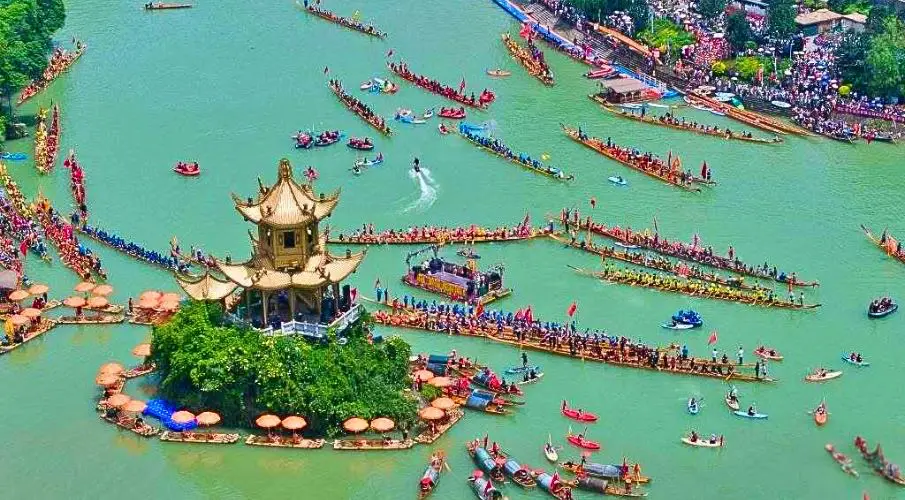
On Friday, China, Hong Kong, and Taiwan celebrated the more than two thousand year old Dragon Boat Festival, known for its races but in essence an ancient festival of health and protection, born from the desire to live in harmony with nature. To this day, people still throw food into the river for a poet who sank into it long ago.

Before the Dragon Boat Festival, Chebei Village in Guangzhou held one of its most important and traditional Dragon Boat Festival celebrations: “Zhaojing,” which can roughly be translated as “sending invitations.” With a history of more than 300 years, Chebei’s dragon boat culture keeps alive a centuries old Cantonese tradition of mutual visits between dragon boat communities. Locally, this custom is known as “Zhaojing.”
On Friday, dragon boat races and lion dances moved across the mainland, through Hong Kong and Taiwan, and everywhere people celebrated the Dragon Boat Festival, which is more than two thousand years old. It is best known for its races, yet its origins lie in ancient ideas of health, protection, and maintaining a good relationship with nature. The fact that the festival has been preserved for thousands of years shows how much people value their inherited customs, said Meng Dongmei, a retiree from Beijing’s Tongzhou District. Her family keeps the festival in many traditional ways. They prepare zongzi, the sticky rice dumplings associated with the celebration, and the children wear five colored bands believed to ward off evil. Online they had also found an old recipe for cooking eggs with mugwort leaves and red dates, together with brown sugar and ginger. It is said to protect against illness and keep people healthy throughout the year, Meng said, and so the family hopes the festival will bring them health.
Beijing’s celebrations continue through the weekend along the capital’s Grand Canal. Over three days, men’s and women’s teams compete, along with mixed teams, over one hundred and two hundred meters, and also over five hundred. Teams are coming from Beijing and Tianjin, from Hebei, Shanxi, and Guangdong. More than one thousand athletes and two hundred thousand spectators are expected, organizers said. The competition strengthened the spirit of the team, said Li Maoshan, who rowed on Friday, and gave participants an opportunity to show endurance and dedication.


Beyond the races, there was more to see. Demonstrations of the martial art Wing Chun and a market featuring traditional crafts, along with a dance in which performers imitate the movements of a lion. These performances were intended to highlight cultural exchange between northern and southern China. Friday’s lion dance came from a group in the southern province of Guangdong. Wherever people celebrate, you find dragon and lion dances, said He Weihong, who founded the group. Dragon boat racing and dragon and lion dancing are inseparable, both belong to the country’s intangible cultural heritage. The roots go deeper than sport. The festival is closely tied to the ancient poet Qu Yuan, who according to legend drowned himself more than two thousand years ago. People, the story says, rowed out to search for him and threw rice into the river so fish would not eat his body. To this day, that story remains linked to the races and to the zongzi that are still prepared throughout China.

“To the rhythm of thunderous drumbeats, the boats glide across the water - an ancient tradition.”
The Dragon Boat Festival is probably the richest and most diverse of all traditional Chinese festivals, said Liu Xiaofeng, who teaches history at Tsinghua University. In different regions, people developed many customs rooted in ideas surrounding the summer solstice and the balance of yin and yang. The festival falls in the fifth month of the traditional lunar calendar, around the time of the summer solstice, which the ancients regarded as a season when insects and poisonous creatures multiplied and illness drew closer. From that came the many customs meant to protect health and drive away misfortune.
At its core, Liu said, the festival is about warding off sickness and misfortune and preserving health. Some people carry pouches filled with medicinal herbs during the festival, others fill their homes with smoke to drive away what is considered harmful. Chinese culture, Liu said, has always placed value on happiness and well being, on living peacefully and safely, and almost all major festivals are connected in one way or another to those wishes.
In Hong Kong, some participants at Friday’s races wore costumes, including a cartoon version of the Taoist deity Ne Zha. Led by the booming beat of drums, rowers pulled their paddles through the water in perfect rhythm, and each boat shot toward the finish while spectators cheered. Others watched the races from home and ate zongzi with their families. Today, more than sixty four out of every hundred people live in cities, Liu said, and ways of living have changed. In a large city, the festival cannot easily be celebrated as it once was in villages, and traditions change with time. Bao Nari, a woman from Beijing who spent years studying in Japan, said the boat races had not been part of the festivals of her childhood, but other old customs such as the five colored bands had been passed down in her family. Since returning home, she has been impressed by how much the culture has grown, a heritage rooted deeply in people’s hearts that gives her generation greater confidence.
And so what is more than two thousand years old survives not as stone but as a gesture repeated again and again. A dumpling shaped by hand, a ribbon tied, an herb burned, a boat rowed in time with the drum. What began as protection against the dangers of the season has become a wish people offer one another, the wish for health and peace. And still, year after year, a people rows out and gives food to the river for a poet who disappeared long ago. Perhaps only what people continue to care for remains alive, and perhaps a tradition survives precisely because it changes and is carried into each new life.
Updates – Kaizen News Brief
All current curated daily updates can be found in the Kaizen News Brief.
To the Kaizen News Brief In English


Es ist unglaublich toll, wie dieses Fest die Jahrhunderte überstanden hat.
Kriege, Tegimewechsel, Repressionen.
Aber die Menschen feiern das Drachenbootfest weiter. 🎎