
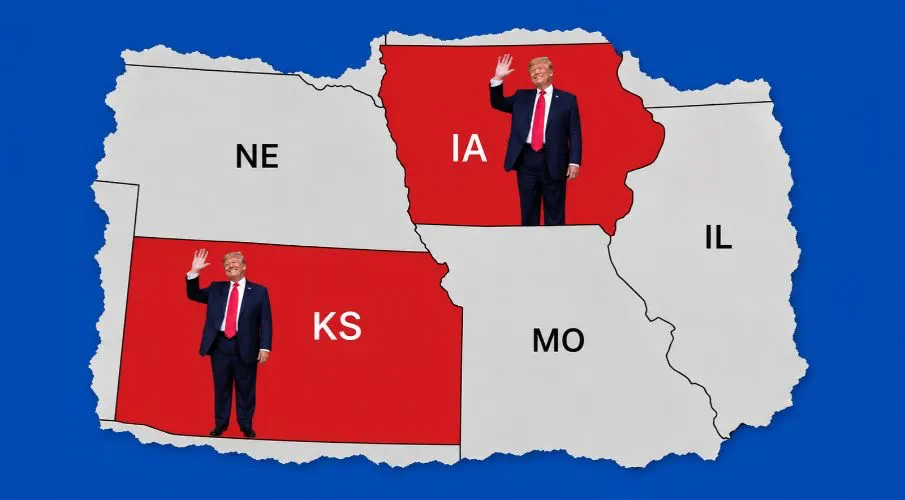
A ringing phone tells you more about the situation than any poll ever could. Especially when it's the president's phone. On Thursday, October 29, everything was still just fine in Donald Trump's world. He wasn't going to Kansas anymore, and he wasn't going to Iowa either. Republicans were in good shape in both states, the White House assured everyone, and the president could reach his supporters much more effectively by phone anyway. Trump himself saw no reason to make the trip. Senator Roger Marshall was doing an excellent job, and his party would celebrate a big victory on election night. A reporter asked whether the cancellations might have something to do with the strain of campaigning. That's when Trump got personal, insulted the man, and insisted he felt perfectly healthy.
A Reuters reporter asks a question. The American president responds with insults: "You are a sick guy!" He then attacks the reporter's appearance, saying he's "way out of shape" and telling him to get in shape because he looks terrible. Trump also goes after the news agency: "Reuters is terrible, by the way."
Healthy enough, at least, to turn everything upside down a day later.
By Friday, the travel plans were back on. On Sunday, November 1, Trump plans to fly to Iowa first, then Kansas, just hours before the November 3 midterm elections. The trip that had been unnecessary only a day earlier had suddenly become urgent overnight. Things had hardly improved during the night. What changed was the way he looked at them.
The president immediately offered an explanation, and it's a little work of art. People from both states had called him, including some very good friends. They had asked him to come in person because that would be better than a rally over the phone. He had initially tried to talk them out of it. But they insisted. So now he's holding two rallies on Sunday.
Reporter: Can you explain all your scheduling changes?
Trump: I wanted to see if I could do telerallies because I do 'em well. I'm unbelievable at telerallies. It only seems to work for me. We are in good shape in a lot of states. They said if you can go, it will be better than a telerally. I tried to talk them out of it. These are telephonic rallies.
A man who doesn't like being asked for favors lets himself be persuaded. Out of friendship. Naturally, it has nothing to do with the map of Senate races. Friendship is an amazingly precise force during campaign season. The calls come from exactly those states where the races are getting tight.
His love of telephone rallies hasn't suffered from the change of course. He's incredibly successful at them, Trump explained. Other politicians can call, but nobody picks up. For him, it works beautifully. He announced more of these appearances for Monday. The White House was now talking about nearly 20 additional telephone events, around which the travel schedule had been arranged. The official explanation changed as quickly as the calendar, and in the end, both pointed in the same direction, westward, toward the prairie.
The polls explain why. In Kansas, where a Republican has been practically crowned rather than elected since time immemorial, Marshall is trailing Democrat Adam Hamilton. A poll conducted from October 26 to 28 showed Hamilton ahead, 50 to 47 percent. Other surveys painted a closer picture, while some had Marshall trailing by as many as 10 points. Not much remains of the excellent position Trump was bragging about on Thursday. A senator who's doing an excellent job doesn't need a president showing up on Sunday.
In Iowa, Republican Congresswoman Ashley Hinson is fighting Democrat Josh Turek for a Senate seat. Several polls show a race with no clear winner. In the average of surveys recorded through October 28, Hinson led by a grand total of 0.5 points. Half a point is a number you can cover with your thumb. Apparently, it's enough to warrant a presidential visit. For weeks, Trump has been traveling through states where Republican victories were long considered laws of nature. Even Florida and South Carolina are now shaping up to be close races. Some of his appearances are taking place in smaller venues. At some events, people were seen leaving before he finished speaking. Trump still talks about enormous crowds. The room gets smaller, the number coming out of his mouth gets bigger.
So, Iowa and Kansas on Sunday. His friends asked him to come, Trump says. His candidates need every vote they can get, the numbers say. Between those two explanations lie two canceled appearances, two new dates, and a president whose phone had to ring before he could hear what the voters had been saying all along.
Updates – Kaizen News Brief
Alle aktuellen ausgesuchten Tagesmeldungen findet ihr in den Kaizen Kurznachrichten.
To the Kaizen News Brief In English


