
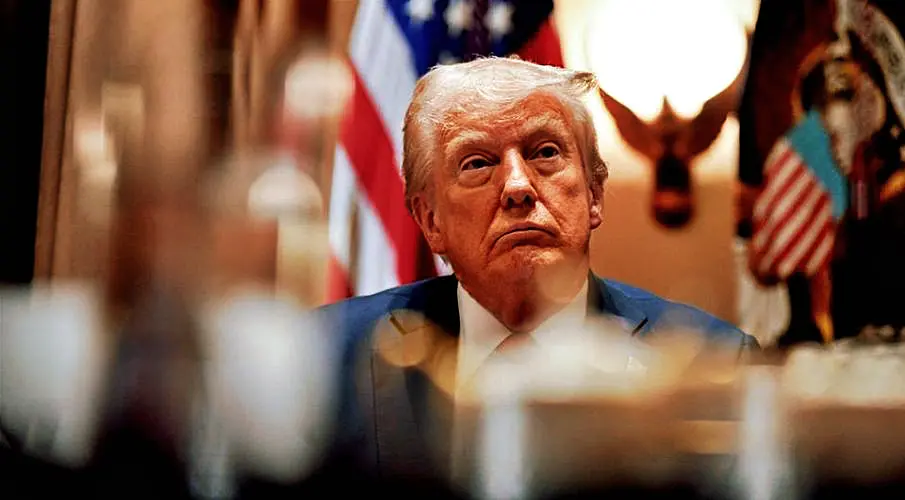
Donald Trump declared Wednesday in the Oval Office that a deal with Iran was “very possible.” Only hours earlier, the same president had threatened Iran with new bombings. If Tehran failed to agree to American demands, “the bombing will start again,” Trump wrote on Truth Social. The attacks, he said, would then take place “at a much higher level and with greater intensity” than before. A few hours later, he was once again speaking about good talks, progress and a possible breakthrough.
Exactly these contradictory messages now define the entire American line in this war. While Secretary of State Marco Rubio had still declared on Tuesday that the war was over, Trump on Wednesday again spoke about possible airstrikes. At the same time, he suddenly referred to the conflict in the White House merely as “a little skirmish.” Meanwhile, roughly 50,000 American troops remain deployed throughout the region. Aircraft carriers, destroyers, naval units and fighter jets remain on alert while Washington publicly speaks simultaneously about peace and new attacks.

Completely different statements also came from Tehran on Wednesday. Iranian Foreign Ministry spokesman Esmail Baghaei declared that the government is currently reviewing an American proposal to end the war. Iran, he said, would deliver its response through Pakistani mediators. Only hours earlier, another Iranian official had dismissed the same proposal as “a list of American wishes.”
Intensive negotiations are reportedly taking place behind the scenes. According to multiple reports, the discussions revolve around a one-sided fourteen-point memorandum being negotiated between American envoys and Iranian representatives. Steve Witkoff and Jared Kushner are reportedly engaged in both direct and indirect talks with Iranian officials. According to the available information, Washington is demanding, among other things, a halt to uranium enrichment. In return, sanctions could be lifted and billions of dollars in frozen Iranian funds could be released. The situation surrounding the Strait of Hormuz is also part of the negotiations.
It is precisely there that the situation remains tense. The United States unexpectedly halted its naval escort operation for commercial ships and justified the move by citing “major progress” in the talks. At the same time, US Central Command declared Wednesday that an American fighter jet had disabled an Iranian oil tanker. The tanker, according to the statement, had attempted to break through the American blockade and ignored warnings. An F/A-18 Super Hornet then fired multiple shots at the ship’s rudder. The vessel is now reportedly unable to continue toward Iran.

The economic consequences of the crisis continue to be felt worldwide. Oil prices fell sharply at times on Wednesday because investors hoped for de escalation, but uncertainty remains enormous. France and Britain continue working on an international naval operation to secure shipping routes. France has already moved the aircraft carrier Charles de Gaulle toward the Red Sea. President Emmanuel Macron is now openly demanding that the Strait of Hormuz be fully reopened immediately, regardless of whether a final peace agreement is reached.
Israel is also visibly preparing for renewed escalation. After talks with Trump, Prime Minister Benjamin Netanyahu declared that both governments still pursue the same objective - the complete removal of enriched uranium from Iran and the destruction of Iran’s enrichment capability. Netanyahu said Trump believes this objective will be achieved “one way or another.” At the same time, he said he had instructed Israeli forces to prepare for every scenario.
In addition, Israel again escalated the situation in Lebanon on Wednesday. For the first time since last month’s ceasefire, the Israeli Air Force once again struck targets in the southern suburbs of Beirut. Israel stated that the target was a commander of Hezbollah’s Radwan unit.
Meanwhile, Trump continues publicly trying to project optimism. In the Oval Office, he said Iran very much wants to make a deal. Speaking to Fox News, he even suggested that an agreement could possibly be reached within a week. Shortly afterward, however, he already walked the statement back and declared there was no fixed timeline at all.
That is now the actual problem with these negotiations. Hardly any statement survives longer than a few hours. Washington says the war is over. A few hours later, new bombing threats follow. The White House says talks are going extremely well. At the same time, Tehran declares American demands unrealistic. Trump says military operations are being ended. Shortly afterward, another Iranian tanker is fired upon.
The situation in the Middle East therefore continues to hang on contradictory messages, personal threats and improvised diplomacy. Officially, the war is over - until someone orders more bombing again.
To be continued ...
Updates – Kaizen News Brief
All current curated daily updates can be found in the Kaizen News Brief.
To the Kaizen News Brief In English


„… Donald Trump erklärte am Mittwoch im Oval Office, ein Abkommen mit dem Iran sei „sehr gut möglich“. Nur Stunden zuvor hatte derselbe Präsident dem Iran mit neuen Bombardierungen gedroht… und dann jam wieder die Aussage, dass die Gespräche sehr gut laufen.“
Damit verdient sich Trump mit seiner Entourage eine goldene Nase.
Die Märkte, vor allem der Ölpreis, reagieren auf jedes Räuspern von Trump.
Eine Öffnung der Strasse von Hormus ohne Frieden zu fordern, ist sinnlos. Das sollte Macron wisse
WederTrump noch der Iran werden das machen.