
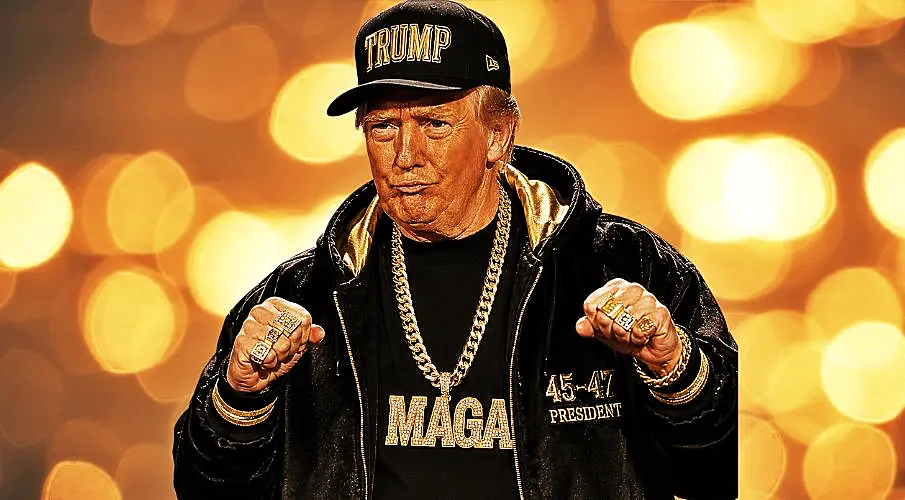
There is a type of photograph that nobody takes of themselves because the outcome is already known. You stand next to another person, a tripod hums, and for the rest of the week you know where you stand. Donald Trump did not just take such a photograph today. He posted it online, put it under a headline in capital letters, and informed the world what it supposedly showed: that he was becoming younger.
"President Trump is getting YOUNGER," the text above the image read. Beneath it, from Trump himself: "President Xi and President Trump are FANTASTIC!"

One should pause here briefly, the way people pause when someone at a family gathering grabs a microphone and says something that cannot be taken back.
In just a few weeks this man will turn eighty. Eighty is an age when other people look for their glasses, confuse their grandchildren, and secretly feel pleased when the elevator is working. Trump, meanwhile, sits in the Oval Office surrounded by wars, a divided Congress, courts that do not obey him, and an Iran that refuses to stop being a problem, and at that exact moment, of all moments, decides to inform posterity of a characteristic that no person and no physician has ever identified in an eighty-year-old.
The story had a beginning. The photograph comes from his China trip earlier this month, and even back then, during an interview with Sean Hannity, Trump spent a surprisingly long time talking about the wrong man. Not trade balances. Not Taiwan. Xi Jinping's height. Xi is tall, Trump said, very tall. Xi stands at around five feet eleven. Trump has claimed for years that he is six foot three. Anyone who has seen them standing next to one another understands why those four inches mattered enough to the president that he brought them up during a television interview.
Then came the return to Washington, and with it perhaps the most revealing moment of the entire story. Trump stood before the press holding a large sign in front of his stomach displaying his planned White House ballroom project. Architecture, one might think. Affairs of state. But Trump explained to journalists with complete openness what the sign was actually for:

"I look so thin. They're going to say, Oh, he's gotten so thin. You don't have to look at my waist. You can look at this. You've seen enough of my waist together with President Xi in China."
That is the moment where the scene changes. A head of state holds a sign in front of his own body and tells reporters standing nearby that they should please look at the sign instead of him. It is a gesture from a schoolyard delivered with the authority of the most powerful office on Earth, and nobody in the room laughed because nobody seemed certain whether they were supposed to.
The numbers the sign was apparently meant to protect are not secret. During his examination at Walter Reed Medical Center last year, Trump weighed 224 pounds, just over one hundred one kilograms, with a body mass index of 28. Medically speaking, that means overweight. It is not a dramatic figure. It is the figure of an average man of his age, and that seems to be exactly the problem. In Trump's world, average is a diagnosis.
He ignores BMI anyway. What is harder to ignore can be seen in recent images of his hand. Observers have repeatedly pointed to discoloration and bruising that later appeared to be covered with makeup in photographs, a hand on which someone placed cosmetic cover in the hope that nobody would notice, which is of course the most reliable way to ensure everyone notices. Former Johns Hopkins professor John Gartner put it this way: you do not have to be a specialist to see the changes.
Trump sees it differently. Or, more likely, Trump is interested in something entirely different.
ecause anyone who listens to him long enough notices that he talks about youth, bodies, and appearance as casually and constantly as other people talk about the weather. During a Coast Guard graduation ceremony, he praised graduates not for discipline or achievement, at least not at first. He spoke about their fitness and appearance. When a particularly successful young man approached him, the President of the United States said into an open microphone: "I hate good-looking men."
"I hate good looking men. We also have the only cadet who earned a perfect score on every single fitness test. I wanna check him out. Look at the muscles on this guy."
It was a joke. It was not a joke. It was one of those statements that in Trump's mouth hangs somewhere between humor, admiration, and an almost painful honesty, and the young man smiled politely, the way people smile when they suddenly find themselves inside something much larger than themselves.
On June 14 Trump will turn eighty. According to reports, the celebration is expected to include UFC fights on the White House grounds, men hitting each other inside a cage as birthday entertainment for the president. "It's going to be the greatest show in the world," he said. One imagines the lawn, the floodlights, the cage, and behind it the White House with its columns where decisions about slavery, war, and the moon landing were once made. And perhaps this is where makeup stops helping. Previous presidents tried to prove strength through what they did, through laws, through treaties, through enduring crises. Trump proves it through what people see. Through height. Through weight. Through the hand. Through the face.
So while the rest of humanity eventually stands in front of a mirror and quietly acknowledges that another year has passed, Donald Trump sits with his phone and writes an equation that would fail in every school in the world. Seventy-nine plus one. The result, announced in capital letters, is: younger.
Updates – Kaizen News Brief
All current curated daily updates can be found in the Kaizen News Brief.
To the Kaizen News Brief In English


Ein Narzisdt und Soziopath kann nicht altern.
Nicht in seiner Welt.
Altern bedeutet Schwåche.
Und da klafft die eigene Vision weit, weit von der Realität auf.
Er sieht, wenn man kein KI oder Photoshop verwendet, definitiv deutliche älter aus.
Falten, Tränensäcke, blaue Flecken, schütteres Haar.
Aber immerhin das rechte Ohr ist so perfekt geheilt, dass man bicht die Narbe vom Streufschuss sieht.
Selbstverständlich hasst er gut aussehende Männer.
Sie haben auf jeden 2 Attribute, die er nicht hat.
Jung sein und gut aussehend (das hatte er auch nie… Frauen haben sich nur wegen des Geldes mit ihm eingelassen)
Nach gut aussehenden Männern drehen sich die Frauen um.
Nach Trump vielleicht, wenn er in jeder Hand mit einem dicken Bündel 100$ Scheinen wedelt.
Da er ja immer präsent sein muss,fallen Facelifting und andere Schönheits-OP weg.
Botox alleine reicht da nicht mehr.
Vielleicht sollte er sich mal den Film „Die unglaubliche Geschichte des Benjamin Button“ ansehen.
Aber das übersteigt wahrscheinlich seinen IQ