
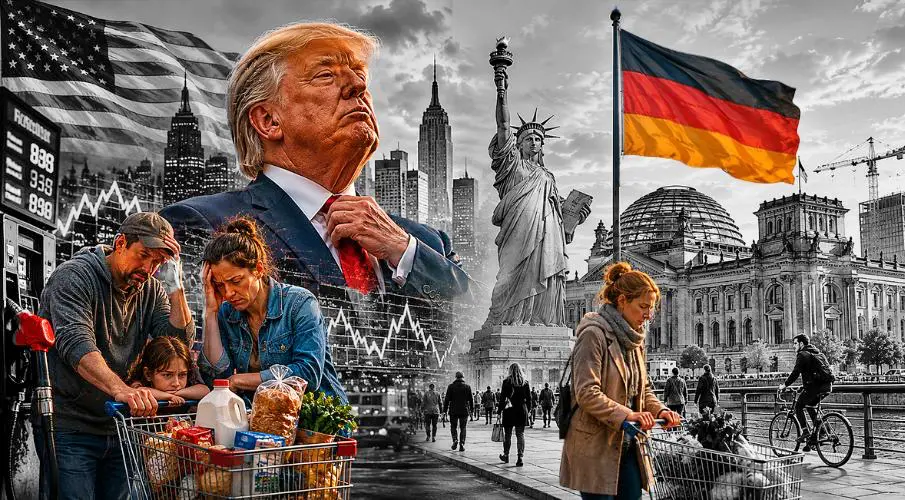
Inflation in the United States is surging again with full force. Gas prices are exploding, food is getting more expensive, electricity costs are climbing, clothing prices are rising, and even dental visits or car repairs are slowly becoming a financial problem for many families. New figures from the U.S. Commerce Department show inflation rose to 3.8 percent in April. It is the highest level in three years. For millions of Americans, it means one thing above all else. Their money is no longer enough.
Particularly alarming is the fact that inflation adjusted incomes are now falling again. For the third consecutive month, many people have been losing real purchasing power. Wages are not rising fast enough to offset price increases. At the same time, pressure is mounting on families whose daily lives are already dominated by higher costs. The official numbers still show minimal growth in consumer spending. But practically all of it is already being swallowed by rising prices.
Many people in Germany are also continuing to feel the impact of rising prices. Food, rent, electricity, and insurance are placing a heavy burden on countless households. Yet a clear difference is currently emerging compared to the United States. While inflation adjusted incomes in America are once again declining, real wages in Germany are still rising slightly. Income growth is currently moving somewhat faster than inflation. In the first quarter of 2026, wage growth stood at around 4.1 percent, while inflation ranged between 2.2 and 2.9 percent.
Despite all criticism of the German government, Germany’s economic policy currently appears significantly more stable than the mix of war policy, tariff conflicts, and constant economic escalation coming out of Washington. That does not mean Germany’s situation is problem free. High energy costs, a weaker industrial sector, and enormous uncertainty continue to weigh heavily on many people and businesses. At the same time, anxiety is also growing here because the war in the Middle East, rising energy prices, and the economic consequences of American policy could quickly reverse the trend once again.
The war against Iran is dramatically worsening the situation. Since the beginning of the U.S. and Israeli attacks on Iran, gasoline prices have risen by more than 50 percent. At times, the average price in the United States reached around $4.50 per gallon. Before the war, prices were still below three dollars. For many Americans, this is the moment when politics suddenly becomes concrete. The drive to work costs more. Groceries cost more. Electricity costs more. Life costs more.
Donald Trump, however, appears almost completely unfazed by it. He described rising gas prices as “peanuts.” Earlier, Trump had also declared that he did not think “even a little bit” about Americans’ personal finances when making decisions about the war. Statements like these are now colliding with a population that is growing increasingly skeptical about the economic situation. Public sentiment toward the administration is visibly deteriorating. Treasury Secretary Scott Bessent is also attempting to downplay developments. Higher prices are only “temporary,” he said on Wednesday. For many Americans, the phrase recalls the inflation crisis of 2021 and 2022, when the government likewise insisted for a long time that rising prices would disappear quickly. Today, the wording feels like a repetition of old mistakes.
The Federal Reserve is therefore coming under increasing pressure. Many businesses and consumers had hoped for interest rate cuts. But the new inflation data could trigger the opposite. Several Federal Reserve officials are now even signaling that under new Fed Chair Kevin Warsh, additional rate hikes may become possible. That would make loans, mortgages, and financing even more expensive. Economists are already openly warning of a new phase of long term price increases. Particularly problematic is the fact that inflation is no longer being driven solely by energy prices. Food, clothing, veterinary costs, electricity, computer technology, and services are all rising simultaneously. Added to this are massive investments in AI infrastructure, creating additional demand and new costs.
Despite all of this, the American economy is still growing slightly for now. Wealthier households in particular continue spending relatively steadily. Major technology corporations are investing enormous sums into new AI centers and data facilities. Yet that itself is becoming a new source of division. While parts of the economy continue investing, many ordinary households are coming under increasing pressure. The situation now feels like a warning sign for far more than just the United States. Economic pressure, uncertainty, and rising living costs are exactly the conditions under which radical parties grow. In Germany as well, people often pretend that the AfD has simple answers to complex economic problems. In reality, the opposite has been visible for years. A great deal of noise, a great deal of scapegoating politics, but hardly any serious economic solutions.
A society that is constantly turned against itself, that attacks institutions, destroys international cooperation, and operates through permanent political escalation does not create prosperity. A party that continuously manufactures conflict, fuels insecurity, and pits entire population groups against one another will not become a country’s economic salvation. States do not collapse only because of bombs or wars. They can also be destabilized from within - by political forces that turn mistrust, chaos, and permanent confrontation into a governing style of their own.
Updates – Kaizen News Brief
All current curated daily updates can be found in the Kaizen News Brief.
To the Kaizen News Brief In English


Da ich im FB Chat nicht berechtigt bin, zu kommentieren, mache ich es hier. Ich tue mich schwer, Lohnstrukturen zwischen USA und Deutschland zu vergleichen. Ich kann nicht erkennen wie Du zu der Überzeugung kommst, dass in Deutschland die Reallöhne noch moderat steigen. Möglicherweise verzerrt der Blick sich, weil Bruttolöhne verglichen werden, ohne die Sozialabgaben einzurechnen bzw. Lohnsteuern. Andererseits schützen aber genau die Abgaben in die Sozialversicherung die Menschen in Deutschland vor dem freien Fall. Um so niedriger die Einkommen sind, um so schwieriger wird es aber auch die Inflation durch Arbeitseinkommen abzufangen.
Zudem definieren konservativ denkende Ökonomen und Politiker genau die Arbeitgeberanteile an Sozialabgaben als als Standortnachteil. Hier wird nur betriebswirtschaftlich gerechnet. Arbeitgeber ziehen aber wie Arbeitnehmer auch volkswirtschaftlichen Nutzen und den wollen sie nicht gegenrechnen. Denn neben Nutzung von Infrastruktur, Energie und Wasser sind auch gesunde Arbeitnehmer eine Ressource, die Arbeitskosten niedrig und stabil hält. Um so niedriger jedoch das Arbeitseinkommen netto ausgezahlt wird, um so geringer ist die Chance für Arbeitnehmervon Arbeit ohne zusätzliche staatliche Unterstützung leben zu können. Und genau hier beisst sich die betriebswirtschaftliche Katze in den Schwarz. Denn Wohngeld, Grundsicherung, Kindergeld usw.geben den Menschen das, was normalerweise der Arbeitslohn ermöglichen müsste. Zudem erhebt der Staat keine direkten Gebühren für Infrastrukturnutzung sondern erhebt Steuern, die dann auch nicht zielgerichtet z.B. in den Straßenbau, Netzinfrastruktur für Energie usw. verwendet wird. Beispielsweise erhebt Deutschland über den Spritpreis hohe Steuern, verzichtet aber auf Maut und erhebt Kraftfahrzeugsteuern ohne eine Kilometernutzung einzurechnen.
…wieso kannst Du nicht kommentieren? Hattest Du doch schon bereits? Habe es nochmal gecheckt, funktioniert – Dann meine genaue Bezeichnung : … steigen die Reallöhne in Deutschland aktuell noch leicht an …, und = Die Einkommen wachsen damit momentan etwas schneller als die Inflation, das bedeudet = Reallohn bedeutet: Lohnentwicklung nach Abzug der Inflation. Der Artikel bezieht sich auf die Inflation, nicht auf einen direkten Lohnvergleich. Die Sozialabgaben usw in der BRD sind uns bekannt. Den Abgleich unserer Zahlen habe ich mit dem Bundesamt für Statistik vorgenommen – Wir reden hier von zwei verschiedenen Ausgangspunkten.
Wenn man Geld hat, jucken einen die Sorgen und Nöte des eigenen Volkes nicht.
Trump ist mit dem goldenen Löffel im Mund aufgewachsen.
Sein Vater hat mit Geld alles bereinigt/besiegelt.
Arme Menschen oder der Mittelstand, dass sind für Trump Looser.
Menschen, die auf Unterstützung angewiesen sind Looser.
Zitat: „Die Inflation in den Vereinigten Staaten steigt wieder mit voller Wucht. Benzinpreise explodieren, Lebensmittel werden teurer, Stromkosten ziehen an, Kleidung kostet mehr und selbst Zahnarztbesuche oder Autoreparaturen entwickeln sich für viele Familien langsam zu einem finanziellen Problem.“
MAGA behauptet weiter, dass es ihnen besser geht als unter Biden oder Obama.
Obwohl der Kontostand und Rechnungen eine andere Sprache sprechen.
Die Gehirnwäsche funktioniert schon so perfekt, dass die Realität den Worten der Trump Regierung untergeordnet wird.
Meine MAGA Bekannten finden, dass es Ihnen jetzt viel besser geht.
Spoiler: Ist nicht so
Der Eine wollte vor 2 Jahren zurück nach Hawaii ziehen. Aber entschied sich die Wahlen abzupassen, damit er wählen kann.
Und nun ist das Ziel von 2025, zu 2026 auf Ende 2027 gewandert… was ich auch bezweifel.