
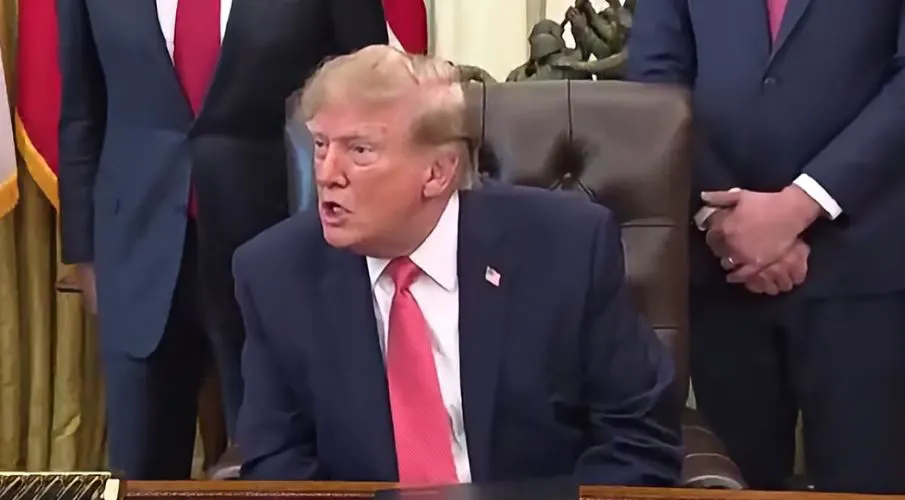
Donald Trump wants a third term. At least he talks about it as though the U.S. Constitution were a piece of paper he could fold and refold any way he pleases. On Tuesday, October 20, 2026, he's sitting in the Oval Office, declaring that the United States has never had a more secure border. That's been the case since the beginning of his second term, he claims. Then he corrects himself: "Or my third term, depending on how you want to define it." He'd like the third term, he adds, just without the results of the second. Behind that bizarre arithmetic is his old lie about the 2020 election supposedly being stolen from him. The 22nd Amendment to the Constitution allows a person to be elected president no more than twice. Trump keeps talking as though denying a defeat often enough could somehow erase it from history.
"So we have now a border that's as strong as we've ever had by far. It's been that way since the very beginning of my second term, or third term, depending on the way you want to define it, and I don't want the results of this; I'd like the third term but I don't want the results of the second term."
The occasion for these remarks is a new Justice Department initiative to combat fraud involving taxpayer money. Trump is putting up $25 million for it. Americans are supposed to be able to report suspected embezzlement through the website Fraud.gov. If someone uncovers $1 billion in fraud and can prove their tip was decisive, Trump promises a 1 percent reward. He explains that the same would apply to amounts of $10 billion or $200 billion. He even mentions $400 billion. Journalists could participate too, he jokes, provided their newspaper approves. Maybe they'd quit their jobs afterward because making money had suddenly become so easy. The considerable gap between a grand promise and a reward that can actually be paid out remains unexplained.
Shortly after Trump finishes speaking, his head drops. His eyes close and open again. As Vice President JD Vance speaks, the 80-year-old sits at the presidential desk and at times appears to have fallen asleep. What the footage clearly shows is his closed eyes and his head dropping; whether he was actually asleep cannot be established with certainty from the footage alone. For an administration whose leader had been talking about another term just minutes earlier, the images are pretty strange. Vance keeps talking. Trump sits behind the desk, his eyelids lowered. A government can tell the public just about any story it wants. Cameras have the inconvenient habit of simply keeping on recording.
Nick Shirley is also in the Oval Office. According to reporting, the conservative online video creator is receiving $10,000. He became famous for accusations against Somali-run daycare centers in Minnesota. During his visits, he interpreted locked doors and refusals to let him inside as evidence of fraudulently obtained government funding. The fact that an unknown man can't simply walk into rooms full of children should initially reassure any sensible daycare operator. The responsible agency in Minnesota later stated that at least 2 of the facilities shown had already been closed for years. Separately, there had indeed been fraud investigations in the state, even during the Biden administration. More than 90 people were charged, and at least 60 were convicted. Apparently, distinguishing between proven crimes and accusations spread publicly is less profitable than a sensational video.
Then the questions begin. A female reporter wants to ask something, and Trump loudly interrupts her: "Wait! Shh! No, no, no!" He repeats his demand and calls on a male colleague instead. Inside the president's own office, a female journalist is told to be quiet for trying to do her job. Nobody invited her there to applaud. A press conference would be a pretty pointless exercise if the president alone got to decide which answers he liked.
Andrew Feinberg, Washington correspondent for the British newspaper The Independent, asks about the rewards. Why would whistleblowers receive just 1 percent when, under the American law against false claims made to the government, they can receive between 10 and 25 percent under certain circumstances? The law dates back to 1863. The legal procedures are different; that's precisely why the question deserves an answer. Trump and Vance get irritated and demand to know who Feinberg works for. He names his newspaper. An explanation of the different compensation rates would have been possible right then. Apparently, information about the person asking is more interesting than information about the money.
"Hey! I don't know who the hell you are, but you better be careful!"
About 5 minutes later, Feinberg asks another question. Trump apparently doesn't recognize him, points a finger at him, and snaps: "I don't know who the hell you are, but you better be careful!" Feinberg later points out that he had introduced himself just minutes earlier. Those words come from the mouth of a president who wields the power of the state and publicly warns a journalist for asking questions. Just what consequences the man is supposed to fear goes unsaid. A pointed finger can sometimes carry more intimidation than a long speech. Still, Feinberg refuses to be driven away.
"Wait, wait! Quiet. QUIET!!!! What's wrong with you? Are you SICK?"
During another exchange a few minutes later, Trump raises his voice again. "Quiet. Quiet! What's wrong with you? Are you a sick person?" Feinberg calmly replies, "Not that I know of, sir." Trump fires back: "I actually think there's something wrong with you." By now, they're a long way from discussing the difference between 1 percent and a possible 25 percent. The president publicly questions the journalist's health for no apparent reason. Feinberg stays calm. He doesn't need to raise his voice for viewers to understand how the 2 men are behaving.

Vance then shares the exchange online and calls Feinberg an "imbecile journalist." The reporter responds: "Mr. Vice President, if you're going to insult me, at least have the guts to tag my account." Vance is the second most powerful man in the American government. That afternoon, he finds time to publicly mock a journalist whose original question still deserves a reasonable explanation. The government initiative doesn't gain another dollar from any of it. At least the public has learned just how much the vice president values serious questions.
Polish journalist Jakub Wiech points out a bitter contradiction: The American president snarls at a reporter and calls him sick for asking a question; then representatives of his administration travel to Europe to lecture people about freedom of speech. A president doesn't have to like journalists or their questions. But the office demands more than the ability to scold people in front of cameras. When those in power respond to uncomfortable questions with personal intimidation, an ordinary press conference becomes a warning to everyone who might dare to press for answers in the future.
And hanging over that entire afternoon is Trump's casual remark about a third term. It comes 2 weeks before the congressional elections, while federal authorities are seizing election records and voting machines and the administration is demanding access to voter rolls. Lawsuits are being filed against Democratic-led states; the basis for some of the allegations is disputed. Whether Trump actually intends to use any of this to try to get around the constitutional limit remains an open question. His repeated claim about the 2020 election remains false. Republicans in Congress have rarely placed effective limits on him, while courts have repeatedly blocked actions by his administration. That political backdrop gives his words weight, even when he says them casually.
A president talking about a third term while threatening a reporter and, a little later, sitting at his desk with his eyes closed: All of it happens during a single event. The occasion was supposed to be a crackdown on fraud. Feinberg wanted to understand how the promised payments would work. Trump could have explained the math. Instead, the journalist got an angry glare and a warning to be damn careful. In front of him stood the desk of the president of the United States. Pathetic.
Updates – Kaizen News Brief
Alle aktuellen ausgesuchten Tagesmeldungen findet ihr in den Kaizen Kurznachrichten.
To the Kaizen News Brief In English


