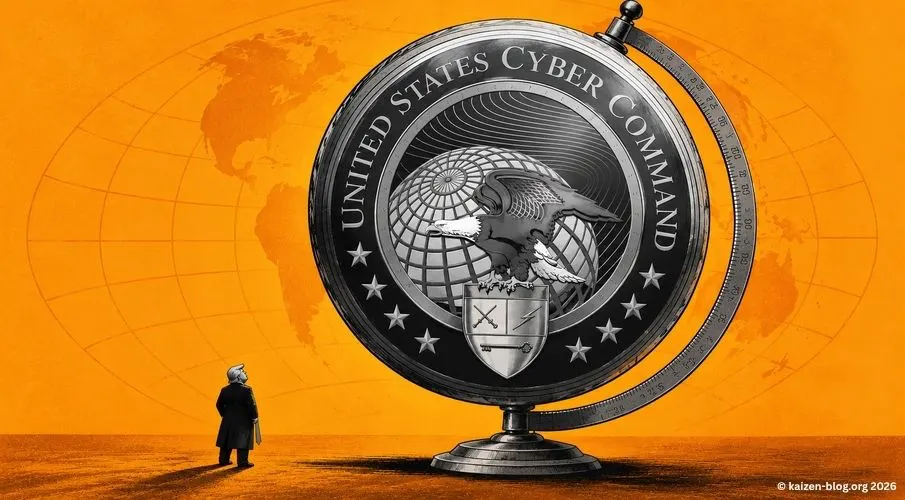
In Washington, National Guard troops stand in front of a ballot drop box. Someone films them. The video spreads like wildfire and sparks outrage. For more than 100 years, a ban has kept federal troops away from polling places. What nobody is filming is in San Antonio, Texas. 7700 Potranco Road, a windowless building with a darkened room inside. This is where Task Force Raider operates, a military unit within a government-wide "Election Security Group." Its mission is to secretly protect the midterm elections from "interference." The old ban knows about polling places. It knows nothing about cyberspace.

Interference is a flexible word. It sounds like the Kremlin hacking polling places or changing vote counts. The task force is looking for something less tangible, "influence": Russian or Chinese attempts to change people's minds. But those minds belong to Americans, whom Washington sees as carriers of foreign influence. The line the military is guarding runs straight through every conversation at the kitchen table. A senior military intelligence officer familiar with the operation considers the concern about election security a pretext. It is meant to keep President Trump happy and reassure the Democrats. Both fear interference and shady dealings. Just not from foreign shores.
The Trump administration has provided no evidence that any country or foreign national intends to interfere or could significantly alter an election result. Nevertheless, Pentagon chief Pete Hegseth made election security the top "operational priority" for the cyber forces in San Antonio last week. People familiar with the operation describe it as a mission that "cannot fail." An enemy nobody can prove exists can never be defeated. But the fight against that enemy can go on forever.
Hegseth's war is top secret. Covert operations online are supposed to fend off attacks, and they also target influencers and citizens campaigning for voters. Some people call that democracy. Until now, none of this has been reported. Documents in our possession show the scope: from millions of anonymous text and voice messages sent abroad to the removal of posts. Entire websites disappear. This violates the longstanding ban on any military involvement in elections, with the approval of both major parties.

Pete Hegseth's September 22, 2026 directive to American intelligence agencies and U.S. Cyber Command: Under the pretext of protecting free elections from foreign influence, he calls for the mobilization of all authorized intelligence and military cyber capabilities. The dangerous implications lie in the combination of intelligence power and the electoral process. When military authorities themselves decide which activities constitute a threat and which countermeasures are necessary, political communication and democratic oversight come under enormous pressure. Hegseth invokes the freedom of voters, of all things. Yet the document sets out neither specific limits on interference with public communication nor independent oversight mechanisms.
The task force, or its predecessor, was supposed to help the Department of Homeland Security and the FBI "defend" the United States. They recruited whoever was most capable, whether military personnel or civilian officials. Defense contractors joined them, bringing the total to more than 350 people. Rewards for Justice offered $10 million. More than 56,000 messages from "psychological operations" went online, along with more than 3 million text and voice messages sent to people in "countries of interest." All of it in secret.

Some of this is defensive. The "Demon Chasers" of the 91st Cyber Operations Squadron, the military's leading offensive cyber squadron, operate in a secure facility covering roughly 4,000 square meters, cleared for the highest classification levels according to contract documents. Their specialty: radio silence, weakening and disrupting enemy telephone and information systems. Deception and exploitation are part of the job as well. In Afghanistan, they learned how to shut down cell phone service across entire areas.
Another unit examines software and data from enemy attacks in a malware laboratory, treating them as "malicious artifacts," and develops counterprograms. Much of the work involves fabricated people. Cyber operators disguise themselves with fake identities and internet addresses so no trail leads back to the government. They roam the internet and approach users to influence them themselves. The guardian against foreign voices speaks with a foreign voice. All sources agree: The military is doing more than fending off foreigners who stir up division. It controls what appears on social media, and therefore legitimate public debate.

Above it all stands Cyber Command's Joint Force Headquarters-Cyber, with its operations center at the NSA-Texas facility. At the former Kelly Air Force Base sits a roughly 93,000-square-meter "security hill." There, another unit built a "state-of-the-art weapons system" that imitates foreign intelligence agencies as they gather information. After the 2020 elections, an "enclave" was created for "the most sensitive activities." The Pentagon means operations whose disclosure could cause lasting damage to U.S. foreign policy or military missions. Or operations that would be deeply embarrassing to the government and its allies, as well as the military. Democracy is not on the list.
Since Trump entered politics in 2016, the military has quietly protected federal elections from cyberattacks. Back then, it was about WikiLeaks and the Kremlin, which exerted influence and hacked Hillary Clinton's emails. Whether that affected the election remains an open question. Barack Obama's White House was nevertheless alarmed and authorized the CIA to carry out covert operations to shut down websites and accounts that could have spread more material. Among them was "DCleaks," created by the Russian military. Obama or Trump, the government restricts free speech.

A photo of National Guard troops in Washington standing in front of a ballot drop box immediately sparked outrage - For more than 100 years, a ban has kept federal troops away from polling places.
A retired senior officer who has been involved in election security since 2016 takes the adversaries seriously. These were no bumbling silent-film cops chasing pimply amateurs and anarchists. Whatever Cyber Command or the CIA could do, Moscow and Beijing could do too. The same applied to the NSA. "We are literally in a daily battle in cyberspace." And yet he has doubts: "Influencing the influencers? I'm uncomfortable with that precedent." At the bottom of that slippery slope stood soldiers at polling places and a government that could control speech and assembly. For this politically independent officer who puts the Constitution first, the old ban remains well justified today. The uniformed personnel may answer to a civilian working group involving several agencies. But fearing only soldiers on the streets is outdated, and the law needs to cover cyberspace. Even a debate fueled from abroad does not require federal intervention.
In early October, California Senators Adam Schiff and Alex Padilla wrote to YouTube and Google. They also wrote to Facebook and Instagram. And to TikTok and X, formerly Twitter. The companies were doing too little to combat "misinformation and disinformation" surrounding the 2026 midterms. Partisan, Trump this, Trump that. But the letters say Congress must "consider investigations and legislation."
The officer responds with the opening words of the First Amendment: "Congress shall make no law." "Period." By now, laws and oversight have become the norm. Hegseth wants the Pentagon involved, for whatever reason. His shield is a single adjective: They are supposedly only fighting "foreign" actors. Fighting what? Online support for Palestinians and criticism of Israel's actions in the Gaza war. Anger at Donald Trump or ICE. At the CIA and FBI as well. "Disinformation" in general. None of that seriously threatens democracy. Yet the administration and the Pentagon sell control over speech as protection.
What is the military doing in cyberspace? Who is it targeting? And what is it planning for its own influence campaign between now and Election Day? The old law keeps soldiers away from polling places. They have already entered the conversations taking place before anyone gets there.
Updates – Kaizen News Brief
Alle aktuellen ausgesuchten Tagesmeldungen findet ihr in den Kaizen Kurznachrichten.
To the Kaizen News Brief In English


