A prison cell sometimes costs the Kremlin more than a plane ticket. An imprisoned artist attracts attention, while one forced into exile loses his audience. Russia's domestic intelligence agency, the FSB, seems to be making that calculation more and more often again. Sometimes, the people targeted are personally told what their options are. They can leave. If they stay, they face prison. The authorities spare themselves a high-profile trial.
In August 2026, Margarita Konovalova, also known as Rita Flores, a former member of Pussy Riot, described how she had been pressured into becoming a covert FSB operative in 2023. For 3 years, she said, she had collected information about artists and activists, including their plans and habits. Her assignments reportedly included Pavel Krisevich and the street artist Philippenzo. Both later left Russia. Flores admitted that she herself had worked to push them out of the country on her handler's orders. As far as the intelligence officer was concerned, the choice had been simple: leave or go to prison.

Krisevich had already spent 3.5 years in a prison colony when he was released in January 2025. A performance on Red Square had landed him behind bars. Afterward came new performances, searches of his home, and repeated periods of administrative detention. In late 2025, according to his account, 2 FSB officers took him out of his cell and into a dark room. Facing the wall, he listened to their threats: He and his loved ones would be crying; he should pack his things and leave the country, or they would lock him up.
More recently, Krisevich had climbed onto a monument to the Soviet S-75 surface-to-air missile in Istra, near Moscow, wearing a cowboy costume. He recreated a scene from Stanley Kubrick's film "Dr. Strangelove," in which Major Kong rides an atomic bomb. He said he wanted to condemn society's growing acceptance of war and threats involving nuclear weapons. He had originally planned to keep the photographs private until after leaving Russia or until Russia became a free country. He was arrested while the photographs were still being taken. Flores knew about the plan. Whether she betrayed him remains unclear. Her handler had reportedly announced that Krisevich would be arrested during the performance if he didn't stop. After 2 consecutive periods of administrative detention, the artist discussed the situation with his wife. He was released in late December and left Russia shortly afterward. According to Krisevich, the direct threat from the FSB was what ultimately made him leave.

Filipp Kozlov, known as Philippenzo, had written his response to the war on the wall of a Moscow bridge. On June 12, 2023, his enormous graffiti piece "AusRussgewaltigung" appeared beneath the Elektrozavodsky Bridge, alongside the Russian coat of arms. He had already been punished 3 times in 2022 for allegedly "discrediting" the military, including for a work depicting coffins. After the new graffiti appeared, police came to his home. He temporarily left Russia. When he returned from Georgia on July 29, he was intercepted at Domodedovo Airport. A 15-day period of administrative detention was followed by another 15 days, both for allegedly disobeying police orders. He was not released until August 26.
A few days later, Kozlov noticed that he was being followed. On August 31, his home and studio were searched. A criminal investigation was already underway over the graffiti, on charges of politically motivated vandalism. Flores later said her handler had demanded that the artist be removed from the country quickly; otherwise, he would be sent to prison for a long time. She urged him to flee and, by her own account, even deliberately started an argument. Kozlov later confirmed her warnings. By October 2023, he was living in Lithuania. Russia put him on its wanted list.

Artist Philippenzo's protest action "Изроссилование" ("Russian Rape"). The Russian word "Изроссилование" is itself a play on "изнасилование" (rape) and "Россия" (Russia).
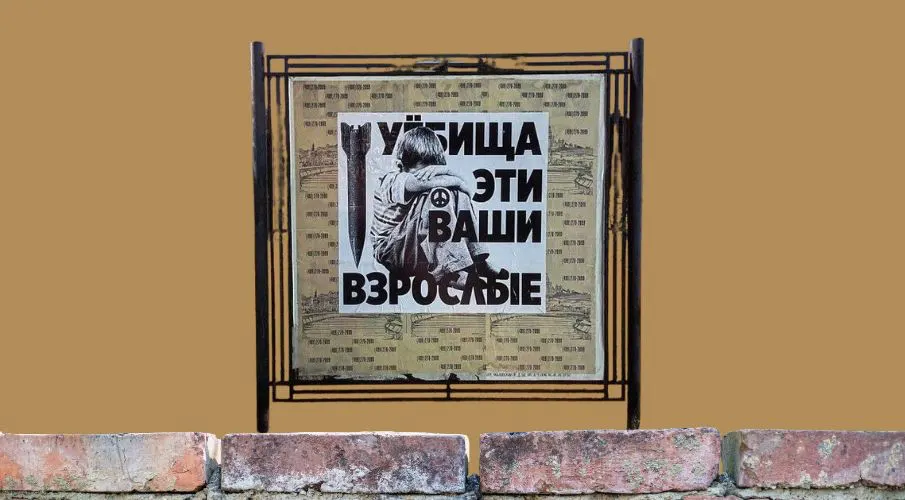
No one bothered trying to discreetly persuade the St. Petersburg street artist BFMTH. In 2023, he spent 15 days in detention for allegedly disobeying police orders. Three hours before his release, an unidentified man wearing a medical mask appeared and threatened him with severe consequences if he didn't leave Russia. The artist suspected the man worked for the country's anti-extremism authorities. BFMTH had depicted Putin behind bars and worked with antiwar activists on Russian streets. He wanted to take his art to more cities. Police grabbed him in Moscow after just 2 days. Apparently, they knew exactly which work he had just put up there.

Street artist BFMTH's protest against the adult world
After his release, BFMTH wanted to lie low in the Russian city of Murom. By the next day, people were following him around town. A car appeared again at the bus station, and one of the people watching him turned up at the train station. Before his train to Kazan, he was searched on the pretext that he might be carrying drugs. They found nothing. In Kazan, police officers were waiting beside his train car and demanded that he buy tickets and leave the city by 9 AM. Otherwise, they would speak to him differently. He booked a ticket to Yerevan; even during a transfer in Sochi, he was detained and questioned again. From Armenia, he said they had driven him out of his own country. Until then, he had been firmly opposed to emigrating.
For well-known politicians, the open door also becomes a threat. Boris Nadezhdin wanted to take part in the State Duma elections in the summer of 2026 after his unsuccessful presidential candidacy in 2024. In July, he was designated a "foreign agent," subjected to administrative proceedings, and banned from leaving the country. Then came a summons from the Investigative Committee. Strangely enough, on July 21, the very day he received the summons, the travel ban disappeared from the government's online services portal. The next day, Nadezhdin flew to Astana. He linked the pressure to his election plans. His name recognition could also have helped independent candidates.

Sociologist Boris Kagarlitsky made a different decision. In July 2023, he was arrested for allegedly "justifying terrorism." On December 12, he was unexpectedly fined 600,000 rubles and released. Prosecutors appealed the ruling. For 2 months, he could have left Russia. He stayed. On February 13, 2024, the fine was replaced with a 5-year prison sentence. Jeremy Corbyn and Jean-Luc Mélenchon spoke out on his behalf, as did Yanis Varoufakis and Amnesty International. Support also came from Brazil. What the authorities might find uncomfortable about a public trial actually happened here.
The thinking goes back further than today's FSB. On January 7, 1974, the Soviet Politburo discussed Alexander Solzhenitsyn, the 1970 Nobel Prize winner in literature and author of "The Gulag Archipelago," which was then being published abroad. Leonid Brezhnev asked whether imprisonment would be politically useful. KGB chief Yuri Andropov proposed forcibly expelling him from the country. Nikolai Podgorny preferred a trial; Foreign Minister Andrei Gromyko feared international protests if Solzhenitsyn were expelled. Initially, the decision was to pursue criminal charges. Andropov kept pushing. On February 7, the KGB requested his deportation to West Germany. On February 12, Solzhenitsyn was arrested. On February 13, he was stripped of his Soviet citizenship and sent to West Germany against his will. He did not return to Russia until 1994.

Joseph Brodsky had also endured forced psychiatric treatment and exile following a trial for "social parasitism." On May 10, 1972, the Soviet passport authorities demanded that he submit his emigration papers within 3 days. Otherwise, a "heated period" would begin, which he understood as a threat. He left against his will. In 1980, Lev Kopelev was allowed to travel to West Germany for an academic visit. Two months later, Moscow stripped him and his wife of their Soviet citizenship. "I'm not an emigrant. I didn't want to leave," he later said. Dozens of others were forced out in the same way.
Today's selection follows the same cruel calculation. A well-known prisoner can inspire solidarity. Someone forced into exile is missing from the walls of Moscow, from the courtroom, or from the ballot. The security services often don't even offer that choice to people who are less well known. They get their prison sentences.
To be continued ...
Updates – Kaizen News Brief
Alle aktuellen ausgesuchten Tagesmeldungen findet ihr in den Kaizen Kurznachrichten.
To the Kaizen News Brief In English


