
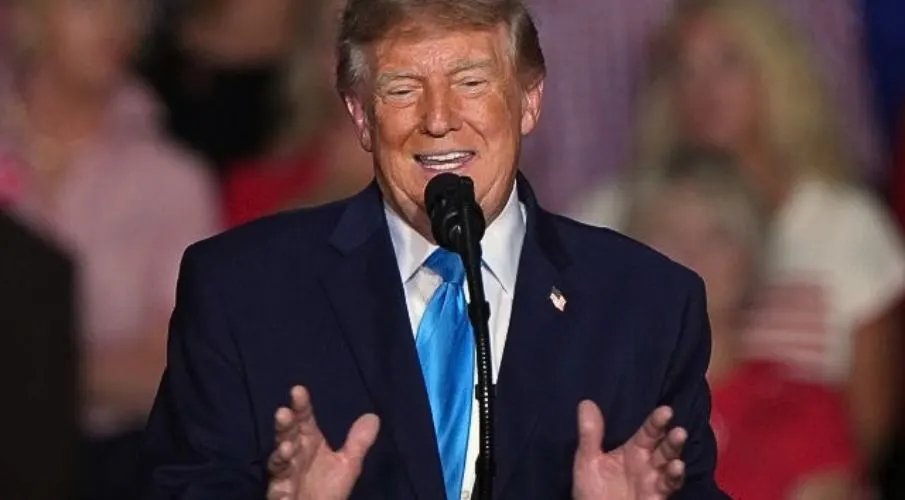
In Grand Island, Nebraska, the president of the United States stood before his supporters Monday night and talked about the war with Iran. Then came a sentence you have to read twice to believe. “They can wipe out a city. Let them wipe out Los Angeles. Let them wipe out San Diego. That is a very small price.” He was talking about millions of people in Los Angeles and San Diego, and he was saying their deaths would be bearable as long as they explained the price of gasoline. The sentence did not come out of nowhere. Pressure on Trump is growing over the economic consequences of the war, and the harder it becomes for him to justify it, the larger the specter he uses to do so becomes.
Trump: “With the war, it’s all just artificial. It’s a little bit expensive. That’s a small price to pay ... let them take out Los Angeles, let them take out San Diego. That is a very small price to pay.”
That night, he wanted to explain why Americans should bear the high costs of the war. The war was far away, almost artificial, the costs were simply a little higher. A small price, he said, for the safety of the world and of his own country. This time, the price he offered was not a few cents at the gas pump, he offered Los Angeles and San Diego, and still called that small. The calculation contradicts itself. The war is supposed to keep the country safe, and in the same breath the enemy is allowed to level these cities. Safety that includes the loss of a city of millions is no longer safety. In a paragraph that claims both things at once, the words have stopped meaning anything.
The danger he was playing with was one he invented himself. Iran’s missiles could hit an American city, he suggested. They cannot. The range of those weapons ends far short of the American coast, no missile from Tehran is falling on California. He conjures up a fire that cannot reach a single U.S. city, then hands the bill for the fear of it to people at the gas pump. First the invented threat, then the real surcharge on the receipt. Fear is a tool for him, not an accident. An opponent whose missiles can never reach the coast still works as a horror image, as long as nobody asks about the range. That is how a homegrown price problem gets sold as a fight for survival. The trick is old, every ruler under pressure knows it: Paint the threat big enough, and your own failure disappears in its shadow. Governing gives way to frightening people.
The way he talks about suffering gives away the rest. The war was almost over, he said, Iran had a high threshold for pain anyway, it even needed it, and the whole thing would end one way or another. Pain that another people supposedly needs. An ending that may take any form, including annihilation, tossed out with a shrug. The message of the night lies in the casual way he disposes of the dead. He has promised again and again since the war began that it would soon be over. Every time the end gets closer, every time it fails to arrive, and prices remain where they were. A man who has been announcing the end for months sells his helplessness as confidence. At the register, none of his forecasts count, only the next bill.
Nobody gives away a city if they still see the people who live there. Families live in Los Angeles, people go to work in San Diego, and that night they became a word on a speaking list. “Let them wipe it out,” said in the tone you use to remove a game piece from the board. In that language, the people of both cities have long since become numbers, and numbers are easy to call small.
Behind the big talk stands a narrowing lead. The appearance was meant to help Republicans ahead of the November election, especially Senator Pete Ricketts, who has to fend off independent challenger Dan Osborn. In 2024, Trump won Nebraska by more than 20 points. Now his party is defending ground in the final weeks that had always been safe for it. The reason is sitting at every gas station, diesel and inflation from the U.S.-Israeli war are hitting farm country too.
The people in Grand Island came with a simple concern, why diesel was eating up their harvest. The answer they got was Los Angeles on the sacrificial table and an enemy that cannot reach them with any weapon. A farmer who wants to know how he is supposed to make it through the fall hears that the loss of a city of millions would be bearable. Between his question and the president’s speech lies an entire ocean. Nobody in Grand Island got any closer to Iran than through the surcharge at the register. Again and again, the speech wandered away from the candidates he had traveled there to support. “We’re kicking Iran’s ass right now,” he shouted at another point. People told him he was the greatest, better than George Washington, better than Abraham Lincoln. In Venezuela, he said, they had taken over the largest oil field outside their own in 1 hour and 48 minutes, delivered like a sports score. Ukraine had blown up many Russian refineries, while back home, he complained, the blue states were shutting down their own. In his telling, everyone is to blame for the prices except him.
The comparison with Washington and Lincoln turns back on him that night. One held a young country together, the other led it through its bloodiest war so it would not fall apart. This president stands in Nebraska and gives away Los Angeles and San Diego in a throwaway line. He claims greatness, what he delivered was the opposite. Turning a city into a line item shrinks the idea of the United States itself.
So there he stands, the man who compares himself to Lincoln, handing Lincoln’s country over to the fire of an enemy for a better night in the news. The missile he warns about never takes off. The price he calls small would be a city. Between the two lies the full depravity of a politics that pays with other people’s lives and calls the bill security. He calls that courage too.
Updates – Kaizen News Brief
Alle aktuellen ausgesuchten Tagesmeldungen findet ihr in den Kaizen Kurznachrichten.
To the Kaizen News Brief In English


Wie war das mit „Schaden vom amerikanischen Volk fernhalten“? Das war doch sein Amtseid, den er damit bricht. Ist das kein Argument für ein Impeachment, neben allem anderen ?
Keine Worte mehr. Zu sagen, der orangefarbene ist krank, ist zu wenig. Da muss mehr dahinter sein.