
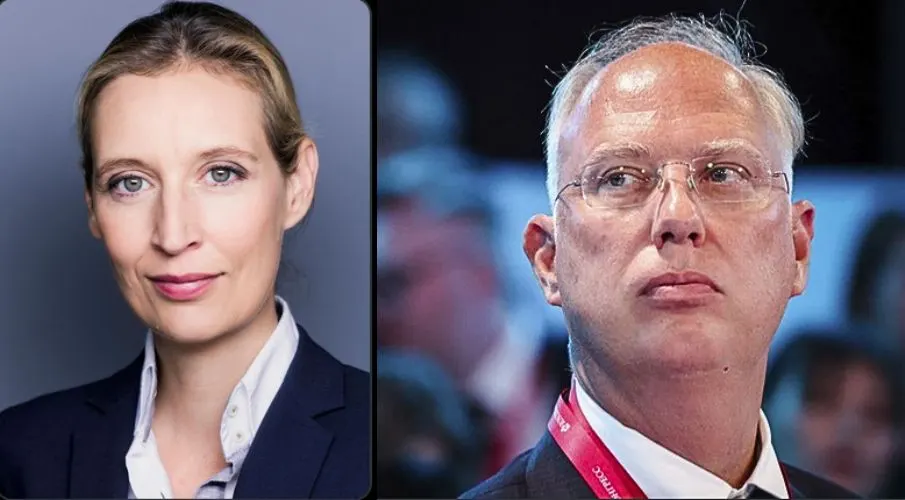
The Nord Stream pipelines come ashore on the coast of Mecklenburg-Western Pomerania, some of them destroyed by explosions in September 2022. This Sunday, Germans are voting in that very state, and the party leading there wants to turn the gas back on. Just how closely Moscow and the AfD are moving toward each other can be seen in a meeting that is now being prepared. Two people familiar with those preparations say a meeting is planned for next spring. Vladimir Putin’s top economic envoy and the AfD leadership are preparing a gathering for no earlier than March 2027 to discuss bringing Russian gas supplies back to Europe’s largest economy. Kirill Dmitriev, a close Putin adviser and head of Russia’s state investment fund, is expected to take part, along with AfD co-leaders Alice Weidel and Tino Chrupalla. An AfD spokesman and a representative for Dmitriev did not respond to any media inquiries. Hardly surprising.

Before the sanctions imposed after Russia’s invasion of Ukraine in 2022, more than one-third of Germany’s crude oil imports came from Russia, along with more than half of its natural gas. The German economy has still not recovered from the blow caused by shutting off those pipelines. The meeting would only take place if a framework for peace between Russia and Ukraine were in place first, one of the people said. The organizers were hoping to bring the AfD and Russia together with the United States at one table. Israel or the United Arab Emirates were being considered as possible locations, with India also mentioned. Dmitriev sat down in Moscow this month with U.S. negotiators Steve Witkoff and Jared Kushner. The organizers would also like them to attend the gas talks, where reopening the Nord Stream pipelines would be examined. A senior U.S. administration official said Witkoff and Kushner had neither been informed about the planned meeting nor invited to it.
The AfD currently cannot govern. A coalition of its opponents is keeping it out of power, but among voters it is the strongest political force in the country. In Saxony-Anhalt, it has just become the largest party in a state election, and this Sunday comes the test in Mecklenburg-Western Pomerania, where the Russian pipelines come ashore. So for now, it is a purely symbolic meeting, since the party is not part of any government. And yet the preparations show just how fragile Germany’s political structure has become: the old refusal by the established parties to work with the party on the far right is doing less and less to slow its rise.
Any attempt to bring Russian gas or Nord Stream back would face fierce resistance in Germany and among its allies, especially in Eastern Europe. Germany must not become dependent on Russia again, said Michael Kellner of the Greens, who was responsible for German energy policy in the government during the crisis after Russian supplies were cut off. The mistakes of that energy crisis must not be repeated. “It cost us 50 billion euros. We cannot want to go back. That would be betrayal. Putin is using the AfD for his own purposes.” Roderich Kiesewetter, a CDU lawmaker from Chancellor Friedrich Merz’s party, said the meeting could strengthen those within his own party who also support buying Russian gas. The AfD stood on Russia’s side and was prepared to betray Ukraine and Germany. Russia used energy, especially Nord Stream, as a hybrid weapon for military purposes. Reopening it would be a disaster for European security and would isolate Germany.
The AfD describes its call for Russian gas as pragmatic. Cheap energy from Russia was “the secret of the success of ‘Made in Germany,’” Weidel had said, after already calling in June for an end to the boycott of Russian oil and gas to support the weakening economy. With the meeting, the party wanted to show that it was capable of acting on foreign policy and accuse the government of doing nothing about high energy prices.
American Chamber of Commerce Welcomed the Plan
Moscow welcomed the idea. The American Chamber of Commerce there called the plan a “positive and timely step.” Bringing Germany, as a major European economy, into the discussion would create a broader foundation for issues that mattered to those countries and the rest of the world, its president Robert Agee said. In eastern Germany, the relationship with Russia carries more weight. Until the fall of the Berlin Wall more than 35 years ago, the region was under Soviet rule, and part of the population there looks on Moscow with greater indulgence and on the United States, the Federal Republic’s protecting power, with suspicion. Along that old dividing line, Germany’s support for Ukraine is beginning to fracture.
Updates – Kaizen News Brief
Alle aktuellen ausgesuchten Tagesmeldungen findet ihr in den Kaizen Kurznachrichten.
To the Kaizen News Brief In English


