
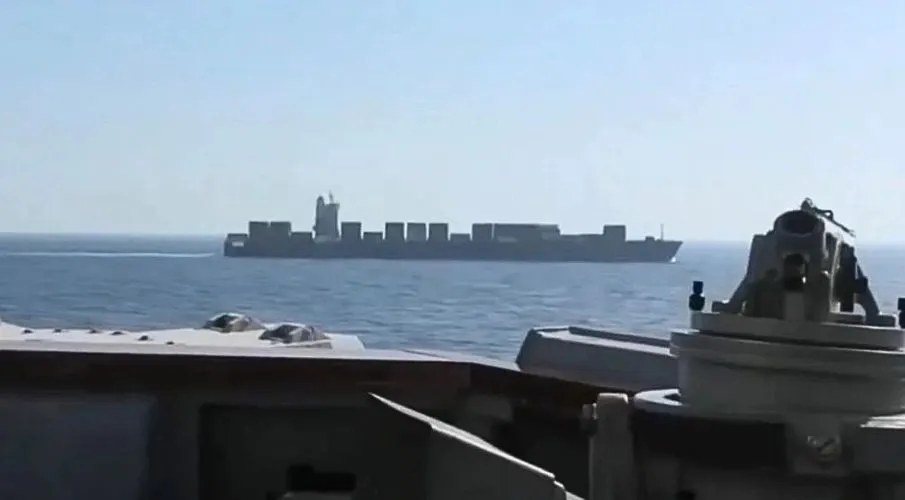
In the Persian Gulf this spring, the United States apparently came within just a few steps of an operation that could have escalated between the United States and China. In the middle of the U.S. war with Iran, the American military received an intelligence report claiming that a Chinese ship was carrying components for a military nuclear program to the Middle East. The report was taken seriously. Commanders prepared to intercept the ship. According to two people familiar with what happened, armed troops had prepared to board it. Planes had already taken off. Altogether, four people familiar with the episode described what happened. Only immediately before the operation was the report examined more closely. That was when officials discovered what the entire operation had been built on: an analyst with a special operations command had used an AI chatbot, and it had incorrectly identified the ship’s cargo.
What exactly the program believed it had identified on board could not be determined from the information available. 1 person familiar with the matter described the report as completely false. It had nevertheless nearly triggered a war because any armed operation against a Chinese ship carried the risk of a direct confrontation between Washington and Beijing. A false classification inside a computer had turned into real-world preparations. Armed people were waiting. Planes were in the air. Only the late review stopped the operation before an invented claim about cargo could turn into a military incident. The mistake began inside a computer. Its consequences would have hit people and nations.
The case lands inside a system that wants to bring artificial intelligence into its work as quickly as possible. The Pentagon and U.S. intelligence agencies are already using such systems to analyze huge volumes of intelligence data. They are also supposed to help select possible targets. They are being used for budget matters as well, along with logistics. According to the information available, there are still no uniform rules for checking the results. Different agencies use different tools under different rules. A former senior government official familiar with the systems being used described the internal programs as basically the same commercial products, just “made up.” That gives the technology an official coat of paint. It does not make its mistakes any smarter.
According to several people familiar with the process, false outputs from such systems had already made their way into intelligence reporting before. So the episode in the Persian Gulf was not an encounter with a completely unknown problem. Younger analysts in particular tended to place too much trust in the tools, they said. They were familiar with such programs and were more likely to accept their results without questioning them enough. This is exactly where speed turns dangerous. A system delivers an answer in seconds, while people later have to answer for the consequences. Sometimes the only thing standing between a quick analysis and a quick bad decision is whether anyone still allows room for doubt. Military decisions do not become harmless just because the first mistake happened on a screen.
The near-interception shows how little distance there can be between a technical claim and armed reality. An analyst enters data, a program classifies the cargo incorrectly. Then the report moves on and gains weight with every desk it passes. Eventually, soldiers are standing by and planes are on the move. In this case, the review came just in time. The disturbing part is that it came only immediately before the operation. An intelligence report is no thought experiment once people are loading weapons because of it. The machine does not have to give an order to influence an order. It is enough for its answer to be treated as reliable.
One person familiar with the matter summed up the problem in 1 sentence: artificial intelligence made it possible to get to a bad idea faster. That is exactly what had happened here. The AI program was wrong about the cargo aboard a Chinese ship, the error was treated as intelligence, and the military began making concrete preparations. Only the final review prevented the false claim from turning into an armed operation. Between the computer and war, there was no grand theory left. There was a delayed review. The distance was small enough that planes were already in the air.
Updates – Kaizen News Brief
Alle aktuellen ausgesuchten Tagesmeldungen findet ihr in den Kaizen Kurznachrichten.
To the Kaizen News Brief In English


Erschreckend….wenn schon Fachleute nicht erkennen welche Texte fehlerhaft sind, wie soll es ein Normalo können?
…Ki ist aktuell eine große gefahr, für die mit sicherheit kontrollvarianten erforderlich sind
Vielleicht erinnert sich der Eine oder Andere noch an den Film „War Games“ aus den 80er.
Das war zwar noch keine echte KI, aber schon da zeigte der Film, wie gefährlich es ist, wenn ein Computer die Kontrolle übernimmt.
Menschen machen Fehler.
Aber eine KI zieht durch. Ohne Prüfung und vor allem ohne Empathie.