
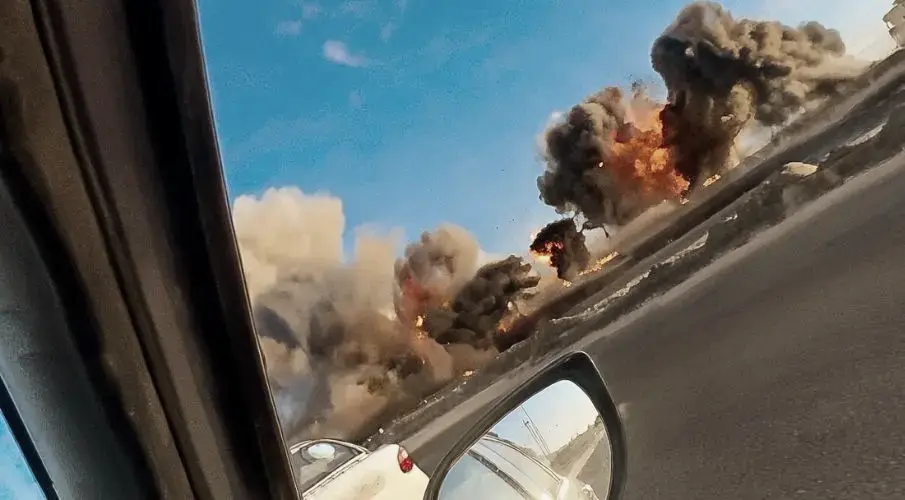
The war in Iran now has a file under international law as well. The independent fact-finding mission on Iran appointed by the UN Human Rights Council says there are reasonable grounds to believe that the United States may have committed war crimes in 2 strikes on February 28. At least 178 civilians were killed, including women and children. At the same time, the mission accuses the Iranian government of serious human rights violations, many of which, in its assessment, amount to crimes against humanity. The report is not legally binding. It could, however, later play a role in international proceedings. The mission, chaired by Bangladeshi jurist Sara Hossain, was established by the UN Human Rights Council in 2022 and is set to present its findings on Monday to the 47-member body.

The conflict began at the end of February with U.S. and Israeli strikes on Iran. On February 28, then-Supreme Leader Ayatollah Ali Khamenei was also killed in a U.S. and Israeli strike. The fact-finding mission is now focusing on 2 U.S. strikes carried out that same day. Its report does not decide guilt in a court of law. It lays out how far the independent experts have come in their assessment of the available evidence.
At the center of the allegations against the United States is Minab in southern Iran. On February 28, at least one U.S. missile struck the Shajareh Tayyebeh school. There is still no final death toll. Iranian state media reported 168 dead, most of them children. The fact-finding mission said it saw reasonable grounds to believe that the United States had carried out an indiscriminate attack in which civilians were killed or injured. Civilian buildings were also damaged, it said. Particularly serious is the assessment of the intended point of impact: The school building itself was the intended target. According to the experts, the destruction was neither the result of a missile that went off course nor merely collateral damage from a strike on a neighboring compound of Iran's Revolutionary Guards.

Read also our article: The Attack on the School - and the Silence Before It
According to the mission's findings, Tomahawk cruise missiles struck the clearly identifiable school. The Trump administration has so far not directly accepted responsibility for the strike. The results of a Pentagon investigation into the bombing of the school have also not been released. The U.S. Department of State did not immediately respond to a request for comment on the new allegations. That still leaves a space between the impact and possible legal responsibility, a space that will have to be filled by evidence and case files. For the families of those killed, that time began on February 28.
The 2nd strike concerns Lamerd, also in southern Iran. According to the mission, Precision Strike Missiles were used there. The weapons dispersed tungsten pellets over a clearly identifiable sports complex and an adjacent residential area. 22 civilian men and women were killed. U.S. Central Command has denied responsibility for the strike. The fact-finding mission assesses the 2 strikes together and says there are reasonable grounds to suspect that indiscriminate attacks were carried out and caused civilian casualties. A military denial does not end that question. It puts it on the table in the first place.
The report also turns its attention to the Iranian government. The mission describes killings by state security forces on a "staggering scale." Over the past 2 years, Iranian forces have violently suppressed protests. Security forces fired assault rifles into crowds and beat protesters. Healthcare workers were arrested. Detainees were tortured and denied legal counsel. Families were sometimes left in the dark about where their relatives were being held. In the mission's assessment, many of these serious violations meet the threshold for crimes against humanity.
Murder and imprisonment are cited as parts of a widespread and systematic attack on civilians. Torture and other inhumane acts were also documented. The Iranian government has also stepped up its use of the death penalty. More than 70 people are said to be at imminent risk of execution, including 5 women and 3 boys. The mission sees this as another severe burden on the country's own population. While a war is being fought outside, the state is tightening the pressure inside on people who already have little protection.

Read also our article: War, markets, power - why Trump’s Hormuz plan is triggering new accusations - further executions in Iran
We ourselves spent weeks in Iran, and much of what we saw there cannot be described in polite language. Some of the bombings came with no apparent warning, targets were missed, civilian facilities were hit, including right in the middle of Tehran. The impression on the ground was brutally clear: They were bombing like hell, and anyone on the ground was simply out of luck. We documented these incidents, secured material and passed it on. Much of it has been archived. We are continuing to review some of it ourselves for possible proceedings before international courts.

We also formed our own picture of what happened in Minab. At the same time, any account of this war would be dishonest if it ignored the barbaric human rights crimes committed by the Iranian regime. We have visual material that we also turned over and that we will not show our readers. It shows bodies after torture and executions, some of them piled on top of one another. These images are so horrifying that they cross every ethical line of what a magazine can still reasonably put in front of its audience. There are effectively 2 separate cases here that have to be investigated independently and with the same severity: possible war crimes stemming from U.S. strikes and the systematic violence of the Iranian regime against its own people. Both demand a relentless investigation. Both demand evidence. And in both cases, no uniform, no government and no flag should ever decide how much the life of a person who was killed was worth.

Also read our article: Minab, 175 Dead and a Tomahawk - One Video and 116 Meters
The experts are calling on the United States and Iran to stop rights violations and crimes. Both countries should provide full reparations to the victims. According to the mission, the report follows a victim-centered approach. It was based on interviews with 73 people inside and outside Iran. The investigators also reviewed documents and satellite imagery. Photo and video material was included as well. Information from organizations and experts the mission considered credible was also taken into account. From many individual pieces of evidence comes a report whose weight lies precisely in documenting events that can disappear quickly in war.

The experts still could not work with full access. The ongoing conflict has driven people from their homes. The internet shutdown made gathering information more difficult. On top of that came the lack of full cooperation from both governments. Nearly 3 dozen requests for information sent by the mission to the Iranian government went unanswered. Requests sent to the U.S. government in June for information and meetings with officials also received no response. The mission thus also makes visible just how difficult it is to investigate a war while it is still being fought and both sides are keeping important doors closed.

The report does not yet amount to a court judgment. It lays out where the investigators stand today: The independent experts see enough evidence to seriously examine possible U.S. war crimes. At the same time, they document what they assess as crimes against humanity committed by the Iranian state. 2 governments are facing grave, different allegations. The question of accountability connects both sides. A school in Minab and a sports complex in Lamerd are now part of a report that could one day be opened again before an international court.
Updates – Kaizen News Brief
Alle aktuellen ausgesuchten Tagesmeldungen findet ihr in den Kaizen Kurznachrichten.
To the Kaizen News Brief In English


