
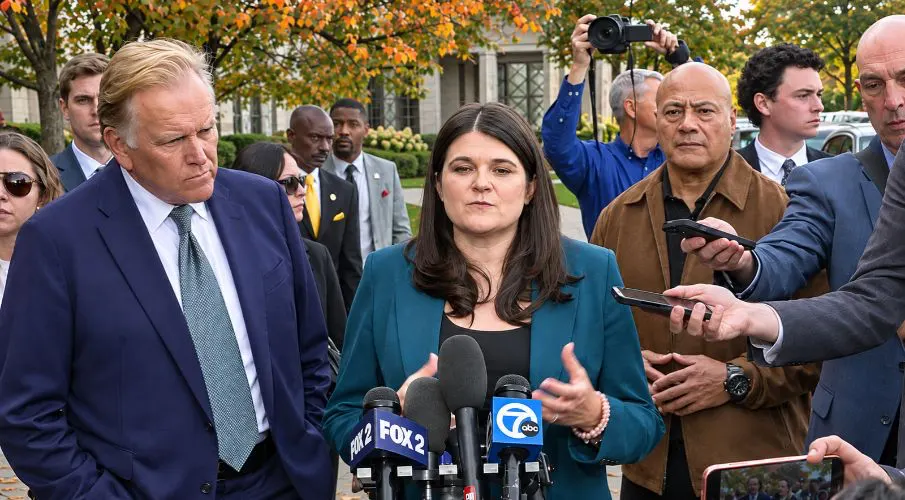
On Saturday evening, Haley Stevens was still texting the address of a church in Detroit to her longtime friend Jim Blanchard. On Sunday, the Democratic congresswoman was supposed to appear there alongside Abdul El-Sayed, the man who had defeated her in the August primary for the U.S. Senate. James Clyburn, one of the country's most influential Black lawmakers, was supposed to lead the church service. The party wanted to put their feud behind them, 2 days before the election. Hours later, Stevens was sitting in a different church. Next to her was Mike Rogers, the Republican running against El-Sayed. She hugged him, smiled for the cameras, and urged voters to send him to the Senate.
Republican Senate nominee Mike Rogers appearing alongside Democratic Rep. Haley Stevens at a church in Detroit, Michigan.
As recently as Friday, Stevens had assured Blanchard over dinner that she intended to reaffirm her support for El-Sayed in writing. On Saturday, she confirmed their plans. The former governor even received another message early Sunday morning. Blanchard has known Stevens for years. He said the woman he had dinner with on Friday wasn't the woman he recognized in this decision. Jamie Raskin had also spent 25 minutes talking with her Saturday evening. She had assured him she would be celebrating election night with the Democrats. Chuck Schumer, Gretchen Whitmer, and Debbie Dingell had received assurances as well. Those are the kinds of promises a party counts on during the final day of a campaign. Stevens chose to attend church with her political opponent.

The feud goes back to the primary campaign. El-Sayed represents a distinctly progressive wing of the party, while Stevens belongs to its more moderate side. Above all, Israel's war in Gaza drove them apart. El-Sayed calls Israel's actions genocide. Stevens rejected that characterization. The American Israel Public Affairs Committee, AIPAC, and affiliated groups spent tens of millions of dollars supporting her. El-Sayed then accused her of serving those interests. He won the primary by a narrow margin and could become the first Muslim elected to the U.S. Senate. Stevens initially supported him publicly, stopped people on the streets of Detroit to encourage them to vote for him, and praised him as a great candidate. Before long, every new expression of support sounded a little more strained.
Last week, her fiancé, Jason Turkish, publicly came out in support of Rogers. El-Sayed had refused to moderate his language about Israel, he said in explaining his decision. Phones immediately started ringing among senior Democrats. Stevens pushed back privately against suggestions that she would do the same. Why would anyone even think that, she asked a staffer in writing. On television, she described herself and her fiancé as a divided household politically and said she still wanted El-Sayed to win. On Friday, Stevens then demanded an apology for his criticism of U.S. military aid to Israel. She also wanted him to condemn a campaign ad supposedly supporting him, which his staff had already disavowed. The ad never aired on television but had been viewed more than 7 million times online.
El-Sayed's staff then asked Stevens to stay away from joint campaign appearances for the remainder of the election. El-Sayed responded with a statement that brought Stevens' primary defeat back into the argument. Late that night, she wrote that she wanted to talk only after the election, when Michigan had elected its Democratic senator. On Sunday, she cited El-Sayed's decision to exclude her as the very reason she was now supporting Rogers. She said she hadn't told Rogers about her decision until that morning. A personal grievance had turned into a public endorsement of a candidate from a party whose policies Stevens herself had previously condemned.
Before the primary, she had called Rogers a rubber stamp for Donald Trump's dangerous agenda. Now her earlier judgment apparently mattered less than her feud with El-Sayed. The switch even caught Rogers' campaign team off guard. His spokesperson, Abby Ronson, said she only found out when the video was posted. Stevens' chief of staff, Justin German, and several other staff members resigned. German said they were shocked and heartbroken. Mallory McMorrow, who had also run for the Senate nomination, accused Stevens of deliberately lying to people and turning her back on them. Schumer called the move a despicable betrayal.
Haley Stevens attended a church service with Republican Senate nominee Mike Rogers at a Black church in Michigan.
Michigan Democratic Party Chair Curtis Hertel declared that Stevens was not currently a member of the party and would not be one in the future. That is bound to reverberate in Washington. Stevens is now supporting the Republican candidate in a race that could help determine control of the Senate. Democratic Rep. Debbie Dingell watched a television interview Sunday night in which Stevens struggled to explain her decision. Stevens repeatedly talked about anger and accused El-Sayed of antisemitic conduct. Asked about her sudden change of heart, she mainly pointed to incidents from the primary campaign, which had ended long ago. Dingell called the interview one of the most painful she had ever watched. She said she had been worried about Stevens for days.
Dingell also spoke about the damage the bitter feud had done to Michigan's Jewish and Arab communities. According to a friend, Stevens' fiancé Turkish, who is Jewish, had accused her of betraying Jewish voters who supported her during the primary. Whether that determined her decision remains unclear. Trump immediately welcomed her support for his candidate, called Stevens brave, and said he would love to have her in the Republican Party. Mike Johnson sent her a message. Republican campaign operatives circulated the church photo showing Stevens smiling beside Rogers. They hardly had to do anything else that Sunday.
Our further reporting found that Haley Stevens' former campaign chair, David Kramer, had already made the political switch before she did. Kramer, who had also raised money for Sen. Elissa Slotkin and was active in Michigan's Jewish Democratic organization, decided to support Republican Mike Rogers. His reason: Abdul El-Sayed's position on Israel. Stevens' fiancé, Jason Turkish, had also publicly endorsed Rogers. A friend of Stevens reported that Turkish had then put intense pressure on her. He had accused her of betraying the Jewish voters who supported her during the primary. While Stevens continued assuring senior Democrats that she would never endorse Rogers, her own fiancé was, according to that account, putting considerable personal pressure on her.
What is particularly revealing, however, is how Stevens handles the accusations of antisemitism she herself levels against her former rival. Ray Wert, the Jewish husband of Democrat Mallory McMorrow, said Stevens had refused to sign a statement against Rogers. The statement criticized his ties to a major donor promoting Christian nationalism and a former campaign staffer who wanted Jews sent to North Korea. Stevens refused to sign. Her concern about antisemitism seems to take on a very different level of severity once it crosses party lines. Then there's Donald Trump, who called El-Sayed a "jihadist" and a member of the Muslim Brotherhood on October 25 and claimed the Muslim Democrat would have to go through a metal detector in the Senate. Trump offered no evidence for his accusations. Stevens is now supporting Rogers, this president's candidate. Just months ago, she had called him a rubber stamp for Trump's dangerous agenda. On Sunday, she sat beside him in a church pew in Detroit. Her former convictions had apparently been left at home. Rogers got her public support, El-Sayed got her accusations. Her conscience, it seems, had found itself a different seat.
Outside the other church in Detroit, Eli Savit, the Democratic candidate for attorney general, was trying to get the conversation back to the cost of living for people in Michigan. The feud surrounding Stevens had by then drowned out what the party's own candidates were trying to say. Savit hoped the sudden break would at least put an end to the endless back-and-forth. The election is on November 3. One church service that was supposed to demonstrate unity will now live in the memories of those involved alongside another, where a Democratic congresswoman embraced her Republican opponent. While voters still had to decide their future, Stevens had already made her decision about her party.
Updates – Kaizen News Brief
Alle aktuellen ausgesuchten Tagesmeldungen findet ihr in den Kaizen Kurznachrichten.
To the Kaizen News Brief In English


