
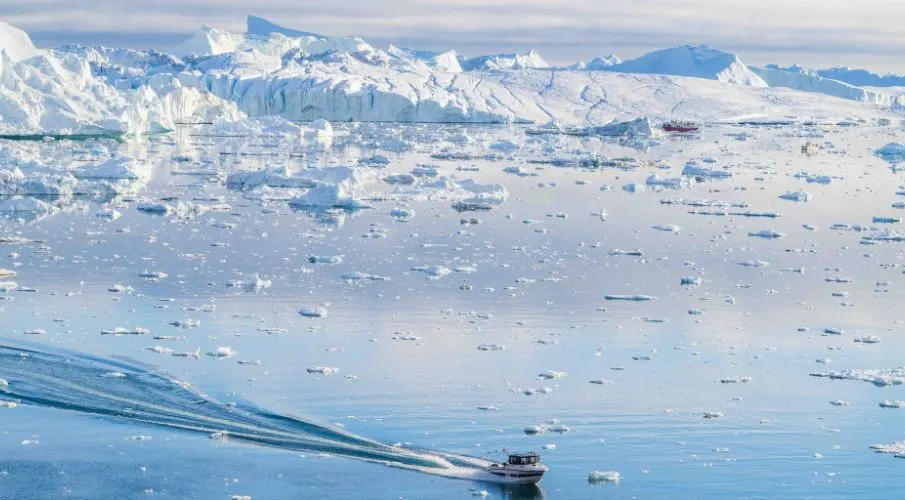
Since 1979, around 12.5 trillion U.S. tons of ice have disappeared from Greenland and Antarctica. That equals 11.3 trillion metric tons. If that mass were spread evenly across the continental United States, it would cover the country in a layer of ice about 5 feet thick. The number is so huge that it almost starts to sound harmless again. Out at sea, it loses that harmlessness fast. Earth's 2 major ice sheets are reacting more and more strongly to a warming planet. Only about 1/6 of the loss is reportedly due to warmer air. Around 5/6, according to the new scientific study, is caused by warmer ocean water attacking the ice sheets from below and along their sides. That reportedly pushes glaciers into the oceans faster. Eric Rignot of the University of California, Irvine, said the ice sheets were melting away rapidly. Sea levels were rising worldwide and would further increase the vulnerability of coastal regions.

The satellite image shows an ice sheet breaking apart along its coast and flowing into the sea. Images like these are among the data researchers use to measure ice loss in Greenland and Antarctica over decades. Since 1979, a combined 11.3 trillion metric tons of ice have disappeared there. One especially important factor is warmer ocean water, which attacks the ice masses from below and along their edges and speeds up the flow of glaciers into the ocean.
The lost ice became nearly 3 quadrillion gallons of water, equal to 11.3 quadrillion liters. That alone has reportedly raised global sea levels by around 1.2 inches since 1979. Other causes of sea level rise come on top of that. 1.2 inches looks small on a ruler. On a coastline, the same number looks very different. Lead study author Ines Otosaka of Northumbria University puts the consequences in very concrete terms. For every additional centimeter of sea level rise, another 2 to 3 million people would reportedly be flooded at least once a year. Greenland's Jakobshavn Glacier is now reportedly retreating by as much as 164 feet a day. On some days, that means a glacier is moving backward by roughly half the length of a football field.
The time-lapse sequence made from satellite images shows changes in a Greenland glacier front between early 2024 and late 2025. Dark areas mark open water, while the bright ice surface repeatedly breaks apart and large sections flow toward the sea. Over the course of the months, the boundary between solid ice and ocean changes visibly. Image sequences like these allow researchers to measure glacier retreat, ice loss and glacier speed over longer periods of time.
The international collaboration of polar scientists led by the European Space Agency had based earlier calculations mainly on European satellite data going back to the 1990s. By adding NASA satellite data, researchers were able to track changes in Antarctic ice masses back to 1979. For Greenland, the data go all the way back to 1972. For a long time, the picture looked relatively calm. In the 1970s, the ice sheets were still relatively stable. The same was true in the 1980s. That stability continued largely into the 1990s. After that, the losses became more noticeable, and in the 2010s they increased sharply. Otosaka said the ice sheets were losing more mass from decade to decade. That was especially clear in the ice being discharged directly into the ocean. The connection to climate change was clear.
Andrew Shepherd of Northumbria University warns about the delay with which warming shows up in the ice sheets. The observed changes reportedly lag global warming by decades. Even if further warming of the planet could be stopped, the consequences would therefore continue for many more decades. Climate writes in long-lasting ink. Between 2020 and 2023, the acceleration briefly appeared to stall. The authors attribute that pause to short-term weather fluctuations. According to Otosaka, the data series analyzed ended in 2023, but newer measurements showed that the acceleration had since picked up again. In East Antarctica, unusually heavy snowfall temporarily added mass. That offset part of the rapid loss from the less stable West Antarctic Ice Sheet. Rignot described those 3 years as nothing more than a bump in a much longer development.
Researchers are particularly concerned that a large share of the loss comes from dynamic processes. In those cases, the ice reacts much more abruptly than it does during the slow melting caused by warmer air. Such processes could trigger tipping points after which the loss would continue to reinforce itself. David Holland of New York University said that this dynamic share was exactly what worried him because it fit an ice-sheet instability and collapse scenario.

The post on the main X account from September 11, 2026, shows it again: When fanaticism takes over, stupidity becomes a weapon and intelligence becomes the enemy. ((https://x.com/AfD is the official main X account of the AfD federal party. The AfD itself explicitly lists
x.com/AfDin its legal notice as one of its official social media profiles.)The AfD takes a real number and builds a false picture around it. 1 billion euros over 10 years for an international forest protection fund becomes "your money sunk in the rainforest." That is political dumbing-down in pocket size: You leave out the fact that the fund invests capital, pays for verifiable forest protection and is meant to stabilize the very system that stores carbon, produces rain and supports entire climate zones. The Amazon does not need German romanticism. Germany needs an Amazon that does not collapse.
The Amazon is not some green postcard scene on the other side of the world. Its trees store enormous amounts of carbon, and through its leaves and soil the forest is constantly pumping water back into the atmosphere. Around half of the rain in the Amazon region depends on this cycle. As the forest shrinks, it gets drier. Fires spread more easily, and stored carbon is released into the atmosphere on top of that. The region then loses, piece by piece, exactly what has kept it stable until now. The rainforest produces rain, reduces heat and binds CO₂. Anyone who reduces protecting it to a headline about "money being sunk" simply leaves out the part that matters for life itself. That is how the AfD becomes the "Alternative For Drought." So wird die AFD zur „Alternative Für Dürre“
The AfD goes a step further. In its 2025 federal election platform, it declares that it fundamentally rejects climate protection policy and calls for Germany to withdraw from the Paris Climate Agreement. In April 2026, the AfD parliamentary group in the Bundestag even demanded an end to all German climate protection measures and the repeal of the corresponding laws.
The international working group based its analysis on 45 independent studies and data from 27 satellites. Holland, who was not involved in the study himself, said the relatively independent methods increased his confidence in the result. Holland said the accelerating ice melt was clearly established. Ted Scambos of the University of Colorado sees Antarctic ice loss as a danger whose greatest consequences could still be decades away. Society was now smart enough to recognize its future, he said. Apparently, it was still not sensible enough to act on that knowledge. Between those 2 sentences lies a whole lot of water and a long list: wars, right-wing populism, Putin, Trump, China and India.
To be continued ...
Updates – Kaizen News Brief
Alle aktuellen ausgesuchten Tagesmeldungen findet ihr in den Kaizen Kurznachrichten.
To the Kaizen News Brief In English


