
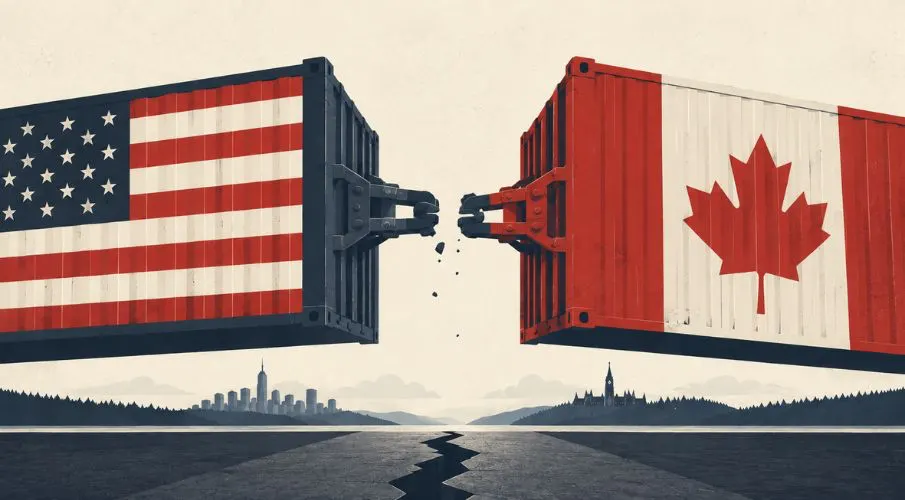
Donald Trump’s trade war with Canadian Prime Minister Mark Carney is landing in exactly the places where Republicans need every percentage point they can get 8 weeks before the midterms. Only about 6 percent of the $715 billion in annual trade is directly affected, but percentages do not live on factory floors. In Michigan, parts cross the border and come back again. In Maine, part of the timber industry depends on trade with Canada. Republican candidates wanted to talk about lower income taxes, child investment accounts, and tax relief for businesses. Now they are talking about tariffs. Whit Ayres, a Republican political consultant in Washington, said Trump had also been elected to bring inflation down and get the economy moving. Anything pushing in the opposite direction, he said, did Republicans little good in an election year. Brent Buchanan of Cygnal said candidates near the Canadian border could find themselves forced to openly put some distance between themselves and the president. Trump’s approval ratings had fallen while gas prices had risen as a result of his war with Iran. Susan Collins of Maine calls the trade war a mistake. She said she had secured exemptions for Canadian road salt and cement. Canadian retaliatory tariffs on Maine seafood had also been avoided.

Mike Rogers is trying to walk a narrower line in Michigan. The Republican is running against Abdul El-Sayed for an open Senate seat and wrote in late August that Trump was right to put America first. Trade, however, could not be treated with a one-size-fits-all approach. He said he wanted to work with Trump to reach a fair agreement that would protect Michigan agriculture and the auto industry. Derrick Van Orden of Wisconsin has dropped that caution. The Republican congressman, whose reelection race is considered a toss-up, said at the party convention in Dallas that Canada had mistreated the American dairy industry for a long time. Those days were over for farmers in Wisconsin, he said. The White House is pushing back as well. Spokesman Kush Desai said Michigan and Iowa had been hit especially hard by unfair foreign trade practices, including those from Canada. Trump had won both states, he said, because he wanted to put American workers and businesses first. Canada had rejected the best trade deal of any U.S. partner. The president would not back away from “America First.”
The border, however, has been telling a different story than a campaign slogan for decades. Companies have built supply chains on both sides, with provinces and states trading raw materials for processed goods. Michigan does close business with Ontario. Maine timber companies operate across the border. Iowa sells farm machinery to Canada. In July, Trump announced a 50 percent tariff on certain Canadian goods. His administration presented the move as a response to Canada’s reaction to the “Liberation Day” tariffs imposed in April 2025. After negotiations collapsed, the 50 percent tariffs took effect at the end of August. Alcohol was hit, along with dairy products. Canada responded on September 8 with new tariffs on aluminum and dairy products. Farm machinery and plastics were added. Paper products and household appliances were also on the list. That same evening, Trump announced that starting September 29, certain Canadian alcoholic products and motorcycles would no longer be allowed into the country. Molasses and other goods are expected to follow. Stephen Brown of Capital Economics wrote that the ban would likely have little effect on the broader economy. In his assessment, the latest measures were aimed mainly at inflicting economic pain on Canada. That increased the risk that the USMCA could fall apart, the very trade agreement Trump himself negotiated during his first term.

Canada’s response hits the political map with remarkable precision. In 2025, more than 25 percent of all exports from Maine and Michigan went to Canada. The same was true for Ohio and Iowa. Wisconsin and Pennsylvania were also above that mark. Maine and Alaska are also among the major importers of Canadian goods. Iowa and Michigan are too. Michigan and Maine both have fiercely contested Senate races. Ohio and Iowa follow with equally tight contests, and Alaska is competitive as well. Texas does more than $69 billion in annual trade with Canada, even though that represents only a small share of the state’s overall foreign trade. It also has a close Senate race. Several of these states are simultaneously electing members of Congress or governors. Michigan alone did more than $66 billion in trade with Canada last year. Canadian tariffs on American steel and aluminum are raising costs there. Small vehicle parts are getting more expensive as well. Glenn Stevens of MichAuto said the auto industry had already reached the point of exhaustion about 1 month ago. After pandemic disruptions and years of shifting federal policy on electric vehicles, there is now a trade war sitting on the workbench too.
Maine escaped a major blow to its lobster industry because Canada removed seafood from its initial tariff list. Plywood and paper are still being hit. Patrick Woodcock of the Maine State Chamber of Commerce said businesses generally welcomed any effort to negotiate better trade agreements. The economy with Canada, however, had grown together over generations. In some industries, he said, neither side would come out a winner. In Iowa, tariffs on farm machinery are hitting manufacturers as well as processors. Sunghun Lim of Iowa State University said major exports such as soybeans and pork had so far been spared. Corn was also exempt. Christopher Pudenz of the Iowa Farm Bureau nevertheless warned that a collapse of the USMCA could destroy an agreement from which Iowa agriculture had benefited greatly. John Truscott of Truscott Rossman, a former spokesman for Republican Governor John Engler, said the chaotic trade war was forcing candidates to deal with an issue they had hardly expected to find on the table during the campaign. That is exactly where it sits now, between factory bills and ballots.
Updates – Kaizen News Brief
Alle aktuellen ausgesuchten Tagesmeldungen findet ihr in den Kaizen Kurznachrichten.
To the Kaizen News Brief In English


